

Pakistan president repeals colonial-era law against suicide

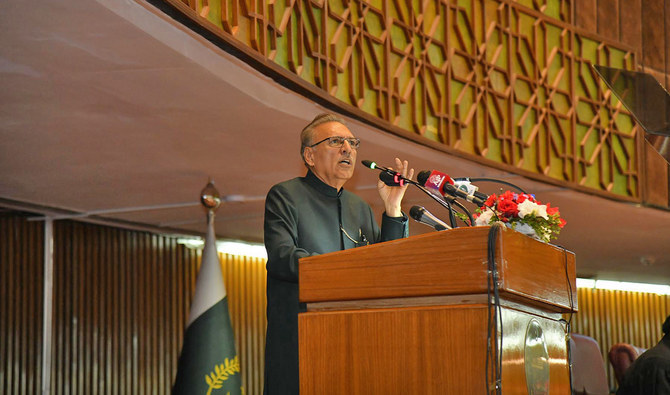
President of Pakistan Dr Arif Alvi addresses a joint session of Parliament in Islamabad, Pakistan, on October 6, 2022. (@NAofPakistan/Twitter)
Short Url
Updated 24 December 2022
Follow

Pakistan president repeals colonial-era law against suicide

  • Under the previous law, attempted suicide was punishable by up to one year in prison, a fine, or both in Pakistan
  • A close aide of Pakistan's PM welcomed the amendment, saying every person in destress must be helped and saved

ISLAMABAD: Pakistan has amended a section of the country's criminal law to repeal colonial-era legislation against suicide, the president's office announced.

The development came in the form of an amendment, signed late Friday by President Arif Alvi and announced by his office on Twitter. The amendment, introduced by the secular Pakistan People's Party, was approved by the parliament's upper house, or Senate, three months ago.

Under the previous legislation — a vestige of colonial times from before the 1947 partition that carved out India and Pakistan from the former British Empire — attempted suicide was punishable by up to one year in prison, a fine, or both in Pakistan.

Salman Sufi, a close aide of Pakistani Prime Minister Shahbaz Sharif, welcomed the amendment and said that each and every person in distress, considering an extreme measure such as taking one's own life, must be helped and saved.

Suicide is still a crime in some countries and though many nations have abolished laws against it, there is still a stigma that surrounds it.

According to a 2019 World Health Organization report about suicide worldwide, more than 700,000 people died by suicide that year, prompting the introduction of new guidance to help countries improve suicide prevention and care.

WHO estimated that at least eight people in 100,000 took their own life in Pakistan in 2019, though the actual number is believed to be far higher as many cases go unreported to avoid a police investigation.


Pakistan launches double-decker buses in Karachi after 65 years to tackle transport woes

Updated 31 December 2025
Follow

Pakistan launches double-decker buses in Karachi after 65 years to tackle transport woes

  • Karachi citizens will be able to travel in double-decker buses from Jan. 1, says Sindh government
  • City faces mounting transport challenges such as lack of buses, traffic congestion, poorly built roads

ISLAMABAD: The government in Sindh province on Wednesday launched double-decker buses in the provincial capital of Karachi after a gap of 65 years, vowing to improve public transport facilities in the metropolis. 

Double-decker buses are designed to carry more passengers than single-deck vehicles without taking up extra road space. The development takes place amid increasing criticism against the Sindh government regarding Karachi’s mounting public transport challenges and poor infrastructural problems. 

Pakistan’s largest city by population faces severe transportation challenges due to overcrowding in buses, traffic congestion and limited bus options. Commuters, as a result, rely on private vehicles or unregulated transport options that are often unsafe and expensive.

“Double-decker buses have once again been introduced for the people of Karachi after 65 years,” a statement issued by the Sindh information ministry said. 

Sindh Transportation Minister Sharjeel Inam Memon and Local Government Minister Syed Nasir Hussain Shah inaugurated the bus service. The ministry said the facility will be available to the public starting Jan. 1. 

The statement highlighted that new electric bus routes will also be launched across the entire province starting next week. It added that the aim of introducing air-conditioned buses, low-fare services, and fare subsidies is to make public transport more accessible to the people.

The ministry noted that approximately 1.5 million people travel daily in Karachi using the People’s Bus Service, while around 75,000 passengers use the Orange Line and Green Line BRT services.

“With the integration of these routes, efforts are being made to benefit up to 100,000 additional people,” the ministry said.