

Pakistan’s reliance on energy imports due to lack of investment in domestic exploration – ADB

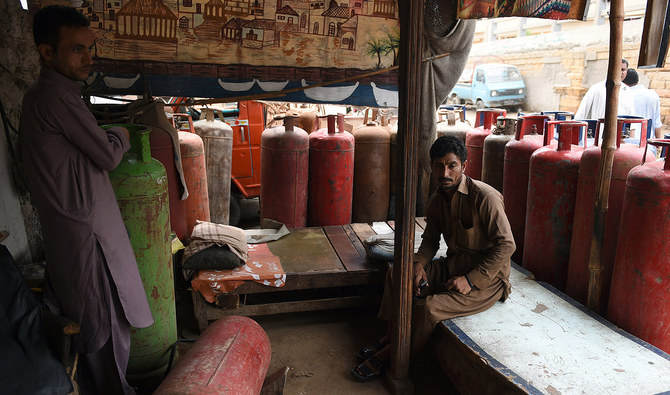
A Pakistani employee fills a gas cylinder at a filling shop in Karachi on July 23, 2015. (Photo: AFP/File)
Short Url
Updated 24 December 2022
Follow

Pakistan’s reliance on energy imports due to lack of investment in domestic exploration – ADB

  • The Asian Development Bank says nearly 46 percent of Pakistan’s primary energy supplies are imported
  • The bank’s latest energy report reveals 25 percent of the country’s population is not grid-connected

ISLAMABAD: An international financial institution has said in a recent report Pakistan heavily relies on energy imports since it is not investing enough money in carrying out exploration and development work to help meet the burgeoning domestic demand.

The Asian Development Bank (ADB) released a comprehensive energy forecast of individual countries, including Pakistan, which are part of the Central Asia Regional Economic Cooperation (CAREC) program on Saturday to help facilitate sustainable energy infrastructure investment.

According to the bank, “CAREC Energy Outlook 2030” seeks to “equip investors and policy makers with insight on regional trends to help identify potential investment opportunities that will improve energy services and reduce carbon emissions” across the region.

“Pakistan’s domestic energy production consists of oil, natural gas, and coal,” it said in an elaborate chapter on the South Asian state. “However, insufficient investment in exploration and development activities has made the country rely heavily on imports— nearly 40 percent of its total primary energy supply is imported.”

The report pointed out Pakistan’s energy requirements had substantially increased from the past and was likely to follow the same trajectory in the foreseeable future.

“Final energy demand in Pakistan was about 96 million tons of oil equivalent (toe) in 2018, and is projected to reach 108–126 million toe in 2030,” it noted.

The document said that natural gas was expected to increase its share in the total energy supply, while reliance on biomass was likely to decrease in the coming years, leading to a cleaner future for residential consumers.

The ADB emphasized greater development of the transmission and distribution (T&D) network, adding that 25 percent of the country’s population was not grid-connected and had no access to the electricity network.

The bank also maintained Pakistan’s energy sector presented “significant investment opportunities” due to its efforts to transition to a more competitive energy market structure. However, it added that several challenges needed to be addressed to introduce a more favorable investment climate, including circular debt issues, and the overall condition and coverage of the T&D grid.

It urged the country to further promote domestic exploration and production of oil and nature gas resources, adding that Pakistan had already optimized pricing and licensing mechanisms for further development of its local production of fossil fuels and become more self-reliant.

The report also encouraged policy makers to decrease energy subsidies, continue to support renewable energy sector and introduce emissions trading scheme.


PCB sets Feb. 11 as date for player auction for Pakistan Super League 11th edition

Updated 5 sec ago
Follow

PCB sets Feb. 11 as date for player auction for Pakistan Super League 11th edition

  • The squad composition would be a minimum of 16 players and a maximum of 20
  • The number of foreign players would be five to seven depending on the squad size

ISLAMABAD: The Pakistan Cricket Board (PCB) on Sunday announced that the player auction for the 11th edition of the Pakistan Super League (PSL) will be held on Feb. 11, setting the stage for franchises to begin assembling squads for the country’s premier Twenty20 tournament.

The development came after a workshop regarding PSL player auction at the Qaddafi Stadium, which was presided over by PCB Chairman Mohsin Naqvi and PSL CEO Salman Naseer.

The workshop was attended by PSL officials, all eight franchise representatives, members of Pakistan’s T20 World Cup squad, PCB officials and other capped players.

“The HBL PSL management shared a detailed presentation on the mechanics of the retention and the auction process and consulted with all the participants,” the PCB said.

“It was agreed that the HBL PSL player auction will take place on Wednesday, 11 February.”

The squad composition would be a minimum of 16 players and maximum of 20 players per franchise. The number of foreign players would be five to seven depending on the squad size, according to the PCB.

It would be mandatory for the franchises to play minimum of three and maximum of four foreign players in the playing XI. The teams are also required to have minimum of two uncapped Under 23 players in the squad and one in the playing XI.

Players either retained or picked in the auction will be engaged for two-year contracts with their respective franchise teams, the board said, adding that franchise teams will be able to retain a maximum of seven players for the 12th edition of the tournament.

“I’m delighted that a consultative and productive session was held between the franchises, players and management today resulting in informed and strategic decisions which will pave the way for bright future for the HBL PSL,” Naqvi said.

“The Player Auction model is a landmark step for the HBL PSL, offering players better financial opportunities through an increased salary purse and a transparent acquisition process, while making the league more competitive and attractive.”

PSL CEO Naseer said the player auction system modernizes player recruitment by promoting fairness, transparency, and market-driven value, strengthening the PSL’s appeal for both players and franchises.

“Today’s workshop saw all views being taken into consideration and this rich feedback will be reflected in our execution of a successful player auction scheduled next month,” he said.

PSL has become a key pillar of the country’s cricket economy, providing financial stability to the PCB and serving as a talent pipeline for the national team. The 11th edition of the league is set to begin from Mar. 26 while the final is expected to be played on May 3, as per the PCB’s schedule.