

Parvez Elahi calls decision to dissolve Punjab assembly ‘final’ after being reinstated as chief minister

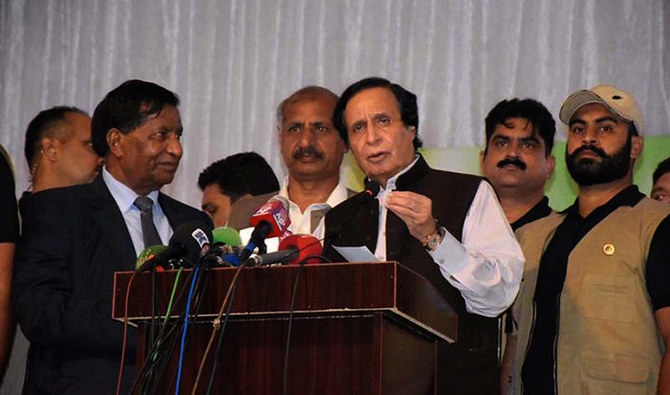
In this picture taken on September 24, 2022, Punjab Cheif Minister Chaudhry Parvez Elahi gestures during an inauguration ceremony of Grand Asian University of Sialkot in Sialkot city. (Photo courtesy: Associated Press of Pakistan/File)
Short Url
Updated 24 December 2022
Follow

Parvez Elahi calls decision to dissolve Punjab assembly ‘final’ after being reinstated as chief minister

  • Elahi took his case to the Lahore High Court after the Punjab governor removed him and dissolved his cabinet
  • His counsel told the court the provincial legislature would continue to function until the next hearing in January

ISLAMABAD: The political drama in Pakistan’s most populous Punjab province continued on Friday after Chaudhry Parvez Elahi said the decision to dissolve the provincial assembly was “final,” shortly after assuring a local court which reinstated him as chief minister that the legislature would continue to perform it functions until the next hearing.
Elahi filed a petition in the Lahore High Court (LHC) earlier in the day after Punjab Governor Muhammad Balighur Rehman issued a notification to remove him from the office and dissolved his cabinet.
His counsel, Barrister Ali Zafar, submitted an affidavit in the court, saying Elahi would not dissolve the provincial assembly until the court convened again and took up the matter on January 11.
The chief minister was subsequently restored by the five-member bench hearing the case that also issued notices to other parties to appear before it during the next hearing.
Shortly after his reinstatement, Elahi said in a Twitter post that the decision to dissolve the assembly was “final” and was in line with former prime minister Imran Khan’s instructions who has been calling for fresh elections in the country.
“The decision to dissolve the assemblies is final,” he said. “Imran Khan’s decision will be fully implemented.”
Elahi maintained the federal government was trying to “run away from elections,” adding that its leaders would be brought before the nation and “the final decision will be made by people.”

Ex-PM Khan, who was ousted from power in April and whose Pakistan Tehreek-e-Insaf (PTI) party rules Punjab and Khyber Pakhtunkhwa, recently announced to dissolve the two provincial assemblies to force the federal government to call early elections in the country.
Elahi, a key Khan ally in Punjab, told the media he would comply with Khan’s request, though he was removed by the governor, appointed by the administration in Islamabad, who claimed that he no longer commanded the majority in the provincial legislature.
As the chief minister took his case to the court, Pakistan Muslim League-Nawaz (PML-N) and Pakistan Peoples Party (PPP), the two main factions that submitted a no-trust resolution against Elahi, withdrew the motion.
The no-confidence resolution was no longer required as Elahi had already been de-notified and was no longer the chief minister, PML-N leader and federal minister Khawaja Saad Rafique said on Twitter.


Spin-heavy Pakistan hit form, but India boycott risks early T20 exit

Updated 9 sec ago
Follow

Spin-heavy Pakistan hit form, but India boycott risks early T20 exit

  • Pakistan face must-win group matches, leaving no margin for error in T20 World Cup progression
  • Recent series wins have restored confidence, but batting volatility remains Pakistan’s biggest risk

LAHORE: Pakistan’s spin-heavy squad are in winning form ahead of the T20 World Cup, but a controversial decision to forfeit their marquee clash against India could still trigger another early exit.

Pakistan came close to withdrawing from the tournament in solidarity with Bangladesh, who pulled out after refusing to play in India, citing security concerns.

The Pakistan government eventually cleared the team’s participation but it barred them from facing India in Colombo in a blockbuster clash on February 15.

With two points for a win, a forfeit of the match will leave Pakistan with no margin for error if they are to progress as one of the top two from a five-team Group A.

It means they must win their opening game against the Netherlands in Colombo on Saturday and beat the United States three days later to stay in contention.

Their final group game will be against Namibia on February 18.

Captain Salman Agha said the move to boycott the India game was out of the team’s hands.

“That is not our decision. We have to follow what our government decides,” he said.

The Pakistan government has not said what their stance might be if the team were to end up facing India again in the semifinals or final. Agha was not thinking about that.

“Our job is to win, and we are capable of doing that,” he said.

Pakistan will be keen to avoid a repeat of the last T20 World Cup in 2024, where a shock super over defeat to co-hosts the United States led to them failing to get out of the group.

The side has since faced criticism for failing to adapt to the modern demands of T20 cricket, with the batting, particularly Babar Azam’s low strike rate, under scrutiny.

The criticism was fueled by Pakistan’s record last year, where 21 of their 34 T20 international wins came against lower-ranked opponents.

CONFIDENCE RESTORED
Against elite teams, the results were sobering: three losses to India in the Asia Cup and a 4-1 series defeat to New Zealand.

However, Agha believes recent performances have restored confidence.

Pakistan beat South Africa 2-1, won a home tri-series, and then completed a 3-0 sweep of an under-strength Australia.

“We’ve had good preparation by beating Australia. We have the luxury of quality spinning all-rounders like Mohammad Nawaz, Shadab Khan and Saim Ayub.

“We’re ticking most boxes and believe we can win the World Cup,” Agha said.

The spin department has been strengthened by Abrar Ahmed and Usman Tariq, the latter known for his unusual, slingy action and exaggerated pause at the crease.

The pace attack is led by the experienced Shaheen Shah Afridi and Naseem Shah.

Faheem Ashraf provides seam-bowling all-round support and newcomer Salman Mirza has been impressive.

Batting remains Pakistan’s most volatile component.

When openers Saim Ayub and Sahibzada Farhan provide strong starts, the side can post competitive totals, but collapses remain a constant threat.

Head coach Mike Hesson has added another layer of risk by leaving out experienced wicketkeeper Mohammad Rizwan because of poor form, opting instead for makeshift options in Usman Khan, Khawaja Nafay and Farhan.

For Pakistan, the ingredients for a deep run are present, but with points potentially forfeited, there is little room left for error.