


KSRelief provides $20m to support WFP’s humanitarian response in Yemen

1 / 5
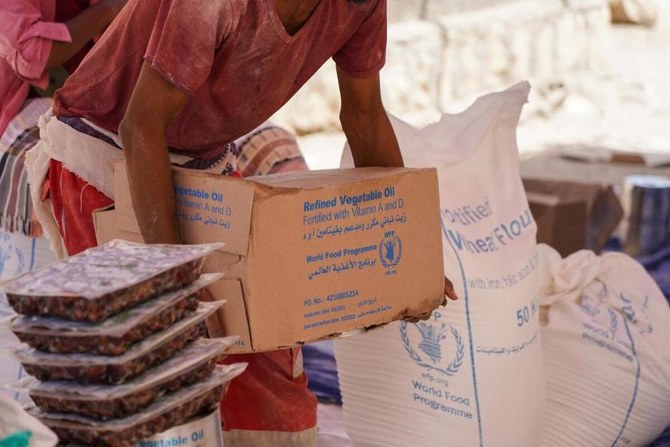
UN World Food Programme has welcomed a $20 million contribution from KSrelief to help meet the urgent food needs in Yemen. (Supplied)
2 / 5
Yemeni man shortly after having collected his share of KSrelief aids. (Supplied)
3 / 5
Man carries his share of KSrelief aids over his shoulder. (Supplied)
4 / 5
With this contribution from KSrelief, the WFP will be able to meet critical gaps in the life-saving food assistance program in three distribution cycles in 2023. (Supplied)
5 / 5
Yemenis queuing to collect their KSrelief aids in front of a WFP tent. (Supplied)
Short Url
Updated 24 December 2022
Follow

KSRelief provides $20m to support WFP’s humanitarian response in Yemen

  • Money will go toward keeping over half a million people away from starvation this winter
  • Since 2015 the Kingdom has given more than $1.86 billion to the WFP for Yemen

SANAA/DUBAI: The UN World Food Programme has welcomed a $20 million contribution from the King Salman Humanitarian Aid and Relief Center to help meet the urgent food needs of the most vulnerable households in Yemen.

With this contribution from Saudi Arabia through KSRelief, the WFP will be able to meet critical gaps in the life-saving food assistance program in three distribution cycles in 2023, averting breaks in operations.

The WFP will procure wheat flour, the main staple component in the monthly food basket, to assist 525,849 severely food-insecure people for up to three months. A portion of the contribution will be used to enhance the livelihoods and resilience of affected families and communities.

“The Kingdom of Saudi Arabia’s continued commitment to addressing urgent humanitarian needs has saved lives and protected the livelihoods of the most vulnerable people throughout Yemen,” said Ahmed Ali Al-Baiz, KSRelief’s assistant supervisor general of operations and programs.

The world faces its worst food crisis in recent history. Conflict, climate shocks, and the potential for a global recession threaten millions of people, especially in conflict-riven Yemen. Amid increased food insecurity, the prospects for the country’s recovery diminish.

“Support from KSRelief has helped keep famine at bay,” said Richard Ragan, the WFP’s Yemen representative and country director. “You see the desperation to get food on people’s faces, and this contribution comes at a critical time for the neediest families.”

This latest contribution brings the total contributions from Saudi Arabia to the WFP’s response in Yemen since 2015 to more than $1.86 billion, including $380 million in 2019 which helped the WFP scale-up operations to reach 13 million people — pulling Yemen back from the brink of famine.


Striking light pillars phenomenon captivates Northern Borders residents

Updated 5 sec ago
Follow

Striking light pillars phenomenon captivates Northern Borders residents

  • The sight captivated residents and visitors alike

RIYADH: A striking astronomical and optical phenomenon was observed in Saudi Arabia’s Northern Borders Region on Monday, as light pillars, a remarkable natural spectacle, appeared in the sky, drawing the attention of locals and enthusiasts of natural phenomena, the Saudi Press Agency reported.

The sight captivated residents and visitors alike, with the interplay of colors and light making for an extraordinary spectacle.

Astronomy Club member Adnan Khalifa said that a light pillar is an optical phenomenon that occurs in the atmosphere as a vertical column of light extending above or below its source. This effect is caused by the reflection of light on tiny ice crystals suspended in clouds or the air.

He added that the light source can be natural, such as the sun, particularly when near the horizon, or the moon. It can also originate from human-made sources, like streetlights, creating a unique and captivating visual display in the sky.

Abouazza El-Mhamdi, associate professor in the physics and astronomy department at King Saud University’s College of Science, told Arab News: “On Monday evening, residents of the Northern Borders Region near Arar witnessed a rare meteorological event — the vibrant light pillars that illuminated the night sky.

“While appearing like a celestial display, this is not a purely astronomical event involving stars or planets, for example, but rather an atmospheric optical phenomenon triggered by an exceptional drop in temperature and perfect wind stillness,” he said. 

“The display featured towering vertical beams of white, orange and yellow light, created when ground-based light sources reflected off tiny, flat ice crystals suspended in the freezing air, which acted like a collective mirror,” he added. 

“Although these pillars are common in Arctic climates like Canada or Russia, their appearance in Saudi Arabia is a remarkable anomaly, highlighting the unique and intense winter conditions currently affecting the Kingdom’s northern reaches,” the professor said.

Following the inclement weather last week, and as a result of several days of low temperatures, vibrant beams of light shot up into the night sky, creating a stunning display.

The phenomenon, characterized by its colorful vertical light columns, occurs under specific conditions, such as temperatures falling below 0 degrees Celsius, while calm winds are also essential.

The unique ice halo effect forms when moisture in the air condenses into ice crystals, reflecting surrounding lights to create a breathtaking visual display.