

KSRelief continues relief efforts in 5 countries

1 / 5
KSRelief distributed winter clothes to families in-need from the refugee and Jordanian community in Amman. (SPA)
2 / 5
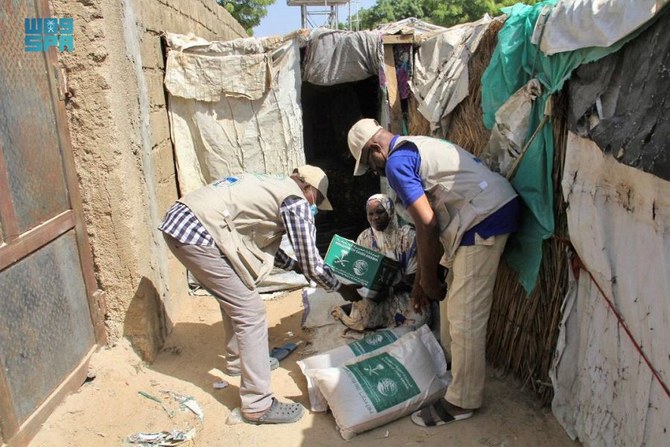
KSRelief delivered 1,432 food baskets to displaced people in the Asheri camp in Nigeria’s Maiduguri. (SPA)
3 / 5
KSRelief delivered 1,432 food baskets to displaced people in the Asheri camp in Nigeria’s Maiduguri. (SPA)
4 / 5
KSRelief distributed 500 food baskets in Al-Malha locality in Sudan’s North Darfur. (SPA)
5 / 5
KSRelief performed 21 surgeries within its voluntary medical camp for neurosurgery in Yemen. (SPA)
Short Url
Updated 16 December 2022
Follow

KSRelief continues relief efforts in 5 countries

DUBAI: The King Salman Humanitarian Aid and Relief Center (KSRelief) distributed winter clothes to Syrian and Palestinian refugees in Amman, Jordan. 
The relief center distributed 130 vouchers, benefiting 23,529 families in-need from the refugee and Jordanian community, state agency SPA reported. 
The aid efforts come as part of KSRelief’s Kanaf in Jordan 2022 Project, implemented in cooperation the Jordanian Hashemite Charity Organization. 
The philanthropic organization also continued its relief efforts in the Shetral district of Khyber Pakhtunkhwa province in Pakistan by distributing 200 winter bags to underprivileged people, which benefited 1,400 individuals in the area. 
Meanwhile, KSRelief delivered 1,432 food baskets to displaced people in the Asheri camp in Nigeria’s Maiduguri, assisting 8,592 people in-need. 
It also distributed 500 food baskets in Al-Malha locality in Sudan’s North Darfur, which benefited 4,052 people in total. 
Additionally, KSRelief performed 21 surgeries within its voluntary medical camp for neurosurgery, offering urgent medical assistance to low-income individuals at Yemen’s Ibn Sina Hospital in Mukalla.
The campaign, which started on Dec. 11 and ends on Dec. 17, has also provided 87 medical consultations to patients at the neurosurgery clinic.

The relief center inaugurated a medical camp for various surgeries in the Socotra archipelago governorate, which will run from Dec. 12 to Dec. 18.

Aside from performing 300 cataract surgeries and lens implants, the camp hopes to assess more than 4,000 cases of both genders.

It will also conduct 100 different surgeries to treat ophthalmic diseases.


Musaned confirms mandatory salary transfers for domestic workers via official channels

Updated 9 sec ago
Follow

Musaned confirms mandatory salary transfers for domestic workers via official channels

  • Move aims to protect wage-related rights, enhance transparency

RIYADH: All employers in Saudi Arabia have been informed they must transfer domestic workers’ salaries through official channels, starting from Jan. 1, 2026.

The move, confirmed through Musaned platform’s X account, aims to protect wage-related rights, enhance transparency and simplify employer-worker relationships.

The electronic payment service provided through Musaned will use approved digital wallets and participating banks to ensure reliability, security and consistency in wage transfers.

Lawyer Majed Garoub told Arab News that the new regulation would help tackle persistent issues in employer-worker relationships, especially disputes over unpaid wages.

He said: “This regulation will significantly help resolve many problems that arise when domestic workers leave the country without proper verification of receiving their full rights.”

Garoub explained that informal salary payments were common in the past, often made without proper documentation or signatures.

This, he added, made it challenging for Saudi employers to prove they had paid all wages if workers later filed claims after returning to their home countries.

The new regulation, which has been rolled out in stages, began with domestic workers newly arriving in the Kingdom on July 1, 2024.

It was then extended to employers with four or more domestic workers in January 2025, followed by those employing three or more by July 2025.

The latest stage, which took effect on Oct. 1, applies to employers with two or more domestic workers. This phased approach has ensured a smooth adoption of the system for all employers.

Garoub said the regulation would bring broader legal and security benefits. He explained that informal salary payments had, at times, enabled illegal practices.

He added: “Workers might have falsely claimed unpaid wages or engaged in activities outside their employment.”

Such funds, he added, could even have contributed to crimes like money laundering or the financing of terrorism.

He said: “By mandating official payment channels, this regulation protects the Saudi economy, national security, and international financial systems.”

The Musaned platform offers significant advantages for both employers and workers. Employers gain a reliable salary verification mechanism that simplifies end-of-contract and travel-related procedures, while workers benefit from consistent, secure and timely payments.

The system also allows domestic workers to transfer their earnings to family members abroad through trusted channels.

For those who prefer cash withdrawals, a Mada card will be issued for secure and convenient access to salaries.

According to Musaned, salary transfers for workers covered under the Wage Protection System must be made through authorized channels.

This regulatory change marks a significant step forward in protecting the rights of domestic workers, ensuring transparency in employer-employee relationships, and bolstering the Kingdom’s economic and security interests.