China sanctions 2 US citizens over action on Tibet

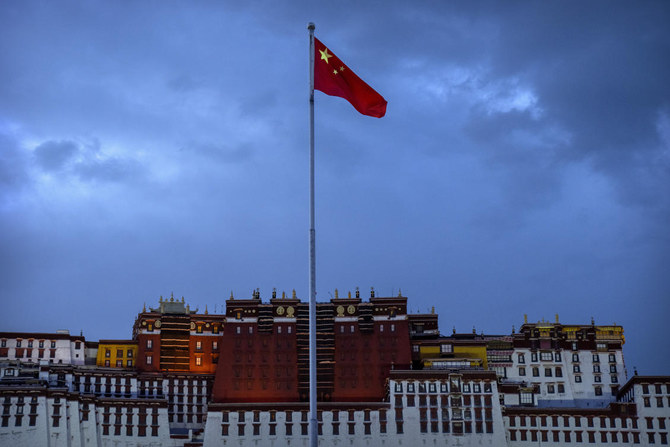
China claims Tibet has been part of its territory for centuries, although backers of the exiled Buddhist leader the Dalai Lama say it was functionally independent for most of that time. (AP)
Short Url
Updated 23 December 2022
Follow

China sanctions 2 US citizens over action on Tibet

  • Todd Stein and Miles Yu Maochun, along with their close family members, would be banned from entering China
  • China in recent years has passed legislation mandating tit-for-tat sanctions against foreign individuals

BEIJING: China has sanctioned two US citizens in retaliation for action taken by Washington over human rights abuses in Tibet, the government said Friday, amid a continuing standoff between the sides over Beijing’s treatment of religious and ethnic minorities.
The Foreign Ministry said in a statement that Todd Stein and Miles Yu Maochun, along with their close family members, would be banned from entering China.
Any assets they had in China would be frozen and they would be barred from contact with people or organizations within China.
The notice said the measures were in response to the US sanctioning two Chinese citizens “under the excuse of the ‘Tibet human rights’ issue.” Neither could immediately be reached for comment.
On Dec. 9, the US imposed sanctions on Wu Yingjie, the top official in Tibet from 2016 to 2021, and Zhang Hongbo, the region’s police chief since 2018.
“Our actions further aim to disrupt and deter the People’s Republic of China’s (PRC) arbitrary detention and physical abuse of members of religious minority groups in the Tibetan Autonomous Region,” Secretary of State Antony Blinken said in announcing the sanctions.
An accompanying Treasury Department notice said Wu had been responsible for “stability policies” in Tibet whose implementation involved “serious human rights abuse, including extrajudicial killings, physical abuse, arbitrary arrests, and mass detentions.”
It said that during Zhang’s tenure, police have been engaged in serious human rights abuses, including “torture, physical abuse, and killings of prisoners, which included those arrested on religious and political grounds.”
The Chinese announcement gave no specific accusations against Stein and Yu.
Stein has been deputy staff director at the Congressional-Executive Commission on China since 2021 and previously served as senior adviser to Under Secretary of State for Civilian Security, Democracy and Human Rights Sarah Sewall, including serving as her lead staffer on Tibetan issues. Previously, he was director of government relations at the monitoring group International Campaign for Tibet.
The Chinese-born Yu is a senior academic who taught at the US Naval Academy and a noted critic of the regime of Chinese Communist Party leader Xi Jinping. He served as key China adviser under former Secretary of State Mike Pompeo.
China in recent years has passed legislation mandating tit-for-tat sanctions against foreign individuals from the US, the EU and other countries over perceived slights against its national interests. Washington and others have compiled a long list of Chinese officials barred from visiting or engaging in transactions with their financial institutions ranging from the leader of the semi-autonomous city of Hong Kong to local officials accused of human rights abuses.
China claims Tibet has been part of its territory for centuries, although backers of the exiled Buddhist leader the Dalai Lama say it was functionally independent for most of that time.
Communist forces invaded in 1950 and China has ruled the Himalayan region with an iron fist ever since, imposing ever stricter surveillance and travel restrictions since the last uprising against Beijing’s rule in 2008. Lengthy prison sentences in dire conditions are imposed for acts of defiance, including defending the region’s unique language and Buddhist culture from attempts at assimilation.
China has also been accused of detaining hundreds of thousands of Uyghurs and other Muslim minorities in reeducation camps as part of a campaign to wipe out their native language and culture, including through forced adoptions and sterilizations. China denies such charges, saying it has only been fighting terrorism, separatism and religious extremism.


Moscow made an offer to France regarding a French citizen imprisoned in Russia, says Kremlin

Updated 5 sec ago
Follow

Moscow made an offer to France regarding a French citizen imprisoned in Russia, says Kremlin

  • Laurent Vinatier, an adviser for Swiss-based adviser Center for Humanitarian Dialogue, Vinatier was arrested in Moscow in June 2024
  • He is accused of failing to register as a “foreign agent” while collecting information about Russia’s “military and military-technical activities” 

The Kremlin on Thursday said it was in contact with the French authorities over the fate of a French political scholar serving a three-year sentence in Russia and reportedly facing new charges of espionage.
Kremlin spokesman Dmitry Peskov told reporters that Russia has made “an offer to the French” regarding Laurent Vinatier, arrested in Moscow last year and convicted of collecting military information, and that “the ball is now in France’s court.” He refused to provide details, citing the sensitivity of the matter.
French President Emmanuel Macron is following Vinatier’s situation closely, his office said in a statement. French Foreign Ministry spokesperson Pascal Confavreux said Thursday that all government services are fully mobilized to pay provide consular support to Vinatier and push for his liberation as soon as possible.
Peskov’s remarks come after journalist Jérôme Garro of the French TF1 TV channel asked President Vladimir Putin during his annual news conference on Dec. 19 whether Vinatier’s family could hope for a presidential pardon or his release in a prisoner exchange. Putin said he knew “nothing” about the case, but promised to look into it.
Vinatier was arrested in Moscow in June 2024. Russian authorities accused him of failing to register as a “foreign agent” while collecting information about Russia’s “military and military-technical activities” that could be used to the detriment of national security. The charges carry a maximum penalty of five years in prison.
The arrest came as tensions flared between Moscow and Paris following French President Emmanuel Macron’s comments about the possibility of deploying French troops in Ukraine.
Vinatier’s lawyers asked the court to sentence him to a fine, but the judge in October 2024 handed him a three-year prison term — a sentence described as “extremely severe” by France’s Foreign Ministry, which called for the scholar’s immediate release.
Detentions on charges of spying and collecting sensitive data have become increasingly frequent in Russia and its heavily politicized legal system since Moscow invaded Ukraine in February 2022.
In addition to criticizing his sentence, the French Foreign Ministry urged the abolition of Russia’s laws on foreign agents, which subject those carrying the label to additional government scrutiny and numerous restrictions. Violations can result in criminal prosecution. The ministry said the legislation “contributes to a systematic violation of fundamental freedoms in Russia, like the freedom of association, the freedom of opinion and the freedom of expression.”
Vinatier is an adviser for the Center for Humanitarian Dialogue, a Switzerland-based nongovernmental organization, which said in June 2024 that it was doing “everything possible to assist” him.
While asking the judge for clemency ahead of the verdict, Vinatier pointed to his two children and his elderly parents he has to take care of.
The charges against Vinatier relate to a law that requires anyone collecting information on military issues to register with authorities as a foreign agent.
Human rights activists have criticized the law and other recent legislation as part of a Kremlin crackdown on independent media and political activists intended to stifle criticism of the war in Ukraine.
In August 2025, Russian state news agency Tass reported that Vinatier was also charged with espionage, citing court records but giving no details. Those convicted of espionage in Russia face between 10 and 20 years in prison.
Russia in recent years has arrested a number of foreigners — mainly US citizens — on various criminal charges and then released them in prisoner swaps with the United States and other Western nations. The largest exchange since the Cold War took place in August 2024, when Moscow freed journalists Evan Gershkovich and Alsu Kurmasheva, fellow American Paul Whelan, and Russian dissidents in a multinational deal that set two dozen people free.