Risking China’s anger, Blinken meets representative of Dalai Lama in India

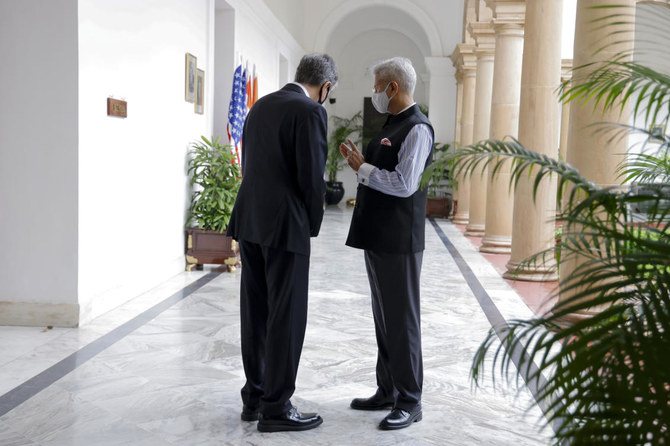
India's Foreign Minister Subrahmanyam Jaishankar, right, and U.S. Secretary of State Antony Blinken walk together before meetings at Hyderabad House in New Delhi, India Wednesday, July 28, 2021. (AP)
Short Url
Updated 28 July 2021
Follow

Risking China’s anger, Blinken meets representative of Dalai Lama in India

  • US Secretary of State Antony Blinken also met his Indian counterpart, Foreign Minister Subrahmanyam Jaishankar

NEW DELHI: US Secretary of State Antony Blinken met with a representative of Tibet’s spiritual leader, the Dalai Lama, in New Delhi on Wednesday, a State Department spokesperson said, a move that is likely to provoke anger in China.
Blinken met briefly with Ngodup Dongchung, who serves as a representative of Central Tibetan Administration (CTA), also known as the Tibetan government in exile, the spokesperson said.
Chinese troops seized Tibet in 1950 in what Beijing calls a “peaceful liberation.” In 1959, the Dalai Lama fled into exile in India following a failed uprising against Chinese rule.
The CTA and Tibetan advocacy groups have received a boost in international support in recent months amid rising criticism of China’s human rights record, particularly from the United States.
In November, Lobsang Sangay, the former head of the Tibetan government in exile, visited the White House, the first such visit in six decades.
A month later, the US Congress passed the Tibet Policy and Support Act, which calls for the right of Tibetans to choose the successor to the Dalai Lama, and the establishment of a US consulate in the Tibetan capital Lhasa.
Blinken’s meeting with Dongchung is the most significant contact with the Tibetan leadership since the Dalai Lama met then-president Barack Obama in Washington in 2016.
China’s foreign ministry did not immediately respond to a request for comment. Beijing says Tibet is a part of China and has labelled the Dalai Lama a dangerous separatist.
In his first visit to India since joining US President Joe Biden’s administration, Blinken also met his Indian counterpart, Foreign Minister Subrahmanyam Jaishankar, and other officials on Wednesday before heading to see Prime Minister Narendra Modi.
The two sides are expected to discuss supplies of COVID-19 vaccines, the security situation in Afghanistan, and India’s human rights record.
Speaking to a group of civil society leaders at a New Delhi hotel, Blinken said that the relationship between the United States and India was “one of the most important in the world.”
“The Indian people and the American people believe in human dignity and equality of opportunity, the rule of law, fundamental freedoms including freedom of religion and belief . . . these are the fundamental tenets of democracies like ours,” he said.
“And of course, both of our democracies are works in progress. As friends we talk about that.”
Indian foreign ministry sources said ahead of Blinken’s visit that the country was proud of its pluralistic traditions and happy to discuss the issue with him.
Modi’s government has faced allegations of suppressing dissent, pursuing divisive policies to appeal to its Hindu nationalist base and alienating Muslims, the country’s biggest minority.
Blinken arrived in India on Tuesday night and leaves for Kuwait later on Wednesday.


Nigeria signals more strikes likely in ‘joint’ US operations

Updated 5 sec ago
Follow

Nigeria signals more strikes likely in ‘joint’ US operations

  • vNigeria on Friday signalled more strikes against jihadist groups were expected after a Christmas Day bombardment by US forces against militants in the north of the country
LAGOS: Nigeria on Friday signalled more strikes against jihadist groups were expected after a Christmas Day bombardment by US forces against militants in the north of the country.
The west African country faces multiple interlinked security crises in its north, where jihadists have been waging an insurgency in the northeast since 2009 and armed “bandit” gangs raid villages and stage kidnappings in the northwest.
The US strikes come after Abuja and Washington were locked in a diplomatic dispute over what Trump characterised as the mass killing of Christians amid Nigeria’s myriad armed conflicts.
Washington’s framing of the violence as amounting to Christian “persecution” is rejected by the Nigerian government and independent analysts, but has nonetheless resulted in increased security coordination.
“It’s Nigeria that provided the intelligence,” the country’s foreign minister, Yusuf Tuggar, told broadcaster Channels TV, saying he was on the phone with US State Secretary Marco Rubio ahead of the bombardment.
Asked if there would be more strikes, Tuggar said: “It is an ongoing thing, and we are working with the US. We are working with other countries as well.”
- Targets unclear -
The Department of Defense’s US Africa Command, using an acronym for the Daesh group, said “multiple Daesh terrorists” were killed in an attack in the northwestern state of Sokoto.
US defense officials later posted video of what appeared to be the nighttime launch of a missile from the deck of a battleship flying the US flag.
Which of Nigeria’s myriad armed groups were targeted remains unclear.
Nigeria’s jihadist groups are mostly concentrated in the northeast of the country, but have made inroads into the northwest.
Researchers have recently linked some members from an armed group known as Lakurawa — the main jihadist group located in Sokoto State — to Islamic State Sahel Province (ISSP), which is mostly active in neighboring Niger and Mali.
Other analysts have disputed those links, though research on Lakurawa is complicated as the term has been used to describe various armed fighters in the northwest.
Those described as Lakurawa also reportedly have links to Al-Qaeda affiliated group for the Support of Islam and Muslims (JNIM), a rival group to ISSP.
While Abuja has welcomed the strikes, “I think Trump would not have accepted a ‘No’ from Nigeria,” said Malik Samuel, an Abuja-based researcher for Good Governance Africa, an NGO.
Amid the diplomatic pressure, Nigerian authorities are keen to be seen as cooperating with the US, Samuel told AFP, even though “both the perpetrators and the victims in the northwest are overwhelmingly Muslim.”
Tuggar said that Nigerian President Bola Tinubu “gave the go-ahead” for the strikes.
The foreign minister added: “It must be made clear that it is a joint operation, and it is not targeting any religion nor simply in the name of one religion or the other.”