

Saudi Arabia and Pakistan condemn ban on girls’ education in Afghanistan

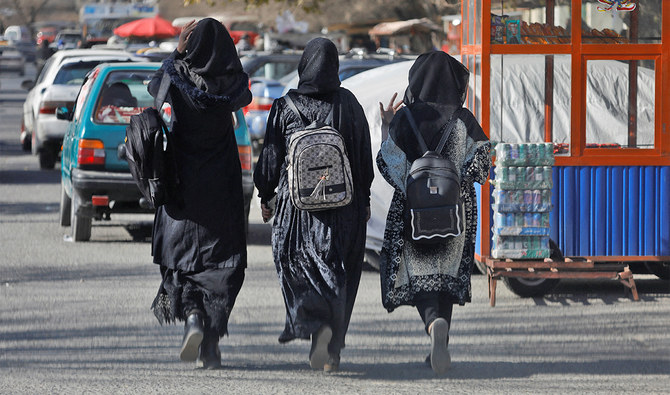
Afghan female students walk near Kabul University in Kabul, Afghanistan, on December 21, 2022. (REUTERS)
Short Url
Updated 22 December 2022
Follow

Saudi Arabia and Pakistan condemn ban on girls’ education in Afghanistan

  • The Pakistani and Emirati foreign ministers discuss the Taliban decision on phone, say Islam safeguards rights of women
  • Saudi Arabia also expresses surprise at the development, points out it has not gone down well with any Muslim country

ISLAMABAD: After Saudi Arabia called on the Taliban to reverse a ban on women pursuing higher education in Afghanistan on Wednesday, the foreign ministers of Pakistan and the United Arab Emirates (UAE) also expressed their reservations over the issue while pointing out that Islam safeguarded women’s rights and did not impose such restrictions.

The Taliban administration ordered women across Afghanistan to stop attending private and public universities earlier this week without giving any reason. The announcement led to international backlash, with many countries and rights activists condemning the development.

According to global media organizations, Taliban security forces in Kabul enforced the higher education ban by stopping women from going to institutions of higher learning.

Pakistan’s foreign minister Bilawal Bhutto-Zardari and his UAE counterpart Sheikh Abdullah bin Zayed Al Nahyan held a wide-ranging conversation on the overall situation in Afghanistan while also focusing on the ban.

“Both leaders emphasized that Islam has accorded women a privileged position, and safeguarded their rights,” said the foreign office in a statement. “They affirmed the need to guarantee women’s rights, as well as the importance of full and equal participation of women and girls in all aspects of life.”
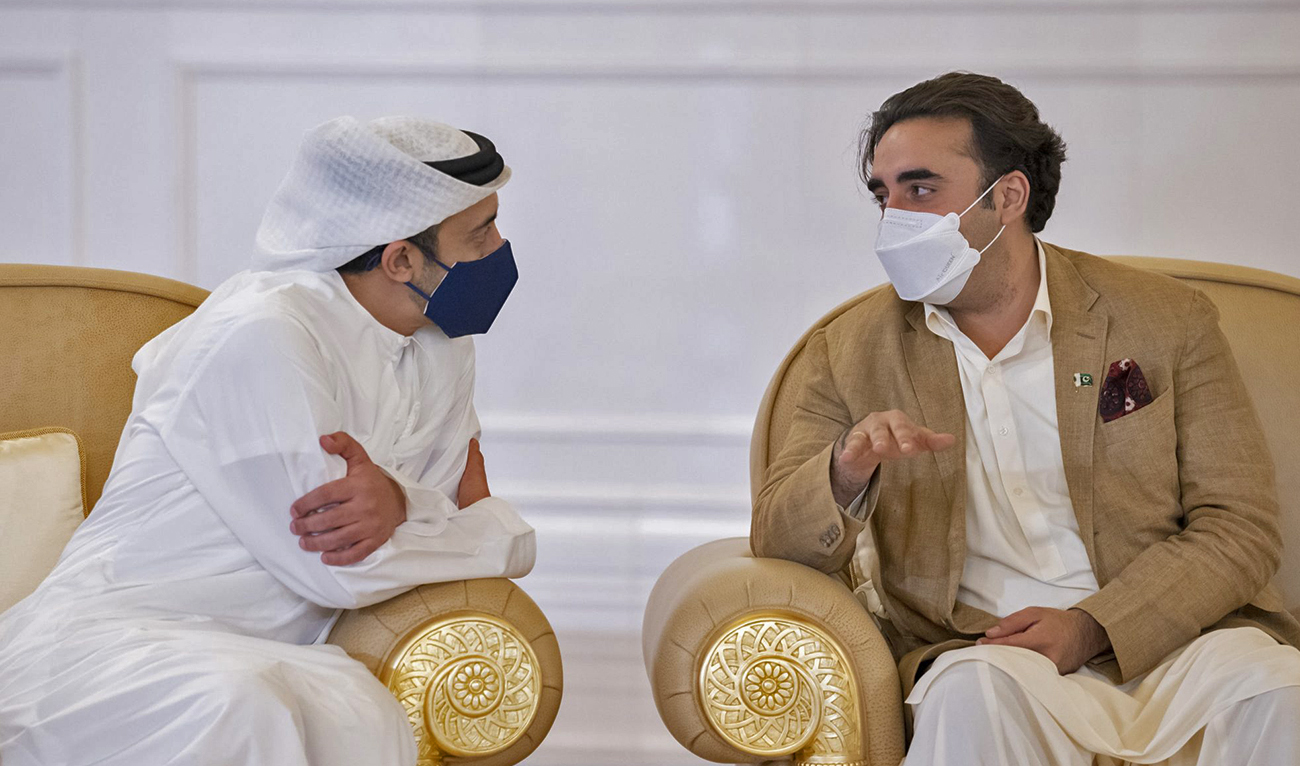


Pakistan's foreign minister Bilawal Bhutto-Zardari (right) meets Sheikh Abdullah bin Zayed Al-Nahyan, UAE Minister of Foreign Affairs at the Presidential Airport in UAE on May 16, 2022. (Photo courtesy: Ministry of Presidential Affairs, UAE/File)

The statement added the two leaders also expressed support for the security, stability and peace in Afghanistan while calling for the advancement of international efforts aimed at building a more sustainable future for the Afghan people.

Earlier, the Saudi foreign ministry expressed surprise and regret at the decision and said it was met with astonishment in all Muslim countries.

The Taliban regime returned to power in Afghanistan in August 2021 after the international forces, led by the United States, left the war-torn country after staying there for about 20 years in the wake of the 9/11 attacks.


Pakistan approves first national gemstones policy, targets $1 billion exports

Updated 09 January 2026
Follow

Pakistan approves first national gemstones policy, targets $1 billion exports

  • Government seeks to overhaul certification, mining, processing to curb smuggling and boost value-added exports
  • Move follows broader push to tap Pakistan’s vast mineral wealth and attract much-needed foreign investment

ISLAMABAD: Pakistan has granted in-principle approval to its first national policy framework for gemstones and precious stones, aiming to reform the sector, align it with international standards and lift annual exports to $1 billion within five years, the prime minister’s office said on Friday.

The decision was taken during a meeting chaired by Prime Minister Shehbaz Sharif, which reviewed reforms for the largely underdeveloped gemstones sector despite Pakistan holding significant reserves of emeralds, rubies, sapphires, peridot and topaz.

The move comes as Pakistan intensifies efforts to monetize its untapped mineral resources amid fiscal pressures and an IMF-backed reform program. Over the past two years, Islamabad has hosted international minerals conferences and signed cooperation agreements with countries including the United States, Saudi Arabia and China to improve governance, attract foreign investment and move up the value chain in mining and minerals processing.

Despite officials estimating Pakistan’s gemstone reserves at around $450 billion, formal exports remain negligible, at about $5.8 million annually, due to weak certification systems, limited domestic processing capacity, widespread smuggling and fragmented regulation across federal and provincial authorities.

“Sharif has granted in-principle approval to a national policy framework to reform Pakistan’s gemstones and precious stones sector and align it with international standards,” the PM’s office said in a statement. 

“The Ministry of Industries and Commerce, after identifying challenges during the preparation of the national policy framework, has developed a comprehensive set of priority policy measures which aim to achieve $1 billion in gemstone-related exports within five years through sectoral reforms.”

According to the statement, the policy framework includes geological mapping to accurately assess reserves, the establishment of internationally accredited laboratories and certification regimes and the creation of a dedicated authority to regulate and promote the sector. The government also plans to set up a National Warranty Office and at least two centers of excellence this year to support training, research and value-added processing.

The policy prioritizes private sector participation, particularly encouraging young entrepreneurs, and seeks to shift Pakistan away from exporting raw stones toward domestic cutting, polishing and branding. The statement said this approach could significantly increase export earnings while generating skilled jobs.

The prime minister also directed the ministry of finance to ensure timely allocation of financial resources required to implement the reforms and stressed the need to involve provincial governments, industry stakeholders and international experts to address structural bottlenecks.

“Pakistani precious stones are renowned globally for their quality, and curbing smuggling while ensuring exports through legal channels will secure billions of dollars in foreign exchange,” the prime minister said, according to the statement.