

Indonesia plans $320m incentive to boost EV sales amid slow clean energy transition

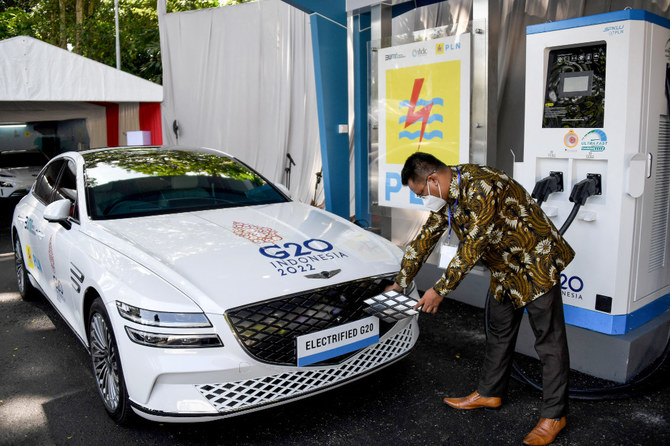
With Indonesia’s slow transition to clean energy, charging EVs is likely to depend on those unclean sources as well. (AFP/File)
Short Url
Updated 21 December 2022
Follow

Indonesia plans $320m incentive to boost EV sales amid slow clean energy transition

  • Southeast Asian nation is one of the world’s largest emitters of greenhouse gas
  • Transportation makes up about 44 percent of total energy consumption

JAKARTA: Indonesia is considering allocating $320 million from next year’s budget to encourage purchases of electric vehicles, a senior minister said on Wednesday, as the country trails in the transition to clean energy.
The Southeast Asian nation, one of the world’s largest emitters of greenhouse gas, has set a new target to cut emissions levels by almost 32 percent on its own by 2030 — a goal more ambitious than its Paris Agreement pledge — and also hopes to achieve net zero emissions by 2060.
Transportation contributes 44 percent to Indonesia’s total energy consumption, according to official data. To reduce that figure, the government is planning to introduce a cap on prices of electric vehicles in a bid to boost sales.
“This is an incentive that many other countries are already doing, because the key for us is energy transition,” Chief Economics Minister Airlangga Hartarto told reporters in Jakarta on Wednesday.
“We also need to develop our market so that (sales of) electric cars can reach a minimum of 20 percent by 2025, around 400,000 units.”
President Joko Widodo, who also took part in the press conference, said that incentives could help to develop the homegrown EV industry.
“We hope with the incentives our electric cars and electric motorcycles industry in our country will grow,” he said.
Despite the government’s focus on promoting EVs, experts said that Indonesia is still lagging in the shift to clean energy sources.
“Without balancing energy transition from fossil energy sources, especially coal, to clean and renewable energy, this incentive is only going to shift emissions from the transport sector to the electricity sector,” Tata Mustasya, regional climate and energy campaign strategist at Greenpeace Southeast Asia, told Arab News.
“There’s a need to speed up energy transition so that the incentives for hybrid cars and electric motorcycles will actually benefit the efforts to reduce emissions.”
Fossil fuels are the dominant source in Indonesia’s power mix, consisting of more than 87 percent. With Indonesia’s slow transition to clean energy, charging EVs is likely to depend on those unclean sources as well.
“The electricity used to charge our EVs is rather carbon-intensive,” Agus Sari, environmentalist and CEO of Landscape Indonesia, which focuses on sustainable landscape management, told Arab News.
“I think promoting EV is a great policy, but EV comes out of two major policies: energy and mobility. We need to make sure that our EV promotion policy is comprehensively integrated with the two,” he said.
Other countries that introduced EV subsidies have also adopted policies to improve city planning, create walkable urban centers and develop efficient public transport systems, he added.
“For energy, we need to make sure that the source of electricity charging our EVs comes from clean sources, otherwise we only move the pollution, not reduce it.” 


Saudi Arabia’s foreign reserves rise to a 6-year high of $475bn

Updated 22 February 2026
Follow

Saudi Arabia’s foreign reserves rise to a 6-year high of $475bn

RIYADH: Saudi Arabia’s foreign reserves climbed 3 percent month on month in January to SR1.78 trillion, up SR58.7 billion ($15.6 billion) from December and marking a six-year high.

On an annual basis, the Saudi Central Bank’s net foreign assets rose by 10 percent, equivalent to SR155.8 billion, according to data from the Saudi Central Bank, Argaam reported.

The reserve assets, a crucial indicator of economic stability and external financial strength, comprise several key components.

According to the central bank, also known as SAMA, the Kingdom’s reserves include foreign securities, foreign currency, and bank deposits, as well as its reserve position at the International Monetary Fund, Special Drawing Rights, and monetary gold.

The rise in reserves underscores the strength and liquidity of the Kingdom’s financial position and aligns with Saudi Arabia’s goal of strengthening its financial safety net as it advances economic diversification under Vision 2030.

The value of foreign currency reserves, which represent approximately 95 percent of the total holdings, increased by about 10 percent during January 2026 compared to the same month in 2025, reaching SR1.68 trillion.

The value of the reserve at the IMF increased by 9 percent to reach SR13.1 billion.

Meanwhile, SDRs rose by 5 percent during the period to reach SR80.5 billion.

The Kingdom’s gold reserves remained stable at SR1.62 billion, the same level it has maintained since January 2008.

Saudi Arabia’s foreign reserve assets saw a monthly rise of 5 percent in November, climbing to SR1.74 trillion, according to the Kingdom’s central bank.

Overall, the continued advancement in reserve assets highlights the strength of Saudi Arabia’s fiscal and monetary buffers. These resources support the national currency, help maintain financial system stability, and enhance the country’s ability to navigate global economic volatility.

The sustained accumulation of foreign reserves is a critical pillar of the Kingdom’s economic stability. It directly reinforces investor confidence in the riyal’s peg to the US dollar, a foundational monetary policy, by providing SAMA with ample resources to defend the currency if needed.

Furthermore, this financial buffer enhances the nation’s sovereign credit profile, lowers national borrowing costs, and provides essential fiscal space to navigate global economic volatility while continuing to fund its ambitious Vision 2030 transformation agenda.