

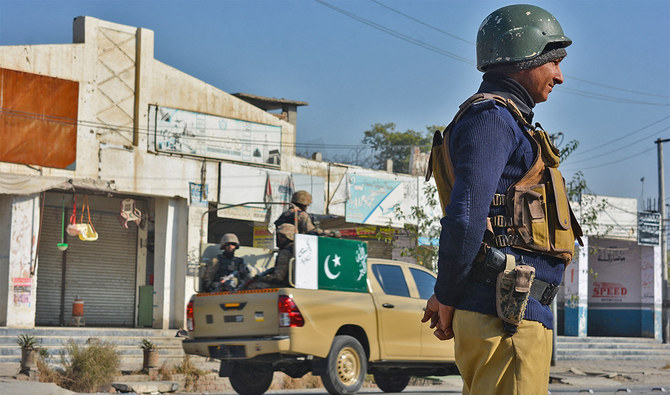

KARACHI: A day after a Pakistan Army Special Services Group (SSG) squad stormed a counterterrorism department (CTD) facility that Pakistani Taliban militants had taken over two days earlier, conflicting accounts have emerged from both sides about the outcome of the showdown.
Army spokesman Major General Ahmed Sharif told a local TV channel late on Tuesday night that one hostage and two commandos died in the operation to retake the compound on Dec 20. He also said one CTD official was killed earlier on Dec 18 when the Taliban detainees first took over the facility, while another was injured on that day but died later. He did not specify if this second official was among those killed during the operation. Ten soldiers, including three officers, were also injured during crossfiring, the spokesperson said.
Of the 35 militants detained in the facility, Sharif added, 25 were killed during the operation, three were arrested while trying to escape and seven surrendered.
According to the account by the military spokesperson and Defense Minister Khawaja Asif, the compound was back under state control on Tuesday. But a Bannu police official speaking on condition of anonymity told Arab News the complex was cleared after 9am on Wednesday.
On Wednesday morning, the Pakistani Taliban, or the Tehreek-e-Taliban Pakistan (TTP), released its own statement, saying the standoff was still ongoing and had intensified after militants inside the CTD complex snatched the army’s armored personnel carriers (APCs) and heavy weapons.
“The war has intensified, for which a fresh SSG squad has also left for Bannu from Peshawar,” Mohammad Khurasani, a TTP spokesman, said in a statement shared with media. “So far, 40 personnel, including six officers, have been killed or injured.”
“If the army is claiming an end to the operation, then why are they not releasing pictures of the compound and martyred mujahideen martyrs? [We] are facing a delay in disseminating information due to suspension of movement and Internet service in the area.”
So far, unlike in past incidents like the Taliban’s attack on a military-run school in Peshawar in 2014 in which 134 children were killed, no footage or pictures of the CTD compound or of killed or captured militants have been released by the government or army so far.
The TTP associates itself with the Afghan Taliban and has been fighting to overthrow the government in Islamabad since the late 2000s. The outlawed group has ramped up attacks in recent weeks since announcing the end of an Afghan Taliban-brokered cease-fire with Islamabad in November.
Speaking at an event in Washington on Tuesday night, Pakistani Foreign Minister Bilawal Bhutto Zardari said the latest attacks by the TTP had crossed a “red line” for Pakistan, saying Islamabad would have to press Afghanistan to take on the TTP or other militant groups operating from the neighboring country.
“As far as the TTP are concerned, it’s absolutely our red line. It is something that we will not tolerate,” he said. “And without going further diplomatically, on record, I would say that absolutely, we would be willing to consider each and every single option to ensure the safety and security of our people.”
On Wednesday, Prime Minister Shehbaz Sharif also vowed to stem the rising tide of attacks, promising to crush “wicked efforts” to create chaos in the South Asian country.
“The state will not bow before any terrorist group,” Sharif said in a statement, calling for a “collective mindset and strategy” to deal with the challenge.
The Bannu counterterrorism center siege started on the same day, December 18, that four Pakistani police officers were killed and another four critically wounded in a militant attack on a police station in the northwestern Pakistani district of Lakki Marwat.
On Monday, a suicide bombing killed at least two passersby and a soldier in the northwestern region of North Waziristan, while the TTP said on Tuesday it had attacked a police station in Wana city in the South Waziristan district and killed two policemen, but police said only one officer had been wounded.
“That TTP was able to breach an important CT facility, take hostages, and then put up a long fight speaks to, on the one hand, a major security failure and, on the other hand, the TTP’s capability,” Dr. Asfandyar Mir, a senior expert at US Institute of Peace, told Arab News.
“Combined with other incidents of violence by the TTP in the region there are some dangerous trend lines of the terror threat in Pakistan.”
Pakistan’s military has conducted several offensives in the tribal regions since 2009, forcing TTP and other militants and their leaders to run into neighboring Afghan districts where Islamabad says they have set up training centers to plan and launch attacks inside Pakistan. Kabul denies the charge.
Mir said the threat from the TTP would grow in the months to come, saying the group’s key strategic advantage was safe havens and access to fighting materials in Afghanistan. And it didn’t help, he added, that Pakistan’s policy response to the challenge was “all over the place for now.”
“Some Pakistani policymakers seem to be hoping that the [Afghan] Taliban will help Pakistan restrain the TTP but it appears unlikely the Taliban will pressure the TTP in any real way,” Mir said, adding that there was a chance of US-Pakistan cooperation against the TTP and other such threats given Washington’s longtime concerns over terrorism threats in the region.
“However, Pakistan will have to clarify it’s Afghanistan policy and whether it seeks to negotiate with the TTP or not,” the expert said, “before the US and other countries concerned about the TTP can assist in any meaningful way.”


