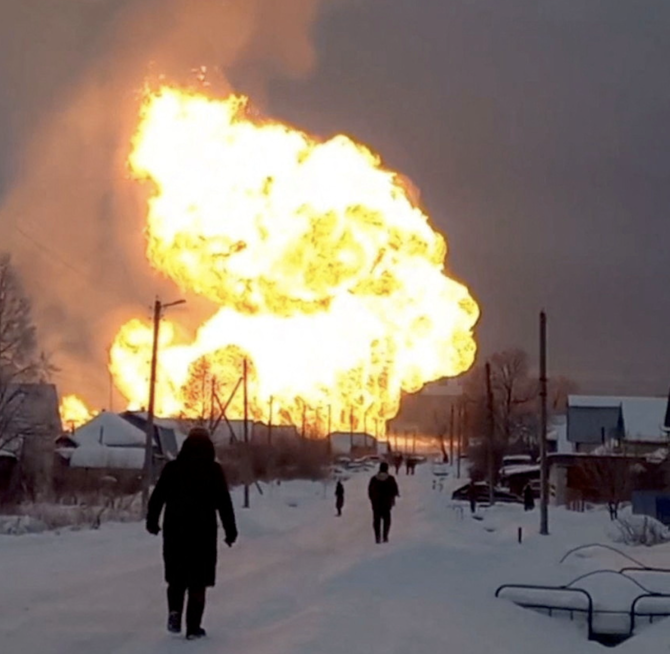
MOSCOW: A blast ripped through a gas pipeline in central Russia, killing three people and disrupting some of the limited amount of Russian gas that is still reaching Europe, local officials said on Tuesday.
The flow of gas through a section of the Urengoi-Pomary-Uzhhorod pipeline that takes gas from Russia’s Arctic to Europe via Ukraine had been halted as of 1:50 p.m. (1050 GMT), the local officials said on the Telegram messaging app.
Oleg Nikolayev, governor of the Republic of Chuvashia, told state TV that three people, who were carrying out servicing work, have died in the accident, while another, a driver, “was in a state of shock.”
He said it was unclear when gas supplies via the pipeline could resume, and authorities were trying to work that out.
The Chuvashia regional Emergencies Ministry said an explosion had ripped through the pipeline during planned maintenance work near the village of Kalinino, about 150 km (90 miles) west of the Volga city of Kazan. It said the resulting gas flare had been extinguished.
The pipeline, built in the 1980s, enters Ukraine via the Sudzha metering point, currently the main route for Russian gas to reach Europe.
Europe’s gas prices have surged this year after Russia cut exports through its main gas pipeline route into Germany, leaving only pipelines via Ukraine to ship Russian gas to European consumers.
The head office of the state-owned gas producer Gazprom and its local branch did not immediately respond to requests for comment.
Gazprom said earlier on Tuesday it expected to pump 43 million cubic meters of gas to Europe via Ukraine through Sudzha in the next 24 hours, a volume in line with recent days.
Forward prices on the Dutch TTF hub rose following the news. The benchmark TTF front-month contract was up 1.10 euros at 108.10 euro per megawatt hour by 1347 GMT. It had traded around 105 euros/MWh earlier in the day.

Three dead as blast shuts part of Russia-Ukraine gas export pipeline
https://arab.news/m2txc
Three dead as blast shuts part of Russia-Ukraine gas export pipeline
- The flow of gas through a section of the Urengoi-Pomary-Uzhhorod pipeline that takes gas from Russia's Arctic to Europe via Ukraine had been halted
- Governor of the Republic of Chuvashia told state TV that three people, who were carrying out servicing work, have died in the accident
After nearly 7 weeks and many rumors, Bolivia’s ex-leader reappears in his stronghold
- Morales was Bolivia’s first Indigenous president who served from 2006 until his fraught 2019 ouster and subsequent self-exile
- He dismissed rumors fueled by local politicians and fanned by social media that he would try to flee the country
LA PAZ: Bolivia’s long-serving socialist former leader, Evo Morales, reappeared Thursday in his political stronghold of the tropics after almost seven weeks of unexplained absence, endorsing candidates for upcoming regional elections and quieting rumors he had fled the country in the wake of the US seizure of his ally, Venezuela’s ex-President Nicolás Maduro.
The weeks of hand-wringing over Morales’ fate showed how little the Andean country knows about what’s happening in the remote Chapare region, where the former president has spent the past year evading an arrest warrant on human trafficking charges, and how vulnerable it is to fears about US President Donald Trump’s potential future foreign escapades.
The media outlet of Morales’ coca-growing union, Radio Kawsachun Coca, released footage of Morales smiling in dark sunglasses as he arrived via tractor at a stadium in the central Bolivian town of Chimoré to address his supporters.
Morales, Bolivia’s first Indigenous president who served from 2006 until his fraught 2019 ouster and subsequent self-exile, explained that he had come down with chikungunya, a mosquito-borne ailment with no treatment that causes fever and severe joint pain, and suffered complications that “caught me by surprise.”
“Take care of yourselves against chikungunya — it is serious,” the 66-year-old Morales said, appearing markedly more frail than in past appearances.
He dismissed rumors fueled by local politicians and fanned by social media that he would try to flee the country, vowing to remain in Bolivia despite the threat of arrest under conservative President Rodrigo Paz, whose election last October ended nearly two decades of rule by Morales’ Movement Toward Socialism party.
“Some media said, ‘Evo is going to leave, Evo is going to flee.’ I said clearly: I am not going to leave. I will stay with the people to defend the homeland,” he said.
Paz’s revival of diplomatic ties with the US and recent efforts to bring back the Drug Enforcement Administration — some 17 years after Morales expelled American anti-drug agents from the Andean country while cozying up to China, Russia, Cuba and Iran — have rattled the coca-growing region that serves as Morales’ bastion of support.
Paz on Thursday confirmed that he would meet Trump in Miami on March 7 for a summit convening politically aligned Latin American leaders as the Trump administration seeks to counter Chinese influence and assert US dominance in the region.
Before proclaiming the candidates he would endorse in Bolivia’s municipal and regional elections next month, Morales launched into a lengthy speech reminiscent of his once-frequent diatribes against US imperialism.
“This is geopolitical propaganda on an international scale,” he said of Trump’s bid to revive the Monroe Doctrine from 1823 in order to reassert American dominance in the Western Hemisphere. “They want to eliminate every left-wing party in Latin America.”



