

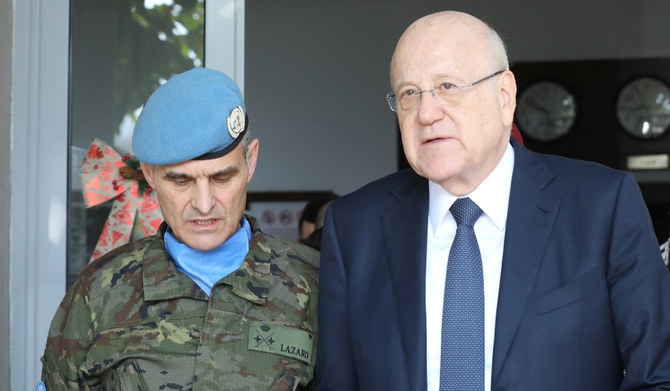

BEIRUT: Lebanon’s caretaker Prime Minister Najib Mikati has promised a full investigation into the attack on a UN peacekeeping convoy that left one soldier dead, saying: “Accountability must be taken.”
Mikati said on Monday that is “unacceptable to undermine the gravity of the incident,” which took place near the village of Al-Aqabiya in southern Lebanon.
“The incident must be taken seriously. Full investigations must be conducted and accountability must be taken,” he said in a meeting with journalists.
The Lebanese Army Intelligence Directorate is investigating the incident.
Pvt. Sean Rooney, 23, an Irish soldier serving with the peacekeeping force, was killed and three others were wounded last Wednesday when their UN Interim Force in Lebanon convoy came under fire in Al-Aqabiya.
UNIFIL acts as a buffer between Lebanon and Israel, and operates in the south near the border, a stronghold of Iran-backed Hezbollah.
One of the wounded, Pvt. Shane Kearney, remains in a serious condition in hospital.
Mikati said: “We hope that investigations soon yield an answer.”
He said that it was unlikely the attack was planned since it took place outside the UNIFIL area of operations.
The prime minister visited UNIFIL headquarters last week and condemned the incident.
On Monday, caretaker Defense Minister Maurice Slim checked on the wounded from the Irish battalion, and confirmed that investigations were underway.
The security services are playing a role, and all involved will be held accountable, he said.
Mikati also said that his government is committed to fulfilling its tasks during the presidential vacancy.
“The main priority is to elect a new president and form a new government, noting that electing the president does not mean the end of the crisis, but rather opening the door to a grace period in the country to reach a solution.”
Lebanon’s crippling economic crisis has resulted in the national currency losing more than 90 percent of its value, with an unprecedented increase in the dollar exchange rate on the parallel market.
The exchange rate reached LBP43,000 to the dollar on Monday.
Parliament so far has failed to elect a president due to the deep division among MPs.
Mikati said that “according to external data, some preparations are taking place to resolve the Lebanese crisis. However, things need time.”
Christian blocs oppose the holding of Cabinet sessions, claiming the caretaker government has no right to exercise the powers of a president.
Mikati said: “When necessary, I will call on the Cabinet to convene, in accordance with the constitutional powers entrusted to me. However, for the time being, there is nothing urgent that requires holding a session.
“Setting the Cabinet’s agenda is entrusted exclusively to the prime minister,” he said.
Mikati also said the Cabinet decisions “are taken by the majority of those present in ordinary matters, and by the majority of the members of the government in exceptional decisions.”
He called on his opponents, including the Free Patriotic Movement, to stop “disrupting and speaking out about the disruption. It is more productive not to disrupt the remainder of institutions.”
He added: “The solution lies in the Lebanese agreeing on their vision for the future, away from fruitless populism.
“We are in a state of emergency and must, as a government and a parliament, agree on the fundamental solutions.”
Referring to his talks with Saudi Crown Prince Mohammed bin Salman in Riyadh a week earlier, Mikati said: “It was an excellent meeting.”
He added: “We spoke about the country’s matters and he expressed his love for Lebanon, and particularly for the Lebanese nationals residing in Saudi Arabia.”


