

NEOM firm signs credit facility deals with banks for green hydrogen plant 

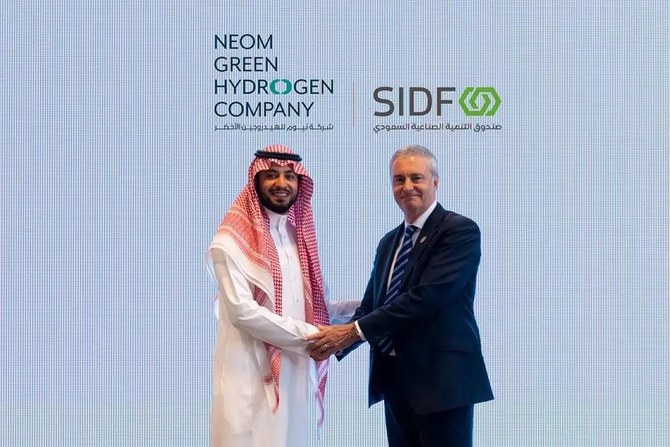
Sultan bin Khalid – Deputy CEO, SIDF (left) with David R. Edmondson, CEO NGHC. (Supplied)
Short Url
Updated 19 December 2022
Follow

NEOM firm signs credit facility deals with banks for green hydrogen plant 

RIYADH: NEOM Green Hydrogen Co. has signed credit facility agreements with local, regional and international banks, along with the execution of a commitment letter with the Saudi Industrial Development Fund to build a green hydrogen-based ammonia production plant.  

To be located at $500-billion Giga-project NEOM, the plant will integrate up to 4 gigawatts of solar and wind energy to produce up to 1.2 million tons of green ammonia translating to up to 600 tons per day of carbon-free hydrogen, according to a press release.  

NGHC, an equal joint venture created by ACWA Power, Air Products and NEOM, said the development will be the world’s largest green hydrogen-based ammonia production plant when it comes into operation in 2026. 

It added that 100 percent of the green hydrogen produced will be available for global export, in the form of ammonia, through an exclusive long-term agreement with Air Products. 

NGHC CEO David R. Edmondson said the company has a clear mission to leverage the expertise and vision of its partners to accelerate the global green hydrogen economy in line with Vision 2030.  

"The recent convening of the investment community in Riyadh is an important step towards the milestone of achieving financial close in early 2023, to deliver the world’s largest facility to produce green hydrogen at scale. We are grateful for the significant support from our shareholders and the investment community to making that happen,” he said. 

The NGHC statement underlined that deal behind the development is structured with significant participation from SIDF and the National Infrastructure Fund. 

Global consultancy firm MEED, last month reported that NEOM is negotiating with entities to invest $20 billion to develop its planned brine chemicals complex in the industrial city OXAGON. 

Citing a close source familiar with the matter, MEED reported that the development will be built in phases and require somewhere between $15 billion to $20 billion in investments.   

According to the report, the chemicals complex aims to build industries and plants that convert brine, the main waste output of desalination, into industrial materials that can be used locally or exported internationally. 

NEOM’s water and energy subsidiary ENOWA said the brine generated from the desalination plant will be treated to feed industries utilizing high-purity industrial salt, bromine, boron, potassium, gypsum, magnesium and rare metal feedstocks, the report added. 

In September, ENOWA’s CEO Peter Terium, during an exclusive interview with Arab News on the sidelines of the Future Desalination International Conference held in Riyadh, said that NEOM will build a water desalination plant by 2024 to combat water scarcity. 

NEOM is Saudi Arabia’s most ambitious project, as the Kingdom eyes diversifying its economy in alignment with the goals outlined in Vision 2030. The construction of the project is progressing steadily in the Tabuk Province in north-western Saudi Arabia, and upon completion, it is expected to become one of the most popular tourist destinations in the Kingdom.  


Saudi Arabia’s debt capital market to hit $600bn by end-2026, up 15% Fitch says 

Updated 7 sec ago
Follow

Saudi Arabia’s debt capital market to hit $600bn by end-2026, up 15% Fitch says 

RIYADH: Saudi Arabia’s debt capital market is expected to reach $600 billion in outstanding issuance by the end of 2026, cementing its position as the largest US dollar debt and sukuk issuer among emerging markets. 

In a report published this week, Fitch Ratings said outstanding Saudi debt surpassed $520 billion in 2025, an annual increase of 21 percent, with sukuk — Shariah-compliant financial instruments — accounting for roughly 62 percent of the total.

The steady momentum in Saudi Arabia’s sukuk market highlights the broader expansion of the Kingdom’s debt markets, as domestic and international investors seek diversification and stable returns. 

Bashar Al-Natoor, global head of Islamic finance at Fitch Ratings, said: “Driven by cross-sector financing needs, fiscal deficits, regulatory initiatives, and expected lower oil prices and interest rates, Saudi Arabia’s DCM is likely to reach $600 billion outstanding in 2026.” 

He added: “Almost all Fitch-rated Saudi sukuk are investment grade, with issuers on Stable Outlooks and no defaults. Following reforms, foreign investors now contribute more than 10 percent of the government’s outstanding direct domestic issuance in primary local markets at end-2025.”

In 2025, the Kingdom’s dollar debt issuance surged by 49 percent to around $100 billion, with sukuk growth outpacing bonds. 

In emerging markets excluding China, Saudi Arabia was both the largest dollar-debt issuer in 2025, with an 18 percent share, and the largest environmental, social and governance dollar-debt issuer, with more than a 26 percent share. 

“Subordinated sukuk issuances by banks are rising. Access to the Saudi riyal and dollar markets is bringing benefits amid tighter riyal liquidity. This is supported by no additional currency risk, and established access to foreign investors,” said Fitch. 

It added that Saudi Arabia’s annual borrowing plan, approved by the National Debt Management Center, aims to source up to 50 percent of sovereign funding needs from private markets, 25 percent to 30 percent from international debt capital markets, and 20 percent to 30 percent from domestic debt capital markets. 

The report further noted that private funding channels, syndicated financing and certificates of deposit for banks are expected to remain among the prominent alternative funding sources in Saudi Arabia. 

Fitch, however, cautioned that Saudi Arabia’s DCM is exposed to oil price sensitivity, interest rate volatility, evolving Shariah requirements for sukuk, and geopolitical risks, which could affect fiscal balances, funding costs and investor sentiment. 

Earlier this month, a separate report by Fitch Ratings revealed that global sukuk issuances reached $300 billion in 2025, representing a 25 percent increase compared to the previous year, driven by steady offerings in Gulf Cooperation Council countries. 

The report added that this growth momentum is likely to continue in 2026, supported by funding diversification efforts, upcoming maturities and refinancing activity across sovereigns, banks and corporates.