

Oil Updates — Crude climbs; pressure on oil firms to set climate targets

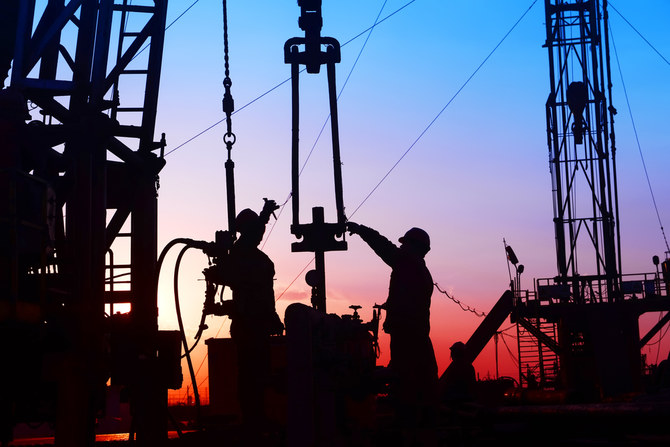
Brent crude futures rose 80 cents, or 0.95 percent, to $79.79 a barrel by 07.55 a.m. Saudi time, while US West Texas Intermediate crude was at $75.00 a barrel, up 71 cents, or 0.96 percent. (Shutterstock)
Short Url
Updated 19 December 2022
Follow

Oil Updates — Crude climbs; pressure on oil firms to set climate targets

RIYADH: Oil prices reclaimed ground on Monday after tumbling more than $2 a barrel in the previous session as optimism from China’s reopening and oil demand recovery outweighed concerns of a global recession. 

Brent crude futures rose 80 cents, or 0.95 percent, to $79.79 a barrel by 07.55 a.m. Saudi time, while US West Texas Intermediate crude was at $75.00 a barrel, up 71 cents, or 0.96 percent. 

On Friday, news outlet Caixin reported that China plans to increase flights with the goal to restore the country’s average daily passenger flight volumes to 70 percent of 2019 levels by Jan. 6. 

China’s diesel and gasoline exports continued to surge in November to their highest level in over a year as refiners dashed to use up their 2022 export quotas and sell down rising inventory. 

Fire put out at unit of Siberian oil and gas condensate field 

A fire at an oil and gas condensate Markovskoye field in Russia’s Irkutsk region in Siberia was extinguished, Igor Kobzev, governor of the region said on Monday. 

Seven people were injured, Kobzev said on the Telegram messaging app. Six were hospitalized, with two in serious condition. 

“There is no danger to residents,” Kobzev said. 

The fire broke out Sunday over an area of about 1,000 sq. m. The field is owned by the Irkutsk Oil Co., one of Russia’s largest private oil producers. 

Investors ramp up pressure on big oil firms to set 2030 climate targets 

A group of investors has tabled resolutions urging four of the world’s top oil and gas companies to set broad climate targets for 2030, reviving pressure on the sector after a year that saw governments shift their focus to energy security. 

Activist group Follow This said it had co-filed the resolutions with six major institutional investors managing $1.3 trillion in assets ahead of the annual general meetings of BP, Chevron, Exxon Mobil and Shell next year. 

In the resolutions, the investors call on the companies to set targets to reduce greenhouse gas emissions by 2030, including those from fuel sold to customers, known as Scope 3 emissions, which account for the vast majority of the sector’s pollution. 

Investors have in recent years ramped up pressure on the oil and gas sector to help tackle climate change, and the Follow These climate-related resolutions have drawn growing support among shareholders. 

However, last year the efforts largely sputtered as investors turned their focus more to higher energy prices and energy security following Russia’s invasion of Ukraine. 

BP, Shell and Chevron have all set some 2030 greenhouse emissions reduction targets that include Scope 3, though Follow This said they are not aligned with the UN’s ambitions to limit global warming to 1.5 degrees Celsius above pre-industrial levels. 

Exxon, which does not have Scope 3 targets, has said the way they are calculated is flawed. The methodology has the unintended consequence of passing carbon footprint to someone else, it says — for example, when companies are punished for producing more natural gas that would replace coal, a more polluting fuel. 

(With input from Reuters) 


Acwa signs key terms to develop 5GW of renewable energy capacity in Turkiye

Updated 23 February 2026
Follow

Acwa signs key terms to develop 5GW of renewable energy capacity in Turkiye

JEDDAH: Saudi utility giant Acwa has signed key investment agreements with Turkiye’s Ministry of Energy and Natural Resources to develop up to 5 gigawatts of renewable energy capacity, starting with 2GW of solar power across two plants in Sivas and Taseli.

Under the investment agreement, Acwa will develop, finance, and construct, as well as commission and operate both facilities, according to a press release.

The program builds on the company’s first investment in Turkiye, the 927-megawatt Kirikkale Independent Power Plant, valued at $930 million, which offsets approximately 1.8 million tonnes of carbon dioxide annually, the statement added.

A separate power purchase agreement has been concluded with Elektrik Uretim Anonim Sirketi for the sale of electricity generated by each facility.

Turkiye aims to boost solar and wind capacity to 120GW by 2035, supported by around $80 billion in investment, while recent projects have already helped prevent 12.5 million tonnes of CO2 emissions and reduced reliance on imported natural gas.

Turkiye’s energy sector has undergone a rapid transformation in recent years, with renewable power emerging as a central pillar of its strategy.

Raad Al-Saady, vice chairman and managing director of ACWA, said: “The signing of the IA (implementation agreement) and PPA key terms marks a pivotal moment in Acwa’s partnership with Turkiye, reflecting the country’s strong potential as a clean energy leader and manufacturing powerhouse.”

He added: “Building on our long-standing presence, including the 927MW Kirikkale Power Plant commissioned in 2017, this step elevates our partnership to a new level,” Al-Saady said.

In its statement, Acwa said the 5GW renewable energy program will deliver electricity at fixed prices, enhancing predictability for grid planning and supporting long-term industrial investment.

By replacing imported fossil fuels with domestically generated clean energy, the initiative is expected to reduce Turkiye’s exposure to global energy market volatility, strengthening energy security and lowering long-term power costs.

The company added that the economic impact will extend beyond the anticipated investment of up to $5 billion in foreign direct investment, with thousands of jobs expected during the construction phase and hundreds of high-skilled roles created during operations.

The energy firm concluded that its existing progress in Turkiye reflects a strong appreciation for Turkish engineering, construction, and manufacturing capacity, adding that localization has been a strategic priority, and it has already achieved 100 percent local employment at its developments in the country.