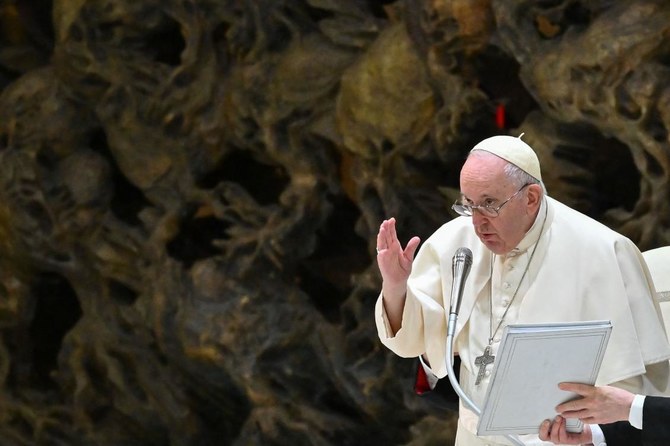
VATICAN CITY: Pope Francis revealed for the first time in an interview Sunday that he had signed a resignation letter nearly a decade ago should poor health prevent him from carrying out his duties.
Francis — who turned 86 on Saturday — has said in the past that he would step down from the papacy should health problems keep him from his duties.
In Spanish newspaper ABC, the pontiff said he signed his resignation letter and handed it over to the Vatican’s secretary of state, Tarcisio Bertone, before that cardinal’s retirement in 2013.
“I signed the resignation and I told him, ‘In case of medical impediment or whatever, here’s my resignation. You have it’,” the pope said.
Asked by the interviewer whether he wanted that fact to be known, Francis replied: “That’s why I’m telling you.”
He added that he didn’t know what Bertone subsequently did with the letter.
Francis has been limited in his ability to walk by an inoperable knee condition which has forced him to rely on a wheelchair in recent months.
The pope has had to cancel or curtail activities several times over the past year because of pain and in an interview in July he acknowledged that he needed to slow down.
“I think that at my age and with this limitation, I have to save myself a little bit to be able to serve the Church. Or, alternatively, to think about the possibility of stepping aside,” he said.
Francis’s predecessor, Benedict XVI, quit over failing health in 2013. He now lives quietly in Vatican City.


Pope Francis signed resignation letter should health fail
https://arab.news/wf46p
Pope Francis signed resignation letter should health fail

- He has said in the past that he would step down from the papacy should health problems keep him from his duties


Italian PM pledges to deepen cooperation with African states
- The plan, launched in 2024, aims to promote investment-led cooperation rather than traditional aid
ADDIS ABABA: Italy pledged to deepen cooperation with African countries at its second Italy-Africa summit, the first held on African soil, to review projects launched in critical sectors such as energy and infrastructure during Italy’s first phase of the Mattei Plan for Africa.
The plan, launched in 2024, aims to promote investment-led cooperation rather than traditional aid.
Italy’s Prime Minister Giorgia Meloni addressed dozens of African heads of state and governments in Ethiopia’s capital, Addis Ababa, and reiterated that a successful partnership would depend on Italy’s “ability to draw from African wisdom” and ensure lessons are learned.
“We want to build things together,” she told African heads of state. “We want to be more consistent with the needs of the countries involved.”
Ethiopian Prime Minister Abiy Ahmed said Italy had provided Africa with a gateway to Europe through these partnerships.
“This is a moment to move from dialogue to action,” he said.
“By combining Africa’s energetic and creative population with Europe’s experience, technology, and capital, we can build solutions that deliver prosperity to our continents and beyond.”
After the Italy-Africa summit concluded, African leaders remained in Addis Ababa for the annual African Union Summit.
Kenyan writer and political analyst Nanjala Nyabola said tangible results from such summits depend on preparations made by countries.
African governments often focus on “optics instead of actually making summits a meaningful engagement,” she said.
Instead of waiting for a list of demands, countries should “present the conclusions of an extended period of mapping the national needs” and engage in dialogue to determine how those needs can be met.
Since it was launched two years ago, the Mattei Plan has directly involved 14 African nations and has launched or advanced around 100 projects in crucial sectors, including energy and climate transition, agriculture and food security, physical and digital infrastructure, healthcare, water, culture and education, training, and the development of artificial intelligence, according to the Italian government.