

Kyiv recovers after Russia strikes, power restored to 6 million

1 / 2
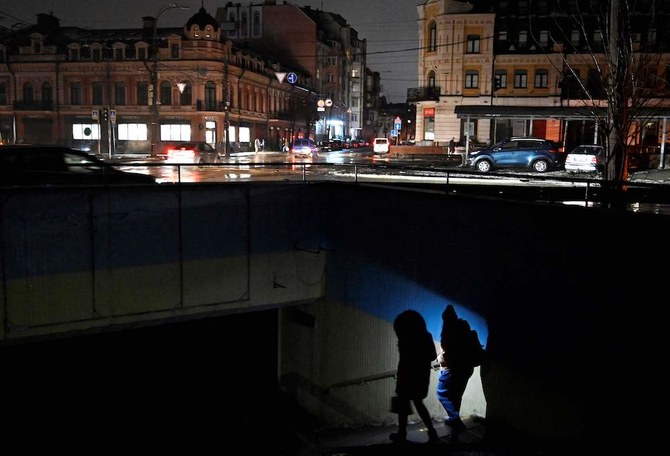
People use a flashlight as they enter an underground passage in Kyiv on Dec 17, 2022, amid the Russian invasion of Ukraine. (AFP)
2 / 2
Damaged cars seen at the scene of Russian shelling in Kyiv, Ukraine, in November 23, 2022. Ukraine worked Saturday to restore electricity and water supplies after Russia's latest wave of attacks pitched multiple cities into darkness. (AP/File)
Short Url
Updated 18 December 2022
Follow

Kyiv recovers after Russia strikes, power restored to 6 million

  • A quarter of Kyiv remains without heating but metro system back in service
  • Only around one-third of the city remained without electricity

KYIV: Basic services were being restored in Ukraine’s capital Kyiv on Saturday after the latest wave of Russian air strikes on critical infrastructure, as residents navigated a city gripped by fog and girded for a holiday season marked by uncertainty.

Mayor Vitali Klitschko said a quarter of Kyiv remained without heating but that the metro system was back in service and all residents had been reconnected to water supply by early morning.

Only around one-third of the city remained without electricity, he said, but emergency outages would still be implemented to save power. “Because the deficit of electricity is significant,” he wrote on the Telegram messaging app.

Ukrainian officials said Russia fired more than 70 missiles on Friday in one of its heaviest barrages since the Kremlin’s Feb. 24 invasion, forcing emergency blackouts nationwide.

Ukraine has managed to restore power to almost 6 million people in the last 24 hours, President Volodymyr Zelensky said in a video address.

“Repair work continues without a break after yesterday’s terrorist attack. ... Of course, there is still a lot of work to do to stabilize the system,” he said.

“There are problems with the heat supplies. There are big problems with water supplies,” Zelensky added, saying Kyiv as well as Vinnytsia and Lviv further to the west were experiencing the most difficulty.

Earlier this month, Kyiv Mayor Klitschko had warned of an “apocalypse” scenario for the capital if Russian air strikes on infrastructure continued, though he also said there was no need yet for people to evacuate.

“We are fighting and doing everything we can to make sure that this does not happen,” he told Reuters on Dec. 7.

In a gloomy winter haze on Saturday, officials reopened a popular pedestrian bridge that had been damaged during an earlier air strike and were setting up a smaller-than-usual Christmas tree in a central square.

The vast space in front of the centuries-old St. Sophia Cathedral is traditionally anchored by a hulking evergreen at Christmas. But officials this year opted for a 12-meter (40-foot) artificial tree festooned with energy-saving lights powered by a generator.

Orthodox Christians make up the majority of Ukraine’s 43 million people.

Klitschko said the tree was funded by donors and businesses, and that no public celebrations would take place.

“I doubt this will be a true holiday,” said Kyiv resident Iryna Soloychuk, who arrived with her daughter to see the tree just hours after another round of air-raid alerts wailed across the country.

“But we should understand that we’re all together, that we should help one another.”


Canada PM Carney says can’t rule out military participation in Iran war

Updated 55 min 12 sec ago
Follow

Canada PM Carney says can’t rule out military participation in Iran war

  • Carney had said the US-Israeli strikes on Iran were “inconsistent with international law”
  • However, he supports the efforts to stop Iran from obtaining a nuclear weapon

CANBERRA, Australia: Canadian Prime Minister Mark Carney said Thursday that he couldn’t rule out his country’s military participation in the escalating war in the Middle East.
Carney’s visit to Australia this week has been overshadowed by expanding war in the Middle East, sparked by a massive US-Israeli strike on Iran that killed its supreme leader, Ayatollah Ali Khamenei.
Speaking alongside local counterpart Anthony Albanese in Canberra, Carney was asked whether there was a situation in which Canada would get involved.
“One can never categorically rule out participation,” he said, while stressing the question was a “hypothetical” one.
“We will stand by our allies,” said Carney, adding that “we will always defend Canadians.”
Carney had said the US-Israeli strikes on Iran were “inconsistent with international law.”
However, he supports the efforts to stop Iran from obtaining a nuclear weapon — a position that Canada takes “with regret” as it represented “another example of the failure of the international order.”
The Canadian leader reiterated on Thursday his call for a “de-escalation” of the conflict.
Carney’s trip is part of a multi-country tour of the Asia-Pacific aimed at reducing reliance on the United States — a hedge against what he has described as a fading US-led global order.
The Australia leg of the tour is aimed at bringing in investment and deepening ties with a like-minded “middle power” partner.

‘Middle power’ rallying cry

On Thursday morning he issued a rallying cry in Australia’s parliament to “middle powers,” urging them to work together in an increasingly hegemonic world order.
Nations like Australia and Canada faced a stark choice — work together to help write the “new rules” of the global order or have great powers do it for them, he said.
“In this brave new world, middle powers cannot simply build higher walls and retreat behind them. We must work together,” he said.
“Great powers can compel, but compulsion comes with costs, both reputational and financial,” the former central banker added.
“Middle powers like Australia and Canada hold this rare convening power because others know we mean what we say and we will match our values with our actions.”
The Canadian leader also said the two countries would together as “strategic collaborators” to pool their vast combined rare earth mineral resources.
And he detailed renewed cooperation in areas from defense to artificial intelligence.
“We know we must work with others who share our values to build solid capabilities,” he told parliament.
Otherwise, he warned, they risked being “caught between the hyperscalers and the hegemons.”
The Canadian leader has frequently clashed with US President Donald Trump, who has repeatedly threatened to annex Canada and slapped swingeing tariffs on the country.
In a speech to political and financial elites at the World Economic Forum in January, Carney warned the US?led global system of governance was enduring “a rupture.”