

Kyiv recovers after Russia strikes, power restored to 6 million

1 / 2
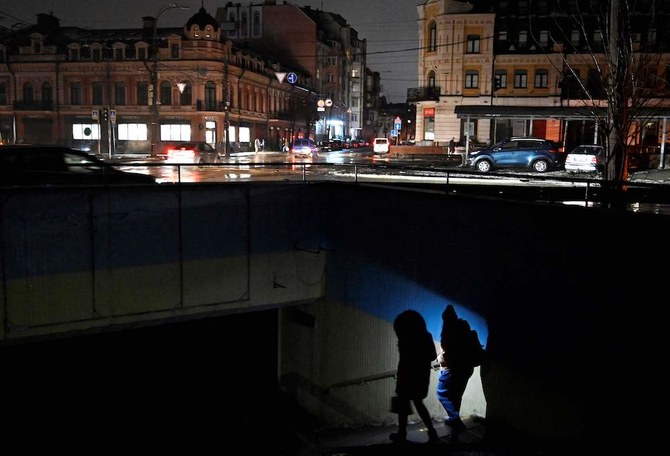
People use a flashlight as they enter an underground passage in Kyiv on Dec 17, 2022, amid the Russian invasion of Ukraine. (AFP)
2 / 2
Damaged cars seen at the scene of Russian shelling in Kyiv, Ukraine, in November 23, 2022. Ukraine worked Saturday to restore electricity and water supplies after Russia's latest wave of attacks pitched multiple cities into darkness. (AP/File)
Short Url
Updated 18 December 2022
Follow

Kyiv recovers after Russia strikes, power restored to 6 million

  • A quarter of Kyiv remains without heating but metro system back in service
  • Only around one-third of the city remained without electricity

KYIV: Basic services were being restored in Ukraine’s capital Kyiv on Saturday after the latest wave of Russian air strikes on critical infrastructure, as residents navigated a city gripped by fog and girded for a holiday season marked by uncertainty.

Mayor Vitali Klitschko said a quarter of Kyiv remained without heating but that the metro system was back in service and all residents had been reconnected to water supply by early morning.

Only around one-third of the city remained without electricity, he said, but emergency outages would still be implemented to save power. “Because the deficit of electricity is significant,” he wrote on the Telegram messaging app.

Ukrainian officials said Russia fired more than 70 missiles on Friday in one of its heaviest barrages since the Kremlin’s Feb. 24 invasion, forcing emergency blackouts nationwide.

Ukraine has managed to restore power to almost 6 million people in the last 24 hours, President Volodymyr Zelensky said in a video address.

“Repair work continues without a break after yesterday’s terrorist attack. ... Of course, there is still a lot of work to do to stabilize the system,” he said.

“There are problems with the heat supplies. There are big problems with water supplies,” Zelensky added, saying Kyiv as well as Vinnytsia and Lviv further to the west were experiencing the most difficulty.

Earlier this month, Kyiv Mayor Klitschko had warned of an “apocalypse” scenario for the capital if Russian air strikes on infrastructure continued, though he also said there was no need yet for people to evacuate.

“We are fighting and doing everything we can to make sure that this does not happen,” he told Reuters on Dec. 7.

In a gloomy winter haze on Saturday, officials reopened a popular pedestrian bridge that had been damaged during an earlier air strike and were setting up a smaller-than-usual Christmas tree in a central square.

The vast space in front of the centuries-old St. Sophia Cathedral is traditionally anchored by a hulking evergreen at Christmas. But officials this year opted for a 12-meter (40-foot) artificial tree festooned with energy-saving lights powered by a generator.

Orthodox Christians make up the majority of Ukraine’s 43 million people.

Klitschko said the tree was funded by donors and businesses, and that no public celebrations would take place.

“I doubt this will be a true holiday,” said Kyiv resident Iryna Soloychuk, who arrived with her daughter to see the tree just hours after another round of air-raid alerts wailed across the country.

“But we should understand that we’re all together, that we should help one another.”


Philippines discovers new gas deposit to boost depleted reserves

Updated 4 sec ago
Follow

Philippines discovers new gas deposit to boost depleted reserves

  • Source near Malampaya field believed to contain 2.8 billion cubic meters of gas
  • It will not take much time to access the gas, expert says, as infrastructure is ready

MANILA: The Philippines on Monday announced a new natural gas discovery, with the reservoir near the country’s largest offshore site estimated to be enough to power about 5.7 million households per year.

About 2.8 billion cubic meters (98 billion cubic feet) of gas were found 5km east of the Malampaya field near the island of Palawan, President Ferdinand Marcos Jr. said in a Facebook video.

“This is equivalent to nearly 14 billion kilowatt-hours of electricity per year. That means it could supply power to more than 5.7 million households, 9,500 buildings, or nearly 200,000 schools,” Marcos said.

“This helps Malampaya’s contribution and strengthens our domestic gas supply for many years to come. Initial testing showed that the well flowed at 60 million cubic feet (1.7 million cubic meters) per day.”

Malampaya, discovered in 1989 and operational since 2001, is the Philippines’ most important natural gas field, located off the west coast of Palawan Island. It is also a key part of the country’s energy infrastructure.

It supplies natural gas for electricity generation in Luzon, the main island of the Philippines, powering several major plants.

Prime Energy Resources Development, which manages the Malampaya project, said in a statement that the new reservoir, Malampaya East-1, was discovered by a “a fully Filipino-led team, reflecting the country’s growing capability in upstream energy development.”

Prime Energy’s well data indicate that Malampaya East-1 volumes are equivalent to about one-third of the remaining producible gas volumes at the original Malampaya.

Against the backdrop of Malampaya’s decline, it will help to secure the country’s gas supplies. It will also keep operational the expensive infrastructure that was installed to operate the legacy field.

“The original Malampaya was like 2.3 trillion cubic feet, so it’s like 4 percent of the original find. I still think that is significant in light of the decline of the Malampaya gas field,” said Alberto Dalusung III, energy transition adviser at the Institute for Climate and Sustainable Cities.

The new gas discovery benefits from ready access to processing facilities such as the 504 km undersea pipeline that was built for Malampaya, which will make it available sooner.

Dalusung estimated it would take up to two years for Filipino consumers to benefit from the new resources.

“The infrastructure is already there,” he said. “You don’t have to build the pipeline. All you have to do is find new gas resources, which we did.”