

Philippines launches incentive program for OFWs to bring more tourists home

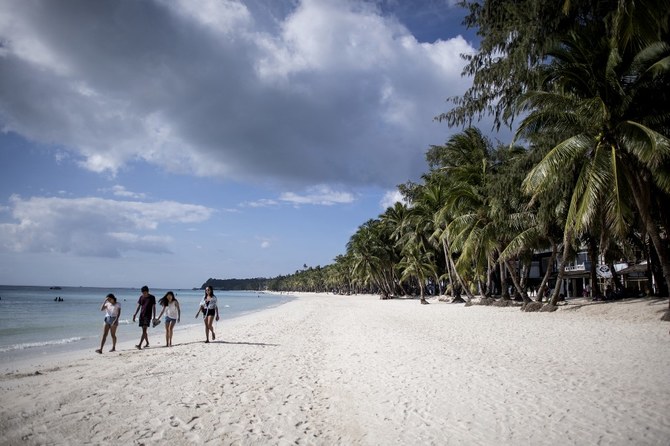
The Philippines, known for its white sand beaches and famous diving spots, is dependent on tourism. (AFP)
Short Url
Updated 15 December 2022
Follow

Philippines launches incentive program for OFWs to bring more tourists home

  • ‘Bisita Be My Guest’ aimed especially at overseas Filipino workers, most of whom live in the Middle East
  • Tourism secretary says hopeful the program will help increase arrivals from Saudi Arabia and the UAE

MANILA: Authorities in the Philippines launched a new incentive program on Thursday, aimed at overseas Filipino workers to encourage them to bring foreign visitors to the country.

The “Bisita (Visitor) Be My Guest” program, introduced by the Department of Tourism in cooperation with the Department of Migrant Workers, the Tourism Promotions Board, and the private sector, aims to boost the Southeast Asian nation’s hospitality sectors as it recovers from two years of coronavirus-induced shutdowns.

“We’re very happy to launch the ‘Bisita Be My Guest’ program,” Tourism Secretary Christina Frasco told reporters in Manila.

“This will give Filipinos, especially our OFWs and those living abroad, opportunities to receive incentives and prizes for bringing home a foreign friend, spouse or family into the Philippines.

“Now as travel restrictions have eased, we look forward to inviting our foreign friends and guests to visit our country and to offer a wide range of culturally rich experiences along with all types of outdoor recreational activities on water and on land,” Frasco said.

The incentives include raffle prizes such as condominium units, cars, and holiday packages, as well as privilege cards for discounts at various malls, hotels and restaurants across the country.
As most of Filipino migrant workers live in the Middle East, the project is expected to help increase arrivals from Saudi Arabia, the UAE, and other countries in the region, Frasco said.

“I had a listening tour with stakeholders in that region, and they’re very excited to partner with the Philippines to harness the Middle Eastern market for us.”

Saudi Arabia, home to over 800,000 Filipino expats, is the Philippines’ main tourism market in the Middle East.

“All of them are so eager to help our country,” Migrant Workers Secretary Susan Ople said during the program’s launch.

“This program gives them a vehicle to do just that.”

The Philippines, known for its white sand beaches and famous diving spots, is dependent on tourism. In 2019, nearly 8.3 million foreign tourists visited the country and the hospitality sector generated around $44 billion — about 13 percent of the country’s GDP, according to the Philippine Statistics Authority.
Most tourism destinations in the country were forced to shut down when the COVID-19 pandemic hit in 2020, dealing a major blow to the industry. Foreign arrivals slumped by 82 percent.

This year, tourism recovery efforts have yielded results following the lifting of several coronavirus restrictions.

By Dec. 15, official data showed that nearly 2.4 million foreign tourists had visited the Philippines.


Radical Israeli settlers post list of their attacks on West Bank Palestinians

Updated 5 sec ago
Follow

Radical Israeli settlers post list of their attacks on West Bank Palestinians

JERUSALEM: The radical Israeli settler group Hilltop Youth has published a tally of attacks it says it carried out against Palestinians over the past month in the occupied West Bank, describing the violence as its “struggle against the Arab enemy.”
The movement, known for hard-line activism and involvement in efforts to drive Palestinians from parts of the territory, posted the list on its Telegram channel on Wednesday, detailing incidents it claimed responsibility for.
The tally, titled “Monthly summary of the struggle against the Arab enemy in the Holy Land,” lists 29 vehicles set ablaze, 12 homes torched, “40 Arabs injured,” and hundreds of windows smashed and olive trees cut down across 33 towns and villages.
Five of them are in Mikhmas, a village near Ramallah. A nearby Bedouin community left the area this month, citing sustained harassment.
On Wednesday, the Ramallah-based Palestinian health ministry said a 19-year-old had died of wounds sustained after being shot by settlers in Mikhmas.
The Hilltop Youth’s figures reflect a surge in settler violence across the West Bank.
The UN said nearly 700 Palestinians were displaced by settler violence and intimidation in January alone — the highest monthly figure since the Gaza war began in October 2023.
Hilltop Youth is a loose network of hard-line settlers, often made up of small groups of teenagers sometimes overseen by an adult, who establish unauthorized outposts atop West Bank hills.
They are widely accused of using intimidation and violence to push Palestinians out from areas surrounding the outposts.
While most Israeli settlers do not engage in violence, a small but militant fringe has been linked to attacks on Palestinians.
On Tuesday, a group of influential rabbis from settlements in the northern West Bank issued a public letter celebrating settlement expansion while insisting violence was forbidden.
Excluding Israeli-annexed east Jerusalem, more than 500,000 Israelis live in West Bank settlements and outposts, which are illegal under international law.
Around three million Palestinians live in the territory, which Israel has occupied since 1967.
The current Israeli government, considered one of the most right wing in the country’s history, has fast-tracked settlement expansion and recognized some outposts.
It approved a record 54 settlements in 2025, according to Israeli NGO Peace Now.