

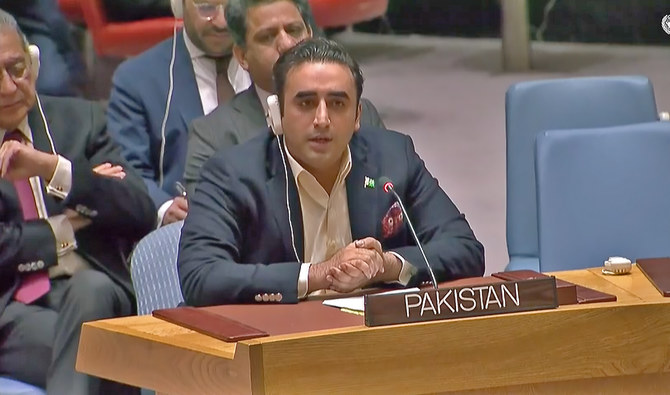

ISLAMABAD: Pakistan’s Foreign Minister Bilawal Bhutto-Zardari on Wednesday urged the United Nations Security Council (UNSC) to ensure the implementation of its resolutions on Kashmir and deliver upon its commitments to regional peace.
The statement by the Pakistani foreign minister came at a high-level debate at the UNSC, themed as “Maintenance of International Peace and Security: New Orientation for Reformed Multilateralism.”
Bhutto-Zardari said while the UNSC covered a lot of issues, but a “multinational” agenda item of the Kashmir issue had been left unaddressed.
“We believe it a multinational agenda, an agenda of this UNSC, and if you want to see the success of the multilateral institution or multilateralism and the success of this very council, surely you can aid in this process and allow the implementation of the resolutions of the UNSC,” the foreign minister said.
“When it comes to the question of Kashmir, prove that multilateralism can succeed, prove that the UNSC can succeed and deliver peace in the region.”
The Muslim-majority Himalayan region has been a flashpoint between Pakistan and India since their independence from British rule in 1947.
Both countries rule parts of the territory, but claim it in full and have fought two of their four wars over the region.
The foreign minister stressed further democratization of all parts of the UN to empower the organization, urging the UNSC to help divert the world’s attention from “narrow national ambitions” to global challenges.
“It does not serve the purposes of the UN to add more members to its elitist club and to expand the tyrannical power of veto,” he said.
“Simultaneously, we must confront the rise of the ideologies of hate, xenophobia, populist extremism, and racial and religious intolerance, including Islamophobia, which imposes discrimination and violence, and even threats of genocide, against vulnerable minorities in certain countries.”
The Pakistani foreign minister has been on an official visit to the United States from December 14 till December 21, and is scheduled to have multiple multilateral and bilateral engagements in New York and Washington DC.
On Wednesday, Bhutto-Zardari met with Csaba Korösi, president of the 77th session of the UN General Assembly, and UN deputy secretary-general Amina J. Mohammed in New York. The meetings were centered around matters pertaining to the impact of climate change, water crisis and sustainable development goals, according to the foreign office.
The Pakistani foreign minister will travel to Washington DC on December 19, where he will hold meetings with high-level government officials, congressional leaders, and Pakistani-American businessmen and community members. He will also engage with think-tanks and the media.
The meetings are likely to focus on bilateral and regional issues of mutual interest to carry forward the momentum in Pakistan-US bilateral relations, particularly in the areas of trade, investment, climate resilience and economic development.


