

Houthis accused of torturing prisoner, concealing death from family for years

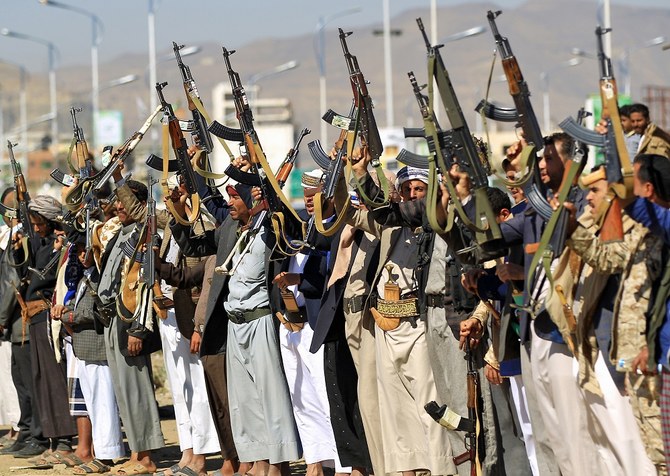
The Yemeni organization’s officials have called for the creation of an international commission to investigate reports of abuse and fatalities among Houthi detainees. (Shutterstock)
Short Url
Updated 14 December 2022
Follow

Houthis accused of torturing prisoner, concealing death from family for years

  • Omar Ahmed Al-Samae mercilessly tortured before being murdered

AL-MUKALLA: A Yemeni human rights group and relatives have accused the Iran-backed Houthis of torturing and killing a prisoner of war and then for years concealing his death from family.

The Yemeni Network for Rights and Freedoms said that Omar Ahmed Al-Samae, a Yemeni government fighter seized from a battlefield in the province of Saada in 2018, was mercilessly tortured before being murdered. The militia group later told his family that he was being held in jail.

But when his parents traveled from Taiz city to Sanaa to see their son, the Houthis escorted them to 48 Model Hospital’s mortuary and showed them his body. It was then that the relatives spotted clear signs of torture.

A medical report showed that Al-Samae had passed away on Nov. 16, 2020. However, the Houthis continued to demand money from his family to make them believe he was still alive, the rights network claimed.

In a statement, the network said: “During this time, the Houthi jail superintendent repeatedly asked the victim’s family for expenditures for their son Omar, despite the fact that Omar had died two years ago as a consequence of electric shock torture.”

The Yemeni organization’s officials have called for the creation of an international commission to investigate reports of abuse and fatalities among Houthi detainees.

The rights group recently claimed that since late 2014, the Houthis had executed 147 inmates in detention facilities, while 282 others had died while imprisoned as a result of negligence. A further 98 detainees were believed to have died within days of being released from Houthi custody.

Meanwhile, Reporters Without Borders (RSF) warned that three Yemeni journalists jailed by the Houthis could soon die after being placed in solitary confinement and tortured for weeks.

The freedom of information group said that the trio, among four journalists sentenced to death by a Houthi-run court two years ago, had been segregated from other prisoners and beaten, and it urged international mediators to assist in their release.

Jonathan Dagher, head of RSF’s Middle East desk, accused the Houthis of using the reporters as hostages to gain leverage in negotiations.

He said: “The Houthis are carrying out their death sentence slowly by torturing these journalists.

“We call on the UN special envoy for Yemen, Hans Grundberg, to do everything possible to secure their immediate release, and we call on the Houthis to follow through on their own proposal to allow UN representatives to visit these hostages and to urgently allow a medical team to come and examine them.”

Separately, in the northern province of Hajjah, an explosive-rigged drone on Monday hit a school in Hairan district, killing a child and wounding three more.

Muammar Al-Eryani, Yemen’s information minister, accused the Houthis of intentionally attacking civilian institutions as the school was not located near a military position or a battlefield.

He said the attack reaffirmed the group’s “disregard for calls and efforts for calm and peace.”


How succession works in Iran and who will be the country’s next supreme leader?

Updated 58 min 38 sec ago
Follow

How succession works in Iran and who will be the country’s next supreme leader?

  • An 88-member panel called the Assembly of Experts “must, as soon as possible” pick a new supreme leader under Iranian law

DUBAI: The death of Iran’s Supreme Leader Ayatollah Ali Khamenei after almost 37 years in power raises paramount questions about the country’s future. The contours of a complex succession process began to take shape the morning after Khamenei’s assassination.
Here is what to know:
A temporary leadership council assumes duties
As outlined in its constitution, Iran on Sunday formed a council to assume leadership duties and govern the country.
The council is made up of Iran’s sitting president, the head of the country’s judiciary and a member of the Guardian Council chosen by Iran’s Expediency Council, which advises the supreme leader and settles disputes with parliament.
Iran’s reformist President Masoud Pezeshkian and hard-line judiciary chief Gholamhossein Mohseni Ejei are its members who will step in and “temporarily assume all the duties of leadership.”
A panel of clerics selects a new supreme leader
Though the leadership council will govern in the interim, an 88-member panel called the Assembly of Experts “must, as soon as possible” pick a new supreme leader under Iranian law.
The panel consists entirely of Shiite clerics who are popularly elected every eight years and whose candidacies are approved by the Guardian Council, Iran’s constitutional watchdog. That body is known for disqualifying candidates in various elections in Iran and the Assembly of Experts is no different. The Guardian Council barred former Iranian President Hassan Rouhani, a relative moderate whose administration struck the 2015 nuclear deal with world powers, from election for the Assembly of Experts in March 2024.
Khamenei’s son could be a possible contender
Clerical deliberations about succession and machinations over it take place far from the public eye, making it hard to gauge who may be a top contender.
Previously, it was thought Khamenei’s protégé, hard-line President Ebrahim Raisi, may try to take the mantle. However, he was killed in a May 2024 helicopter crash. That has left one of Khamenei’s sons, Mojtaba, a 56-year-old Shiite cleric, as a potential candidate, though he has never held government office. But a father-to-son transfer in the case of a supreme leader could spark anger, not only among Iranians already critical of clerical rule, but also among supporters of the system. Some may see it as un-Islamic and in line with creating a new, religious dynasty after the 1979 collapse of the US-backed Shah Mohammad Reza Pahlavi’s government.
A transition like this has happened only once before
There has been only one other transfer of power in the office of supreme leader of Iran, the paramount decision-maker since the country’s 1979 Islamic Revolution.
In 1989, Grand Ayatollah Ruhollah Khomeini died at age 86 after being the figurehead of the revolution and leading Iran through its bloody eight-year war with Iraq. This transition now comes after Israel launched a 12-day war against Iran in June 2025 as well.
The vast powers of a supreme leader
The supreme leader is at the heart of Iran’s complex power-sharing Shiite theocracy and has final say over all matters of state.
He also serves as the commander-in-chief of the country’s military and the powerful Revolutionary Guard, a paramilitary force that the United States designated a terrorist organization in 2019 and which Khamenei empowered during his rule. The Guard, which has led the self-described “Axis of Resistance,” a series of militant groups and allies across the Middle East meant to counter the US and Israel, also has extensive wealth and holdings in Iran.