

Pakistan accuses India of being behind 2021 bombing outside Hafiz Saeed's home

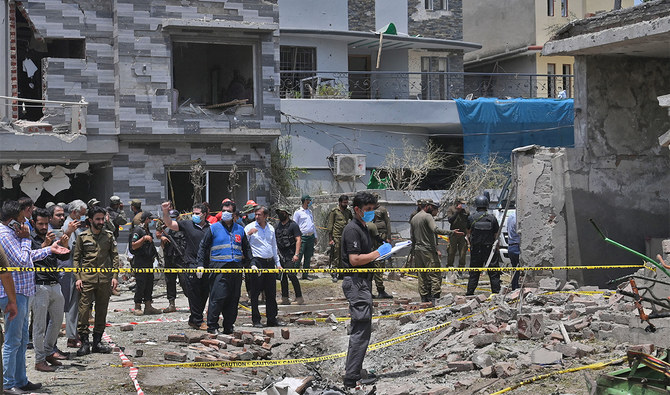
Security officials inspect the site of an explosion that killed at least three people and wounded several others in Pakistan's eastern city of Lahore on June 23, 2021. (AFP)
Short Url
Updated 13 December 2022
Follow

Pakistan accuses India of being behind 2021 bombing outside Hafiz Saeed's home

  • Interior minister says Indian intelligence agency, Research and Analysis Wing, had backed the cell involved in suicide bombing
  • A suicide bomber rammed a car into a police checkpoint just outside Hafiz Saeed's house, killing four people in Lahore in 2021

ISLAMABAD: Pakistan's interior minister accused India on Tuesday of being behind a bombing in 2021 near the house of Hafiz Saeed, the founder of a militant Islamist group blamed for a deadly 2008 attack in Mumbai.

A suicide bomber rammed a car into a police checkpoint just outside Saeed's house, killing four people in the eastern Pakistani city of Lahore in 2021. No one from his family was hurt.

"We have strong evidence that India was involved in this attack. Our forces have all the evidence that they funded it," Interior Minister Rana Sanaullah told a news conference in Islamabad.

A spokesperson for India's foreign ministry did not respond to a Reuters request for comment.

Saeed founded the Islamist group Lashkar-e-Taiba (LeT). India has accused LeT of orchestrating the 2008 attack on the country's financial capital, which killed 166 people, and says Saeed himself was the mastermind behind the assault. Saeed has denied any involvement with militancy, including the Mumbai attack.

Sanaullah said Pakistan's counter terrorism unit had recently arrested several members of a cell after finding clues to their involvement in the 2021 suicide attack. He said India's main intelligence agency, Research and Analysis Wing (RAW), had backed the group.

He did not give any more details on when the arrests took place or present any evidence to back his allegations.

A top counter-terrorism official sitting alongside him said Pakistan had traced cash transactions of more than $800,000 which were used to fund the cell. He said there was evidence showing the money came from India.

Sanaullah said Saeed was not at his home when the suicide bomber hit, but said his family might have been the target.

Saeed was arrested by Pakistan in 2019 and subsequently convicted of numerous terrorism financing charges. He is currently serving a 31-year prison term. He has never been tried for the 2008 Mumbai assault.

India has for decades accused old rival Pakistan of supporting Islamist militants in attacks on Indian targets throughout the region. Pakistan denies that and accuses India of supporting separatist rebels in Pakistan.


Customs seize narcotics, smuggled goods, vehicles worth $4.9 million in southwest Pakistan

Updated 16 December 2025
Follow

Customs seize narcotics, smuggled goods, vehicles worth $4.9 million in southwest Pakistan

  • Customs seize 22.14 kg narcotics, consignments of smuggled betel nuts, Hino trucks, auto parts, says FBR
  • Smuggled goods enter Pakistan’s Balochistan province from neighboring countries Iran and Afghanistan

ISLAMABAD: Pakistan Customs seized narcotics, smuggled goods and vehicles worth a total of Rs1.38 billion [$4.92 million] in the southwestern Balochistan province on Tuesday, the Federal Board of Revenue (FBR) said in a statement. 

Customs Enforcement Quetta seized and recovered 22.14 kilograms of narcotics and consignments of smuggled goods comprising betel nuts, Indian medicines, Chinese salt, auto parts, a ROCO vehicle and three Hino trucks in two separate operations, the FBR said. All items cost an estimated Rs1.38 billion, it added. 

Smuggled items make their way into Pakistan through southwestern Balochistan province, which borders Iran and Afghanistan. 

“These operations are part of the collectorate’s intensified enforcement drive aimed at curbing smuggling and dismantling illegal trade networks,” the FBR said. 

“All the seized narcotics, goods and vehicles have been taken into custody, and legal proceedings under the Customs Act 1969 have been formally initiated.”

In the first operation, customs officials intercepted three containers during routine checking at FEU Zariat Cross (ZC) area. The containers were being transported from Quetta to Pakistan’s Punjab and Khyber Pakhtunkhwa provinces, the FBR said. 

The vehicles intercepted included three Hino trucks. Their detailed examination led to the recovery of the smuggled goods which were concealed in the containers.

In the second operation, the staff of the Collectorate of Enforcement Customs, Quetta, intercepted a ROCO vehicle at Zariat Cross area with the local police’s assistance. 

The driver was interrogated while the vehicle was searched, the FBR said. 

“During interrogation, it was disclosed that drugs were concealed inside the spare wheel at the bottom side of the vehicle,” it said. 

“Upon thorough checking, suspected narcotics believed to be heroin was recovered which was packed in 41 packets, each weighing 0.54 kilograms.”

The narcotics weighed a total of 22.14 kilograms, with an estimated value of Rs1.23 billion in the international market, the FBR concluded. 

“The Federal Board of Revenue has commended the Customs Enforcement Quetta team for their effective action and reiterated its firm resolve to combat smuggling, illicit trade and illegal economic activities across the country,” it said.