


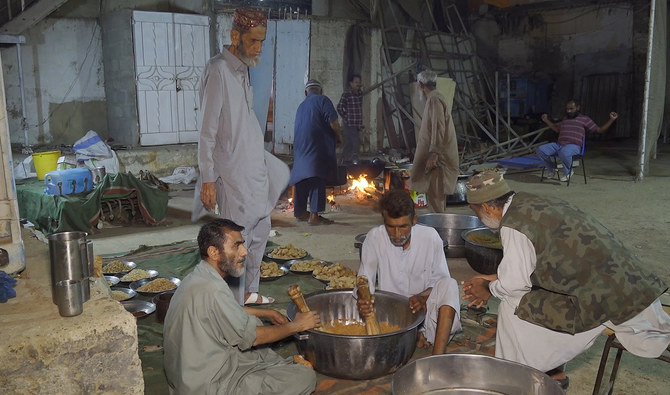
KARACHI: With the onset of every winter season, a small, close-knit community of stonemasons in the southern Pakistani city of Karachi comes together to share a special, centuries-old Rajasthani dessert called ‘churma.’ The delicacy is prepared under the supervision of Imtiaz Ali Silawat, 71, at a community hall in Ranchore Line neighborhood in the city’s downtown area.
To cook churma, doughs of flour are fried, mashed and parched in oil, before being equally distributed into several pots. It is followed by the addition of cashew nuts, pistachio, almonds, cardamom and edible gum to the mixture.
To give the delicacy a sweet taste, sugar syrup and jaggery syrup is added to it, followed by the addition of desi ghee at the end to give it a rich, exotic taste.
“This is our unique taste, these are called Halwajat and this is eaten in the winter season,” Silawat, who supervises the entire process, told Arab News over the weekend.
“Anyone who eats it is stunned as to what are they eating,” the 71-year-old said with a sense of pride.
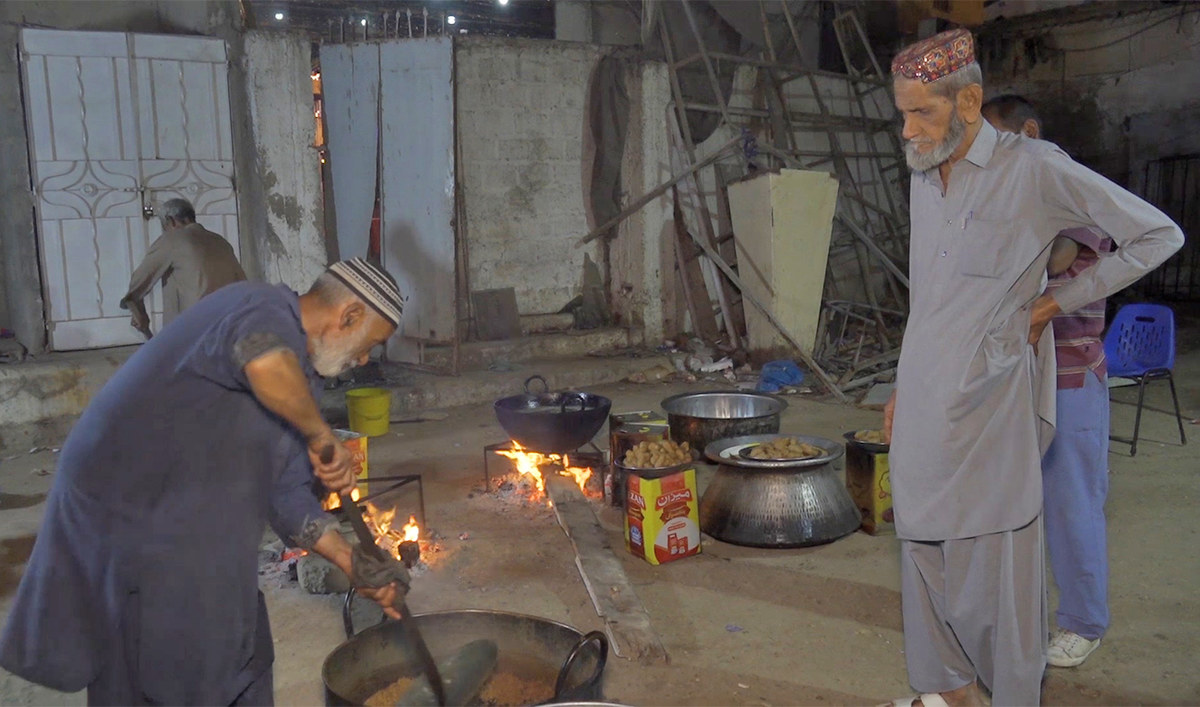
Imtiaz Ali Silawat (right), 71, oversees the making of the Rajasthani dessert called ‘churma’ in Karachi, Pakistan, on December 11, 2022. (AN Photo)
Looking for work, the Silawat community migrated from the northern Indian state of Rajasthan to Karachi some 200 years ago.
A number of Victorian era heritage buildings in the southern Pakistani metropolis reflect the craftsmanship of the community. A few of these buildings are Frere Hall, Sindh High Court, Merewether Clock Tower, Empress Market, Karachi Port Trust, Radio Pakistan, Dayaram Jethamal (DJ) College, Narayan Jagannath Vaidya (NJV) School and the Karachi Metropolitan Corporation.
The close-knit community of roughly 30,000 no longer constructs buildings, but it does pride itself with speaking the Marwari language and cooking traditional cuisines.
“[Making the Rajasthani churma] is our centuries-old tradition. Our ancestors would prepare it. After their generation passed away, [the recipe] has been in my hands for the last 45 years and I have been preparing it,” Silawat told Arab News as he instructed a team of chefs preparing churma.
“I have trained other workers [chefs] so if I am no more, it will continue for the coming generations.”
While the recipe has been passed on from generation to generation, Silawat has added his own touch to the delicacy by adding more dry fruits to the mixture.
“Not that many [dry] fruits were there [in the original recipe], but we have added them. Now, we add [dry] fruits like cashew nuts, according to the weather.”
Wali Muhammad, a 65-year-old Silawat community chef, said preparing churma required precision as a minor mistake could spoil its taste.
“[All ingredients] have to be added, if you will not [add] them, it will not create the [same] taste,” he told Arab News.
“If you would remove it [from the stove] half-cooked, it would not create that taste. We have to see it when it’s prepared and when [one] has to put in anything, otherwise, it will lose the taste.”
Once prepared with a labor of whole day and night, churma is sold to people who book it in advance at a nominal price of Rs620 ($2.75) per kilogram.
Silawat says he could earn money from the high-quality dessert by selling it at a higher price, but making churma is not a business for him, but it is his passion to pass on the recipe to others.
He said some members of the Silawat community also gift the delicacy to people of other communities: “If we want, we can sell it for Rs2,000 [per kilogram], but this is our ‘saughaat’ (gift).”


