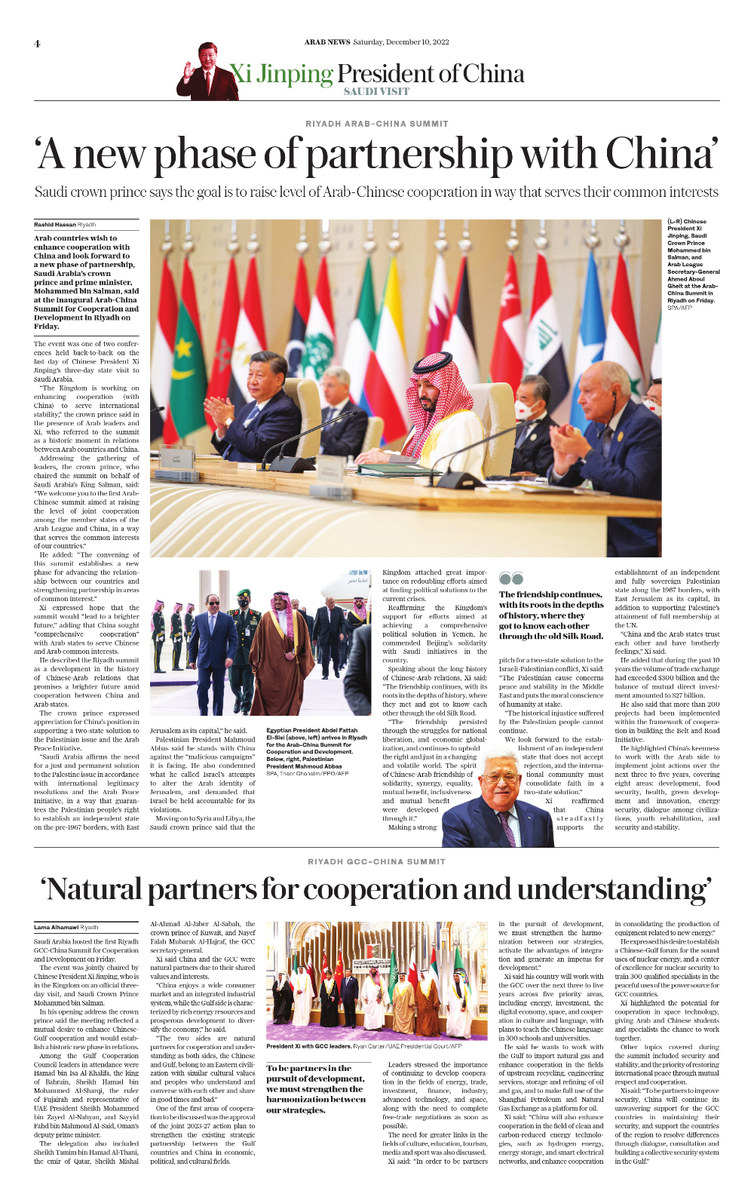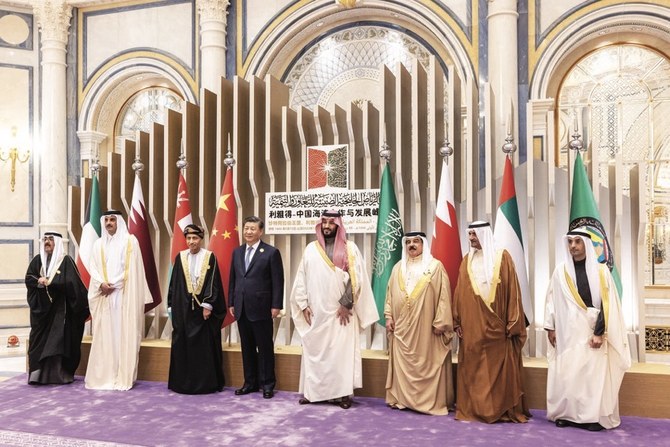

RIYADH: Saudi Arabia hosted the first Riyadh Gulf Cooperation Council-China Summit for Cooperation and Development on Friday.
The event was jointly chaired by Chinese President Xi Jinping, who ws in the Kingdom on a three-day state visit, and Saudi Arabia’s Crown Prince and Prime Minister Mohammed bin Salman.
In his opening address, the crown prince said the meeting reflected a mutual desire to enhance Chinese-Gulf cooperation and would establish a historic new phase in relations.
Among the GCC leaders in attendance were King Hamad bin Isa Al-Khalifa of Bahrain; Sheikh Hamad bin Mohammed Al-Sharqi, the ruler of Fujairah and representative of UAE President Sheikh Mohamed bin Zayed Al-Nahyan; and Sayyid Fahd bin Mahmoud Al-Said, Oman’s deputy prime minister.

Xi said his country will work with the GCC over the next three to five years across five priority areas. (SPA)
The delegation also included Sheikh Tamim bin Hamad Al-Thani, the emir of Qatar; Sheikh Mishal Al-Ahmad Al-Jaber Al-Sabah, the crown prince of Kuwait; and Nayef Falah Mubarak Al-Hajraf, the GCC secretary-general.
Xi said China and the GCC were natural partners due to their shared values and interests.
He added: “For more than 40 years the two sides have written impressive chapters of solidarity, support, and joint cooperation.
“China enjoys a wide consumer market and an integrated industrial system, while the Gulf side is characterized by rich energy resources and prosperous development to diversify the economy.
“The two sides are natural partners for cooperation and understanding as both sides, the Chinese and Gulf, belong to an Eastern civilization with similar cultural values and peoples who understand and converse with each other and share in good times and bad.”
One of the first areas of cooperation to be discussed was the approval of the joint 2023-27 action plan to strengthen the existing strategic partnership between the Gulf countries and China in economic, political, and cultural fields.
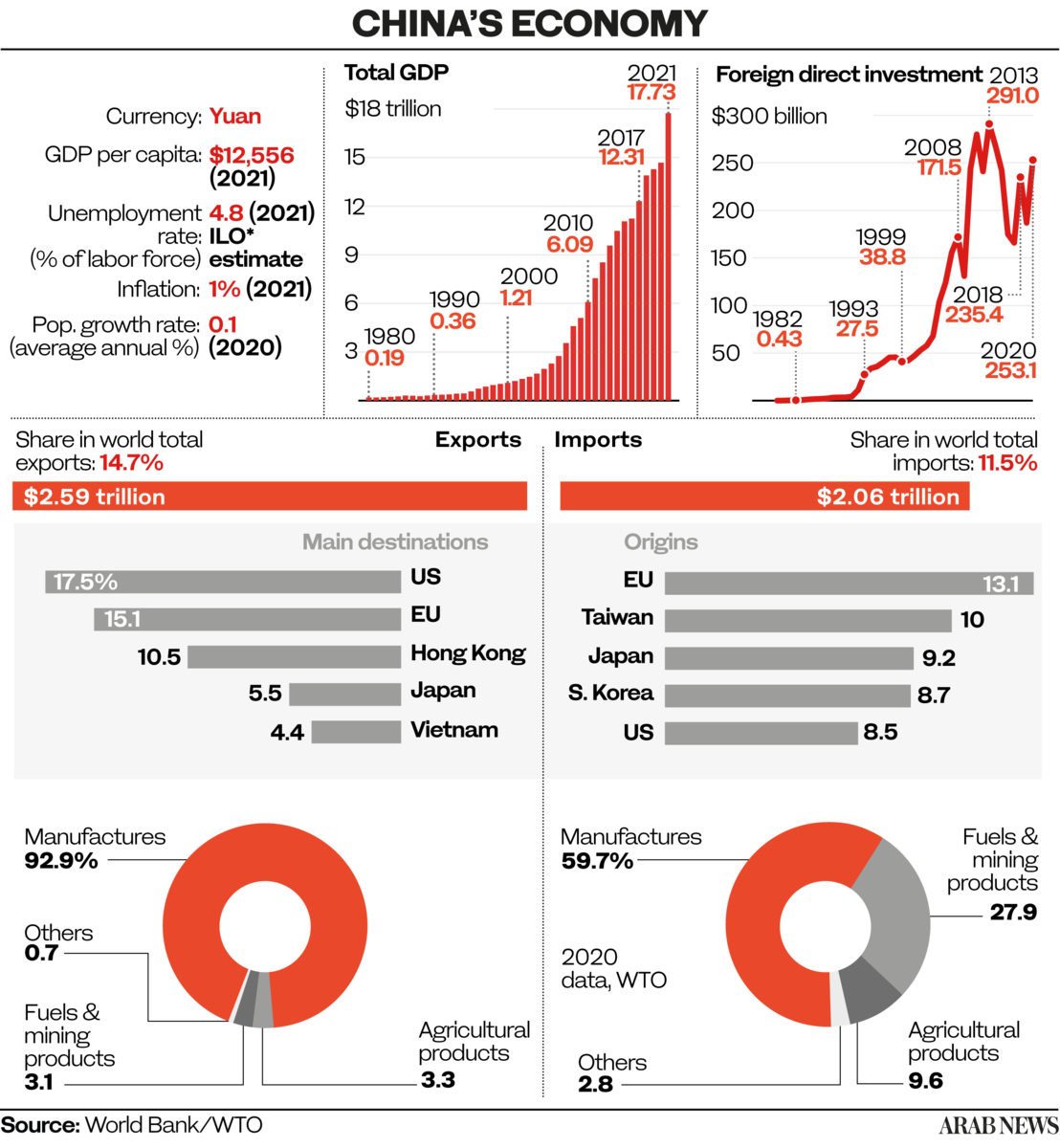
The volume of trade between the GCC states and China reached $228.9 billion in 2021 — a big leap from the $148.2 billion recorded in the previous year.
Leaders stressed the importance of continuing to develop cooperation in the fields of energy, trade, investment, finance, industry, advanced technology and space, along with the need to complete free trade negotiations as soon as possible.
The need for greater links in the fields of culture, education, tourism, media, and sport was also discussed.
Xi added: “In order to be partners in the pursuit of development, we must strengthen the harmonization between our strategies, activate the advantages of integration and generate an impetus for development.”
Xi said his country will work with the GCC over the next three to five years across five priority areas, including energy, investment, the digital economy, space, and cooperation in culture and language, with plans to teach the Chinese language in 300 schools and universities.
He said he wants to work with the Gulf to import natural gas and enhance cooperation in the fields of upstream recycling, engineering services, storage and refining of oil and gas, and to make full use of the Shanghai Petroleum and Natural Gas Exchange as a platform for oil.
Xi said: “China will also enhance cooperation in the field of clean and carbon-reduced energy technologies, such as hydrogen energy, energy storage, and smart electrical networks, and enhance cooperation in consolidating the production of equipment related to new energy.”
He expressed his desire to establish a Chinese-Gulf forum for the sound uses of nuclear energy, and a center of excellence for nuclear security to train 300 qualified specialists in the peaceful uses of the power source for the GCC countries.

The event was jointly chaired by Chinese President Xi Jinping, who ws in the Kingdom on a three-day state visit, and Saudi Arabia’s Crown Prince and Prime Minister Mohammed bin Salman. (SPA)
Xi highlighted the potential for cooperation in space technology, giving Arab and Chinese students and specialists the chance to work together.
“Chinese foreign relations are distinguished by a long history and a promising future,” he said.
Other topics covered during the summit were security and stability, and the priority of restoring international peace through mutual respect and cooperation.
Xi said: “To be partners to improve security, China will continue its unwavering support for the GCC countries in maintaining their security, and support the countries of the region to resolve differences through dialogue, consultation and building a collective security system in the Gulf.
“China welcomes the GCC countries to participate in the global security initiative in order to maintain peace and stability in the region with joint efforts, and to be partners for the advancement of civilization.
“Then we must strengthen the rapprochement among our peoples, diversify human and cultural communication, benefit from the distinguished cultural fruits on both sides, and strengthen the jewel of Eastern civilization, which provides a positive contribution to the development and progress of human civilization.”
Bahrain’s King Hamad expressed his gratitude to King Salman for his invitation to participate in the summit.
He said it reflected “the keenness of the GCC countries, brotherly Arab countries, and the friendly People’s Republic of China to intensify cooperation and joint coordination in various fields, for the benefit and good of our countries and the whole world.”
Al-Hajraf said President Xi’s visit to Saudi Arabia represented an important opportunity to address issues of common interest, build on countries’ relations, and enhance cooperation in energy, investment, the economy, and development.