

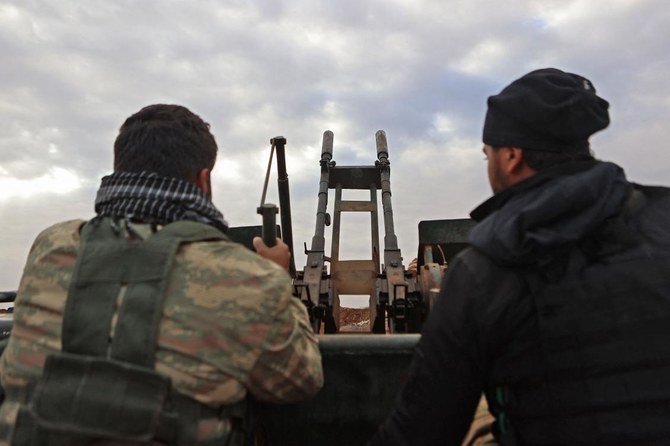
US-led forces resume normal patrols in Syria

The Syrian Democratic Forces has long warned that fighting off new Turkish incursion would divert resources away from targeting Daesh sleeper cells. (AFP)
Short Url
Updated 03 December 2022
Follow

US-led forces resume normal patrols in Syria

  • They were reduced after Turkish strikes that began on Nov. 20 in Kurdish-controlled areas

JEDDAH: A US-led coalition fighting terrorists resumed regular patrols in Kurdish-held areas of northeast Syria on Friday after earlier Turkish airstrikes.

Patrols were reduced following the Turkish strikes that began on Nov. 20 in Kurdish-controlled areas of Syria and Iraq, in response to a deadly Istanbul bombing that Ankara blamed on Kurdish groups.

Hundreds of American troops are in Syria as part of the fight against remnants of Daesh.

Two four-vehicle patrols bearing US flags set off separately from a base in Rmeilan in Hasakah province. A vehicle belonging to the Kurdish-led Syrian Democratic Forces accompanied each convoy, which traveled in different directions toward Syria’s borders.

The usual 20 weekly patrols had dropped to around five or six following the Turkish strikes.

The US supports the SDF, which is the Kurds’ de facto army in the area, and led the battle that dislodged Daesh from the last scraps of their Syrian territory in 2019.

FASTFACT

US Defense Secretary Lloyd Austin told his Turkish counterpart on Wednesday that Washington was in ‘strong opposition to a new Turkish military operation in Syria.’

Turkiye said it struck targets of the Syrian Kurdish People’s Protection Units, which dominate the SDF but which Ankara sees as an offshoot of the Kurdistan Workers’ Party.

The Syrian Observatory for Human Rights, a Britain-based war monitor with a vast network of sources on the ground, said patrols were also seen on Friday in Deir Ezzor province further south.

The SDF has long warned that fighting off a new Turkish incursion would divert resources away from protecting a prison holding Daesh fighters or fighting Daesh sleeper cells still waging hit-and-run attacks in Syria.

Sheikhmous Ahmed, the head of the displacement department in Syria’s northeast, said that Turkish raids in late November had disrupted operations in and around Al-Hol, a detention camp where women and children affiliated with Daesh fighters are held.


Secrecy, mines and Israeli strikes complicate removal of Assad-era chemical weapons, says Syrian envoy

Updated 7 sec ago
Follow

Secrecy, mines and Israeli strikes complicate removal of Assad-era chemical weapons, says Syrian envoy

  • Nevertheless, new authorities made significant progress in their work with Organization for the Prohibition of Chemical Weapons, he tells UN Security Council
  • Syrian authorities grant OPCW experts unrestricted access to 23 sites and since October have been hosting the organization’s longest continuous presence in the country

NEW YORK CITY: Syria’s envoy to the UN said on Thursday that secrecy surrounding the nation’s former chemical weapons program, security risks from land mines and other unexploded ordnance, and Israel’s targeting of suspected weapons sites continue to complicate his government’s efforts to eliminate Assad-era chemical weapons.
Speaking at a UN Security Council meeting about Syria’s chemical weapons, Ambassador Ibrahim Olabi said the nation’s new authorities had nevertheless made significant progress over the past year in their work with the Organization for the Prohibition of Chemical Weapons.
Despite what he described as “major challenges,” Syria had moved the issue “from a stage of suspicion and manipulation to one of partnership with the OPCW,” he said, adding: “Syria has achieved a qualitative leap in its cooperation with the OPCW.”
This shift is reflected in recent decisions by the watchdog’s executive council and changing positions among its member states, Olabi noted.
Syria’s chemical weapons program has been under international scrutiny since the early years of the country’s civil war, when repeated chemical attacks killed or injured large numbers of civilians. The deadliest incident occurred in 2013 in the Damascus suburb of Eastern Ghouta, when a sarin attack killed hundreds and triggered international efforts to dismantle the country’s chemical arsenal.
Olabi said the authorities that took over after President Bashar Assad and his regime were toppled in December 2024 were confronting what he called the “heavy legacy of the Assad era,” during which chemical weapons were widely used against civilians. He described the program as an inherited burden rather than a policy of the new government.
“The chemical file is a prime example of these inherited issues, issues of which we were victims,” he added.
Syrian authorities have granted OPCW experts unrestricted access during eight deployments that included visits to 23 sites, he said, and since October have been hosting what he described as the organization’s longest continuous presence in the country.
“This marks the beginning of a sustained presence of the OPCW in Syria,” Olabi added.
Adedeji Ebo, the UN’s deputy high representative for disarmament affairs, said OPCW teams visited 19 locations in Syria last year, four of them previously declared chemical weapons sites and 15 suspected locations, where they conducted interviews and collected samples in their attempts to determine the full scope of undeclared chemical weapons activity.
Some other sites are in dangerous areas, he added, which poses significant risks to both Syrian and international personnel.
“On-site destruction may be required where conditions prevent safe removal,” Ebo said, noting that a recent OPCW decision authorizing expedited on-site destruction of weapons marked a positive step forward.
He also highlighted the reestablishment of Syria’s National Authority for the OPCW and the watchdog’s current, continuous presence in Damascus.
Olabi said Syrian national teams had identified two sites containing empty cylinders previously used to store toxic chemicals and had immediately reported them to the OPCW. Syrian authorities also handed over about 6,000 documents relating to the former regime’s chemical weapons program, he added, and helped arrange interviews with 14 witnesses, including individuals who were involved with the program.
Syrian authorities were also cooperating with international investigators examining chemical attacks by Assad’s government, he said, and accountability and justice for the victims are priorities for the new authorities.
“Syria reiterates its determination to continue the efforts to close this chapter,” Olabi said, adding that there was “no place for chemical weapons in today’s world.”