

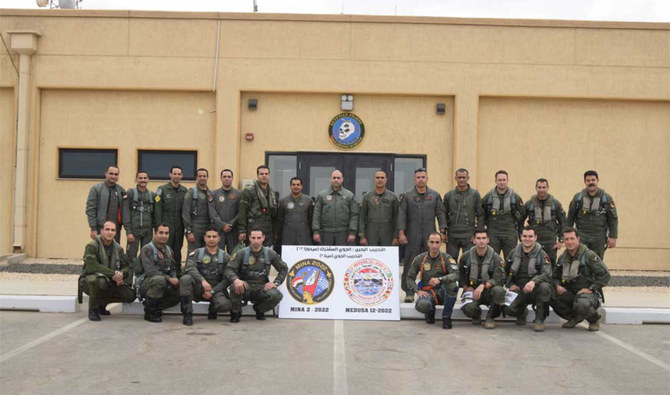
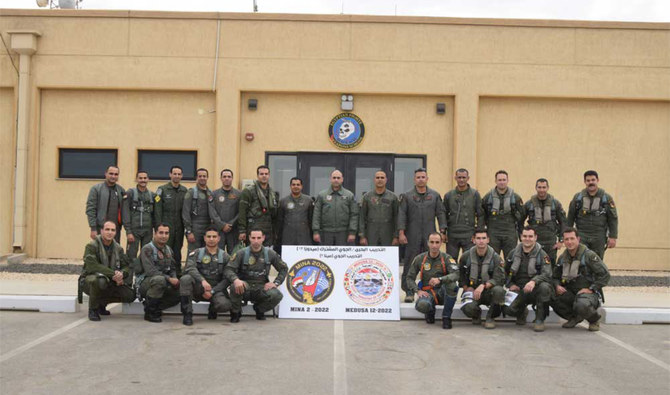
Egypt, Greece carry out joint air exercise MENA-II

1 / 2
The exercise comes within the framework of supporting and strengthening military cooperation relations with friendly and brotherly countries. (Egypt’s Defense Ministry)
2 / 2
(Egypt’s Defense Ministry)
Short Url
Updated 02 December 2022
Follow

Egypt, Greece carry out joint air exercise MENA-II

CAIRO: The Egyptian and Greek air forces carried out the joint air exercise MENA-II with the participation of multirole combat aircraft.

The exercise comes within the framework of supporting and strengthening military cooperation relations with friendly and brotherly countries, said Egyptian military spokesman Gharib Abdel-Hafez.

The training included the implementation of a number of theoretical lectures to unify concepts, refine skills, and coordinate the management of joint operations in various methods of modern air combat.

Multirole fighters from both sides carried out joint sorties to train in attacking hostile targets and defending vital assets efficiently.

The training showed the extent to which the participating personnel have reached a high level of professionalism in carrying out all tasks, Abdel-Hafez said. 

The training “reflects the extent to which the air forces of both countries possess advanced human and technical capabilities that qualify them for joint action under various circumstances,” he added.

According to the Egyptian military, the training is an extension of a series of joint exercises being conducted in light of the Egyptian and Greek armed forces’ growing partnership and military cooperation in a variety of fields.

The MEDUSA-12 drills lasted several days in the Mediterranean Sea last month, and forces from Cyprus, Saudi Arabia, and the US took part.

Observers from the UAE, Bahrain, Jordan, Germany, France, Romania, Congo, and Morocco were also present.

In August, Egyptian and Greek naval forces engaged in a joint exercise in the Mediterranean, within the range of the Egyptian Northern Fleet.

According to the Egyptian military, the drills contributed to exchanging joint experiences with Greek naval forces, and helped both sides achieve common aims and maintain maritime security and stability in the region.


WHO says Dubai global emergency logistics hub ‘resuming operations’

Updated 5 sec ago
Follow

WHO says Dubai global emergency logistics hub ‘resuming operations’

  • Hanan Balkhy, WHO’s Eastern Mediterranean regional chief, says more than 50 emergency supply requests across 25 countries are affected by the pause
  • The hub stopped work this week after Iran launched waves of missile and drone attacks across the Gulf
GENEVA: The World Health Organization said its global health emergencies logistics hub in Dubai was resuming operations on Friday after a pause caused by the war in the Middle East.
“One of our most immediate concerns is the disruption of humanitarian health supply chains,” Hanan Balkhy, the UN health agency’s Eastern Mediterranean regional chief, told a press conference in Geneva.
“After a temporary pause, WHO’s Hub for Global Health Emergencies Logistics is today resuming operations,” she said, speaking from Cairo.
She said the UAE, in coordination with the UN’s World Food Programme, had confirmed that it stood ready to facilitate urgent humanitarian shipments.
“More than 50 emergency supply requests across 25 countries are currently affected,” said Balkhy.
“These pending requests — which will benefit more than 1.5 million people — include WHO supplies for Lebanon, Gaza, Yemen, and Somalia, as well as polio laboratory supplies for global detection and eradication activities across a number of countries.”
She said the WHO would be working in the coming days to process urgent new shipments and clear priority backlogs.
Balkhy noted that even before the escalation of hostilities in the Middle East, health systems in many countries were already operating at full capacity.
“WHO has pre-positioned trauma supplies and essential medicines at our warehouse in Tehran and is closely monitoring the situation — including potential mass casualty needs, disruptions to essential health services, and possible displacement,” she said.