Four dead as bomber hits Pakistan police protecting polio teams

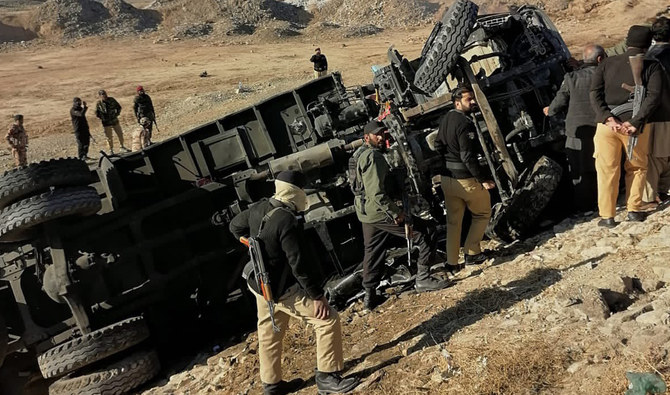
Police inspect a site around a damaged police van following a suicide bombing near Baleli Customs on November 30, 2022. (Photo courtesy: Balochistan police)
Short Url
Updated 30 November 2022
Follow

Four dead as bomber hits Pakistan police protecting polio teams

  • Suicide bomber blew himself up near a truck carrying police officers on their way to protect polio workers
  • Dead included a police officer and three civilians from the same family who was traveling nearby in a car

QUETTA: A suicide bomber blew himself up near a truck carrying police officers on their way to protect polio workers near Quetta Wednesday, killing a police officer and three civilians from the same family who was traveling nearby in a car. The bombing also wounded 23 others, mostly policemen, officials said.

Ghulam Azfer Mehser, a senior police officer, said the attack happened as the policemen were heading to the polio workers, part of a nationwide vaccination drive launched Monday.

The blast was so powerful that it toppled the truck carrying police officers into a ravine, he said, adding that the bombing also damaged a nearby car carrying members of a family.

He said that the anti-polio campaign will continue even after the bombing.

Pakistani President Arif Alvi, Prime Minister Shahbaz Sharif and other officials in separate statements condemned the attack. It came a day after Pakistani Deputy Foreign Minister Hina Rabbani Khan traveled to Kabul to discuss a range of issues with the Afghan Taliban, including the latest threat from the local Taliban.
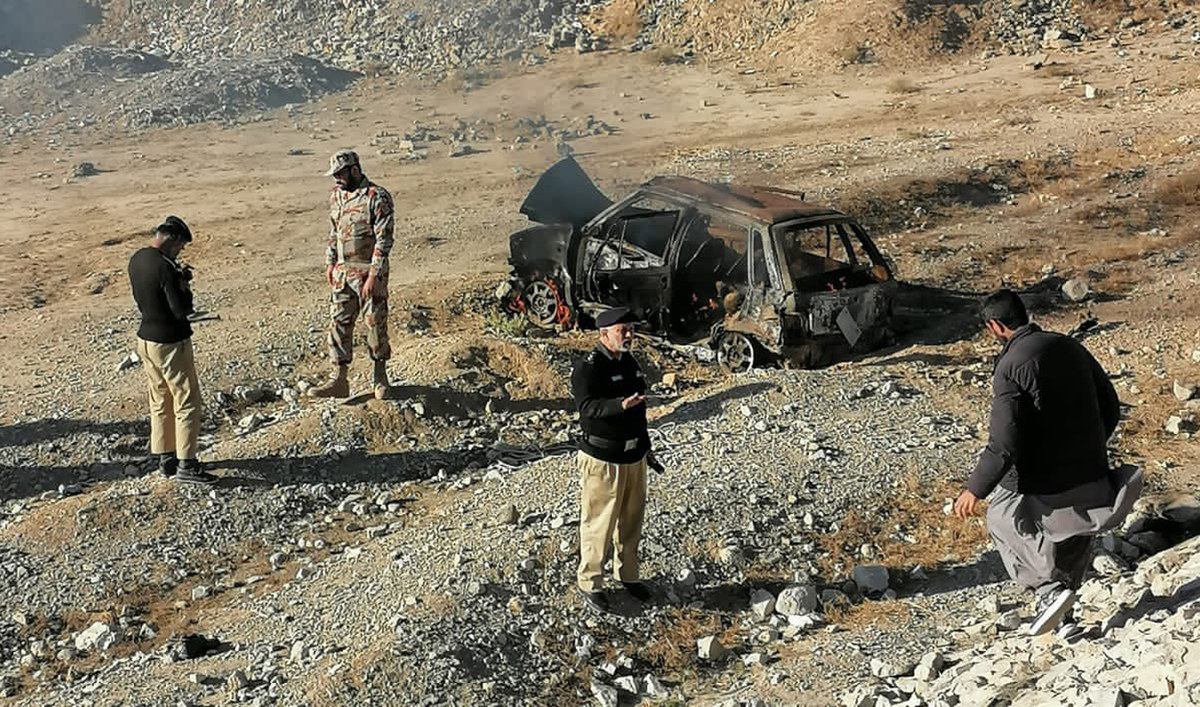


Security officials inspect the site after a bomb blast in Baleli on November 30, 2022. (Photo courtesy: Balochistan police)

Pakistan wants Afghanistan’s Taliban not to allow the Pakistani militants to use their soil to launch attacks inside this Islamic nation, which has witnessed scores of attacks. Most have been blamed on the Pakistani Taliban, who in a statement claimed responsibility for the bombing in Balochistan on Wednesday.

The Tehreek-e-Taliban Pakistan group, or TTP, said the attack in Balochistan targeted police to avenge the killing of their former spokesperson, Abdul Wali. He was widely known as Omar Khalid Khurasani and was killed in a bombing in Afghanistan’s Paktika province in August. His death was a heavy blow to the group.

The attack on police came amid a spike in new polio cases among children. The latest vaccination campaign is the sixth such drive this year and will last for five days, aiming to inoculate children under the age of 5 in high-risk areas.

The drive is aimed at Islamabad and in the high-risk districts in eastern Punjab and southwestern Balochistan province, where Monday’s attack took place. It killed at least two people, including a police officer and a child. A similar campaign will be launched in the northwest in the first week of December.

Pakistani authorities have been launching such campaigns regularly despite attacks on workers and police assigned to inoculation drives.

Militants falsely claim that vaccination campaigns are a Western conspiracy to sterilize children. Since April, Pakistan has registered 20 new polio cases, which can cause severe paralysis in children.

Pakistan came close to eradicating polio last year, when only one case was reported.

Currently, Pakistan and Afghanistan are the last two countries in which polio has not been eliminated.

Wednesday’s bombing happened two days after The Pakistani Taliban ended a monthslong cease-fire with the government in Islamabad, ordering its fighters to resume attacks across the country, where scores of deadly attacks have been blamed on the insurgent group. In Monday’s statement, the outlawed TTP group said it would end the five-month cease-fire after the army stepped up operations against the TTP.
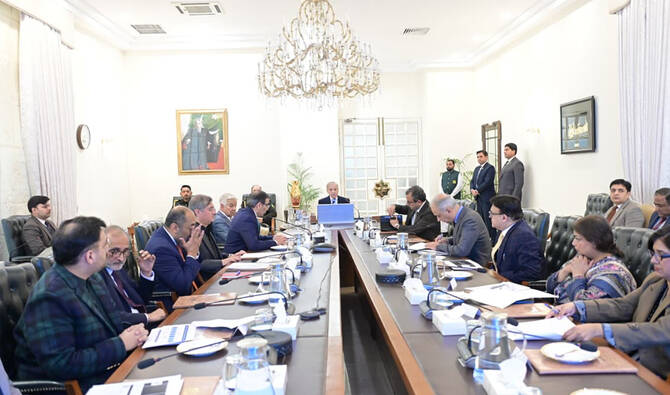


Pakistan PM calls privatization top priority, discusses selling power firms after PIA stake sale

Updated 7 sec ago
Follow

Pakistan PM calls privatization top priority, discusses selling power firms after PIA stake sale

  • Government plans to privatize five electricity distributors as part of IMF-backed economic reforms
  • Last year, a consortium led by Arif Habib Group won the bid for a 75 percent controlling stake in PIA

ISLAMABAD: Prime Minister Shehbaz Sharif described the privatization of state-owned enterprises (SOEs) as his administration's top priority on Tuesday, as he discussed the sale of loss-making power distribution companies after the government successfully divested a 75 percent stake in Pakistan International Airlines (PIA) in December.

The push to privatize power utilities follows the government’s efforts to restructure and offload state firms under broader economic reforms recommended by the International Monetary Fund (IMF) under a $7 billion loan program with Pakistan.

The IMF has repeatedly urged Islamabad to reduce fiscal losses by privatizing or restructuring chronically loss-making SOEs.

“Privatization of loss-making state-owned enterprises is among the government’s top priorities,” the prime minister said, according to a statement released by his office after a meeting on privatization. “The successful privatization of 75 percent shares of PIA is the first drop of rain.”

Last month, a consortium led by the Arif Habib Group won the bid for a 75 percent controlling stake in the national flag carrier, offering Rs 135 billion ($482 million) in a transaction the government described as a milestone in its privatization drive.

Building on that momentum, officials said the Privatization Commission plans to divest electricity distribution companies in two batches. The first phase will include Islamabad Electric Supply Company, Gujranwala Electric Power Company and Faisalabad Electric Supply Company, followed by Hyderabad Electric Supply Company and Sukkur Electric Power Company in the second batch.

Prime Minister Shehbaz Sharif also directed the commission to accelerate digitalization and strengthen its public relations and marketing functions to improve transparency, governance and engagement with investors, according to the statement.

The power sector has long been a drain on public finances due to high losses, inefficiencies and mounting subsidies, making it a central focus of Pakistan’s reform agenda under the IMF program.

Prior to the PIA sale, the United Arab Emirates-based International Holding Company acquired a majority stake in First Women Bank Limited under a government-to-government privatization deal.

That transaction was finalized in October 2025, with Pakistani and UAE officials attending the signing ceremony.