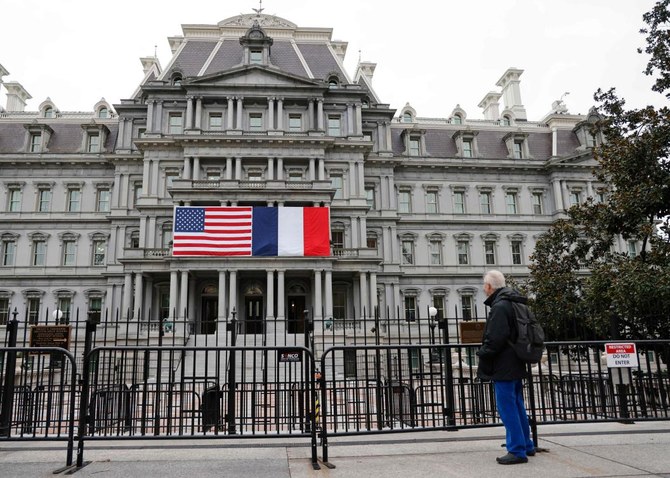
WASHINGTON: French President Emmanuel Macron was set to arrive in Washington Tuesday for a rare state visit hosted by Joe Biden, but hard-nosed disagreements about US-EU trade will loom over the pomp and ceremony at the White House.
Due to Covid delays, this is the first formal state visit of Biden’s presidency and US officials say the choice of France for the honor reflects both deep historical ties and their intense current partnership in confronting Russia over its war in Ukraine.
Biden will host Macron with a full ceremonial military welcome, a poignant visit to Arlington National Cemetery, an Oval Office sit down, a private dinner with their spouses Wednesday and the state banquet on Thursday, where Grammy-award winning American musician Jon Batiste will perform.
Compared to Macron’s edgy first experience of a state visit as the guest of Donald Trump in 2018, this trip — concluding with a stop Friday to the once-French city of New Orleans — will be a carefully choreographed display of transatlantic friendship.
Certainly the diplomatic furor that erupted last year when Australia canceled a deal for French submarines and instead signed up for US nuclear subs is now buried.
But even with little risk of Trump-style fireworks, Macron has major grievances to air.
Top of these is tension over Biden’s signature green industry policy, the Inflation Reduction Act, or IRA, which will pump billions of dollars into climate-friendly technologies, with strong backing for American-made products.
Europeans fear an unfair US advantage in the rapidly emerging sector just as they are reeling from the economic consequences of the Ukraine war and Western attempts to end reliance on Russian energy supplies.
Talk in Europe is now increasingly on whether the bloc should respond with its own subsidies for homegrown products, effectively starting a trade war.
“China favors its own products, America favors its own products. It might be time for Europe to favor its own products,” French Finance Minister Bruno Le Maire told France 3 radio on Sunday.
Martin Quencez, deputy director of the Paris office of think-tank GMF, said Macron will tell Biden “there’s a contradiction between an administration that constantly talks of alliances... and at the same time takes a decision like the IRA that will impact allies’ economies.”
Another gripe in Europe is the high cost for US liquid natural gas exports — surged to try and replace canceled Russian deliveries.
Responding to accusations that the United States is effectively profiteering from the Ukraine war, a senior US administration official said this was a “false claim.”
The official also played down IRA-related tensions, saying a “very constructive set of conversations” is underway on how to prevent European companies from being shut out.
To underline the importance of the issue for Paris, Macron met with dozens of business executives ahead of his departure to Washington, urging them to keep investing in France. These included representatives from US giants Goldman Sachs and McDonald’s.
The breadth of Macron’s entourage — including the foreign, defense and finance ministers, as well as business leaders and astronauts — illustrates the importance Paris has put on the visit.
However, at the White House, a senior official said the main goal is to nurture the “personal relationship, the alliance relationship” with France — and between Biden and Macron.
That more modest sounding goal will include improving coordination on helping Ukraine to repel Russia and the even more vexing question of how to manage the rise of the Chinese superpower.
“We are not allies on the same page,” one adviser to Macron told AFP, forecasting “challenging” talks with Biden.
Despite his strong support for Kyiv, Macron’s insistence on continuing to maintain dialogue with Russian President Vladimir Putin has irked American diplomats.
The China question — with Washington pursuing a more hawkish tone and EU powers trying to find a middle ground — is unlikely to see much progress.
“Europe has since 2018 its own, unique strategy for relations with China,” tweeted French embassy spokesman Pascal Confavreux in Washington.
A senior US official said even if their approaches were “not identical,” they should be at least “speaking from a common script.”


![]()

Trade tensions overshadow Macron’s showy White House visit
Short Url
https://arab.news/cg5nx
Trade tensions overshadow Macron’s showy White House visit
- This is the first formal state visit of Biden’s presidency and US officials say the choice of France reflects both deep historical ties and their intense current partnership in confronting Russia
- The breadth of Macron’s entourage — including the foreign, defense and finance ministers, as well as business leaders and astronauts — illustrates the importance Paris has put on the visit


Latest updates


© 2026 SAUDI RESEARCH & PUBLISHING COMPANY, All Rights Reserved And subject to Terms of Use Agreement.