

Number of Muslims in UK up 44% in a decade

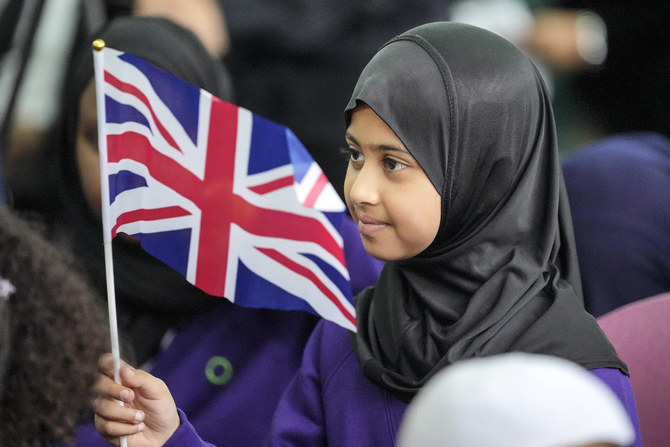
Of the UK’s total population, 6.5 percent — 3.9 million people — are adherents of Islam. (File/AP)
Short Url
Updated 29 November 2022
Follow

Number of Muslims in UK up 44% in a decade

  • Latest census shows 6.5% of population are adherents of Islam
  • Second most common ethnic group is “Asian, Asian British or Asian Welsh”

LONDON: The Muslim population of the UK has risen 44 percent in a decade, according to the latest census figures published by the Office for National Statistics. Of the country’s total population, 6.5 percent — 3.9 million people — are adherents of Islam.

Meanwhile, the second most common ethnic group in the UK is now “Asian, Asian British or Asian Welsh,” making up 9.3 percent of the population.

In figures showing that the UK has diversified apace since the last census in 2011, London is now two-thirds ethnic minority, while other major cities such as Leicester, Luton and Birmingham have become home to “minority majorities,” driven by significant increases in Asian communities from Pakistan, Bangladesh, India and East Africa.

The census is a survey of trends across the UK that is undertaken every 10 years to provide as accurate a picture of the makeup of the country as possible.

The 2021 census found that around 10 percent of UK households now contain members from at least two different ethnic groups, an increase of 8.7 percent.

It also found that Punjabi and Urdu have become the fifth and sixth most common languages spoken in the UK, with 291,000 and 270,000 speakers respectively, making up around 1 percent of the total population.

The deputy director of the census, Jon Wroth-Smith, said: “Today’s data highlights the increasingly multicultural society we live in. The percentage of people identifying their ethnic group as ‘White: English, Welsh, Scottish, Northern Irish or British,’ continues to decrease. Whilst this remains the most common response to the ethnic group question, the number of people identifying with another ethnic group continues to increase.

“However, the picture varies depending on where you live. London remains the most ethnically diverse region of England, where just under two-thirds identify with an ethnic minority group, whereas under one in 10 identify this way in the North East.

“But despite the ethnically diverse nature of society, nine in 10 people across England and Wales still identify with a UK national identity, with nearly eight in 10 doing so in London.”


Row erupts in UK over support for British-Egyptian activist Alaa Abd El-Fattah

Updated 54 min 52 sec ago
Follow

Row erupts in UK over support for British-Egyptian activist Alaa Abd El-Fattah

  • Arab Spring campaigner’s ‘abhorrent’ social media posts resurface after he arrived in Britain following release from Egyptian prison
  • PM Starmer criticized for glowing welcome to activist who had previously been supported by both Tory and Labour governments

LONDON: The UK prime minister is facing criticism after he celebrated the return to Britain of a human rights activist who was recently released from an Egyptian prison but whose past social media posts apparently contained violent and antisemitic language.
Successive British governments have campaigned for the release of Alaa Abd El-Fattah, a dual national who had been imprisoned in Egypt for most of the past 14 years. He returned to the UK on Friday after Egyptian authorities lifted a travel ban that had forced him to remain in the country since he was freed in September.
But a senior member of the opposition Conservative Party on Saturday criticized Prime Minister Keir Starmer for giving a “personal, public endorsement” to Abd El-Fattah when Starmer said he was “delighted” the activist had been reunited with his family in Britain.
Robert Jenrick, the Conservative spokesman on justice issues, demanded to know whether Starmer knew about historical social media posts in which Abd El-Fattah allegedly endorsed killing “Zionists’’ and police. Jenrick also called on Starmer to condemn Abd El-Fattah’s statements and withdraw his “unalloyed endorsement” of the activist.
“Nobody should be imprisoned arbitrarily nor for peaceful dissent,’’ Jenrick wrote. “But neither should the prime minister place the authority of his office behind someone whose own words cross into the language of racism and bloodshed.”
The Foreign, Commonwealth and Development Office said in a statement that it had been “a long-standing priority” of governments under both major parties to work for Abd El-Fattah’s release. But that does not imply an endorsement of his social media posts, the spokesman said.
“The government condemns Mr. El-Fattah’s historic tweets and considers them to be abhorrent,” the statement said, using a slightly different style for his last name.
Abd El-Fattah’s family in the UK had vigorously campaigned for his release, arguing that he had spent most of the past 14 years behind bars because of his opposition to the government of President Abdel-Fattah El-Sisi.
His mother, Laila Soueif, 69, staged a 10-month hunger strike to pressure British authorities to do more to secure her son’s release.
Starmer on Friday paid tribute to Abd El-Fattah’s family and all the others who campaigned for his freedom.
“I’m delighted that Alaa Abd El-Fattah is back in the UK and has been reunited with his loved ones, who must be feeling profound relief,” Starmer said.
But soon after Abd El-Fattah arrived at London’s Heathrow Airport, critics began circulating historical social media posts in which he appeared to endorse the killing of Zionists and police.
The Times of London reported that Abd El-Fattah has previously said the comments were taken out of context and were part of a “private conversation” that took place during an Israeli offensive in the Gaza Strip.
Abd El-Fattah’s press team didn’t immediately response to a request for comment, and it was not immediately clear whether the posts were authentic.