

Lebanon’s courthouses suffer from judicial paralysis

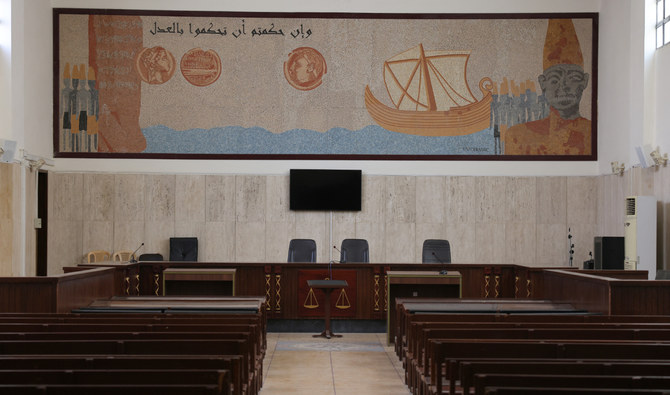
A picture shows an empty court room in Lebanon's Justice Palace in Beirut on August 30, 2022. (AFP/File)
Short Url
Updated 28 November 2022
Follow

Lebanon’s courthouses suffer from judicial paralysis

  • Judges’ suspension of work has damaged public trust in system, lawyers and security official say

BEIRUT: Lebanon’s courthouses are paralysed after the country’s judges’ strike entered its fifth month. 

This prolonged inactivity has had a severe impact on the daily lives of Lebanese people, with hundreds of pending files and detainees awaiting prosecution.

More than 450 of the 560 judges in Lebanon have stopped working, with the rest continuing in military courts or for humanitarian reasons.

The strike centers around demands for salary revisions after the collapse of the Lebanese pound, as well as improvements in working conditions.

In addition to the collapse of the pound, political interference has caused significant displeasure among many in the judiciary, contributing to the desire to strike.

“People are greatly affected,” said Imad Al-Masri, a lawyer specializing in criminal proceedings. “As lawyers, we must defend people’s interests, along with our personal interests, as we are on the verge of bankruptcy and our salary is zero.”

He stated that lawyers in Lebanon are unable file complaints to release detainees, noting that preventive detention is limited to two months.

“There are humanitarian cases where people have to be released. Some (of those who) were arrested due to misdemeanors … can be released in days at the stroke of a pen. However, they have been held for months in inappropriate conditions and no one is taking action.”

Al-Masri added: “Had it not been for the security agencies that are taking action in prosecuting criminals, we would be governed by the law of the jungle.”

Another lawyer, who did not reveal his name, said: “Court hearings in a criminal court (are taking place) without a representative of the Public Prosecution office. This court is considered illegal.

“Some judges suddenly choose not to suspend their activity and decide to open files that are classified as having political coverage, such as in the bribery file of the directory of road traffic.”

The lawyer added that he tried to file an urgent complaint last week before the Cassation Public Prosecution about an attempt to kill one of his clients. However, the complaint was rejected, and when he added that the suspect might kill his client, the prosecution responded that their hands were tied.

The judges’ strike has led many citizens to lose trust in the judiciary, with some taking matters into their own hands.

A security source noted that cases of fraud and physical abuse had increased in the last months, and that offenders are no longer afraid since courthouses are not taking any action. Stories of public prosecutors not receiving people’s complaints or legal proceedings, and police stations not receiving directives to arrest suspects, meanwhile, are common.

Judges who have suspended their activities have been receiving $1,500 for three months, in addition to their salary, while continuing their strike.

However, this is covered by the Support Fund for Judges, a judicial source told Arab News, as a temporary aid while demands for a salary review continue.

The Lebanese Judges Association declared last month that “responsibility, anger and blame should be directed at the political authorities.

“The case of judges suspending their work was not given any importance, thus leaving the people and judges to suffer humiliation, as if justice is not, and never was a priority,” said the association.

Arab News learnt that the Lebanese central bank, the Banque du Liban, had agreed to give judges their salary at the rate of 8,000 Lebanese pounds to the US dollar, subject to the approval of caretaker Prime Minister Najib Mikati.

At current rates, though, judges’ monthly salaries are worth between 1.6 million pounds ($40) and 8.2 million dependent on rank and experience.

These salaries ranged between $400 and $5,000 per month before the collapse of the pound.

The increase of the public sector’s wages within the 2022 budget, meanwhile, did not include judges.

A judicial source told Arab News: “There is no electricity, no paper and no pens (at the courts). We sometimes use both sides of a sheet of paper and a phone’s flashlight to search files due to the diesel shortage and the generators’ intermittent power.

“Consequently, there is neither heating, nor cooling or maintenance, and garbage is piling up in some justice palaces.

“There are attempts to interfere politically in judicial files. How can one work in such conditions, in addition to the extremely low salaries?”


Australia seeks charges over a 2024 Israeli airstrike in Gaza that killed an Australian aid worker

Updated 3 sec ago
Follow

Australia seeks charges over a 2024 Israeli airstrike in Gaza that killed an Australian aid worker

  • Australian Zomi Frankcom was one of four aid workers killed by an Israeli drone on April 1, 2024
MELBOURNE: Australia is demanding criminal charges over a 2024 Israeli airstrike on an aid convoy in Gaza that killed seven people, including an Australian aid worker, the country’s prime minister said Wednesday in a case that has drawn sweeping condemnation and strained relations between the two countries.
Prime Minister Anthony Albanese said he conveyed the request to visiting Israeli President Isaac Herzog during a meeting earlier in the day.
Australian Zomi Frankcom was one of four World Central Kitchen aid workers killed by an Israeli drone on April 1, 2024. The other aid workers were an American-Canadian dual citizen, a Palestinian and a Polish national. Three British security staff were also killed in the same airstrike.
There was no immediate response on Albanese’s request from Herzog, who visited the national capital, Canberra, on Wednesday after spending two days in Sydney, where he comforted Jews reeling from an antisemitic attack at Bondi Beach in December that left 15 dead.
Herzog’s visit triggers controversy
Though Australia’s major political parties largely back Herzog’s visit, Albanese spoke in Parliament on Wednesday to several lawmakers who opposed it, accusing the Israeli leader of inciting genocide in Gaza and inflaming community tensions within Australia.
The prime minister defended the visit and said it was an opportunity to “raise the issue” of the killed aid workers.
“That’s one of the reasons why you have dialogue in a respectful way; to get outcomes and to advance Australia’s national interests,” he told Parliament.
Four months after the aid convoy strike, an Australian inquiry found the airstrike resulted from procedural failures and errors on the part of the Israeli military.
Albanese said it was a “tragedy and an outrage” and that he made clear Australia’s “expectation that there be transparency about Israel’s ongoing investigation into the incident.”
“We continue to press for full accountability, including any appropriate criminal charges,” he added.
Israel’s president describes a ‘very emotional’ visit
Herzog told reporters that his visit has been “very emotional” in the wake of the suffering the Bondi massacre had caused Sydney’s Jewish community.
“It’s also an opportunity to bring the relations between our nations on a new beginning and a better future,” Herzog said outside Albanese’s office.
“I think the relations between us do not depend only on the issue of Israel and the Palestinians and the conflict but has a much broader base,” he added. “We should, together, make sure that it’s uplifted to new directions.”
Mainstream Jewish groups in Australia have welcomed the visit of Herzog, a former leader of the centrist Labour Party who now plays a largely ceremonial role.
Albanese and Herzog dined on Tuesday night at the prime minister’s official residence on Sydney Harbor before flying together to Canberra on Wednesday morning in an Australian air force jet.
Protests against Israel mark Herzog’s visit
Hundreds of demonstrators, some waving Palestinian flags, and several lawmakers gathered outside Parliament House to protest Herzog’s presence.
On Monday, as Herzog arrived in Sydney, thousands of demonstrators rallied there and also in downtown Melbourne. Australia’s two largest cities are home to 85 percent of Australia’s Jewish population.
Mehreen Faruqi, the Muslim deputy leader of the influential Greens party, told protesters outside Parliament House on Wednesday that Herzog was not welcome in Australia.
She condemned Albanese and New South Wales state Premier Chris Minns for police using pepper spray and aggressive tactics in clashes with protesters in Sydney on Monday. Police were given increased powers to arrest protesters due to Herzog’s visit.
“It is shameful that the premier of New South Wales and the prime minister of Australia are offering warm handshakes, photo opportunities and canapés to a war criminal, to a war criminal who has incited genocide, while those who are fighting for peace, who are protesting against the genocide, are attacked and assaulted and thrown to the ground,” Faruqi told the crowd, many of whom chanted “arrest Herzog.”
David Pocock, an independent senator and former captain of Australia’s rugby team, also joined the demonstration outside Parliament.
“It was the wrong decision to invite President Herzog at this time when we have seen so much strain on communities and tension in communities across the country,” Pocock told Australian Broadcasting Corp.
A heavy police presence at the Sydney rally on Monday prevented demonstrators marching from the Sydney Town Hall. Police arrested 27 demonstrators and charged nine, mostly with assaulting police.
Minns defended the police actions, saying that if the protesters had marched from the town hall, they might have clashed with thousands of mourners of the Bondi massacre who had gathered at an event with Herzog nearby.
Before returning to Israel, Herzog will visit Melbourne, where protests are planned for Thursday afternoon. In Melbourne, the Israeli president is to visit the ruins of the Adass Israel Synagogue, torched in late 2024.
Australia accused Iran of directing that arson attack and expelled Iranian Ambassador Ahmad Sadeghi last August.