

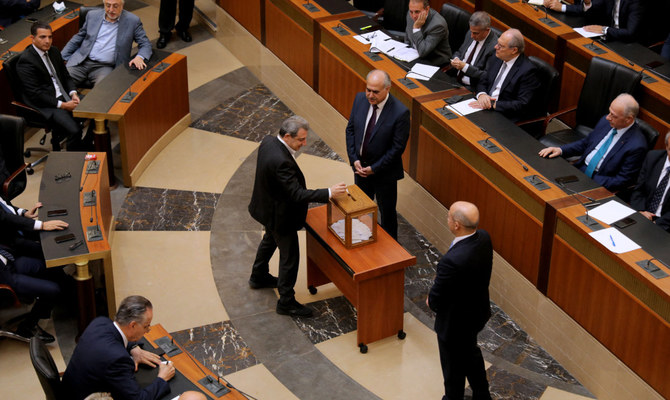

BEIRUT: Lebanese MPs failed for the seventh time on Thursday to elect a successor to former President Michel Aoun.
MP Michel Moawad won the support of 42 MPs, but his tally fell well short of the required majority and was exceeded by the number of spoiled ballots cast by pro-Hezbollah lawmakers.
Next Thursday has been set for a new session of parliament to elect the president.
Moawad obtained two new votes from Change MPs Najat Saliba and Mark Daou. He said that his support was growing and called on the opposition to build bridges among themselves.
A Hezbollah MP suggested the name of Gen. Joseph Aoun, commander of the armed forces, for the presidency, but his candidacy requires a constitutional amendment.
MP Sajea Attia had demanded the formation of a mixed parliamentary committee that would set a road map to break the stalemate.
MP Adeeb Abdel-Masih said that depositors camping in the vicinity of the parliament had threatened him, and added: “Either you elect a president and work to return our money, or there will be blood in the country. I consider this a threat to civil peace.”
Following the session, MP Ali Hassan Khalil, who is Parliament Speaker Nabih Berri’s political aide in the Amal Movement, stressed the need to search for a formula to break the stalemate.
He added that “exiting the session and losing the quorum for the second session is one of the methods of expressing an opinion, and the white paper confirms our insistence not to challenge any other component.”
Hezbollah MP Ali Ammar stressed the need for dialogue. He said Gen. Aoun presented “a good example in his management of the military institution and was able, through his leadership of the army, to protect civil peace.”
Kataeb Party MP Sami Gemayel described the latest developments as “a tasteless play,” and urged future polling sessions to elect a president.
Meanwhile, two newly elected MPs, including Change’s Ramy Finge, lost their seats following an appeals process before the Constitutional Council.
Finge, an activist who had pledged to fight corruption, had his Sunni seat in Tripoli revoked by the council and returned to his opponent and long-time MP Faisal Karami, who said that it would not be possible to elect a new president without consensus and dialogue.
The council also accepted the appeal submitted by candidate Haider Asif Nasser for the Alawite seat in Tripoli of MP Firas Al-Salloum.
Hezbollah MPs and allies left the plenary hall before the start of the second session to ensure that it lost the quorum.
The session at the 128-member parliament was attended by 110 MPs.
There were 50 white papers belonging to MPs of the Free Patriotic Movement, Hezbollah, Amal Movement, and independent MPs allied with Hezbollah.
Eighty Sunni and Change MPs, who have not yet made up their minds about voting for Moawad, put papers on which the phrase “New Lebanon” was written.
Academic Essam Khalifa received six votes, five of which were from independent MPs, while Ziyad Baroud won two votes, one of which was from Deputy Speaker Elias Bou Saab.
There was also a paper in the ballot box bearing the name Badri Daher, director general of customs, who has been arrested in connection with the Beirut Port explosion. He is affiliated with the Free Patriotic Movement.
Another paper bore the name of Salvador Allende, the Marxist president of Chile from 1970 to 1973.


