

Somali troops overpower militants to end hotel siege

1 / 2
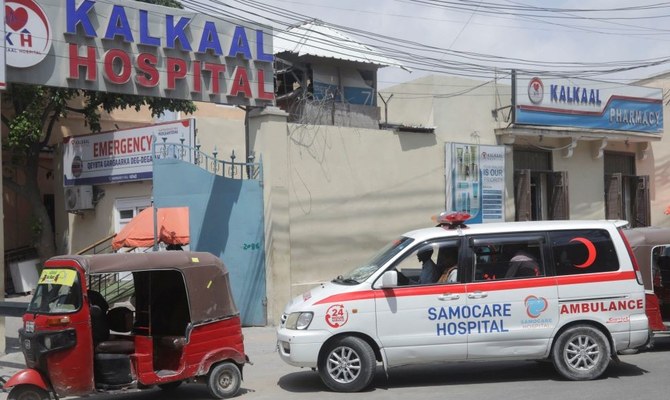
An ambulance carrying an unidentified wounded person drives into Kalkaal hospital after Al-Shabab militants attacked Villa Rose hotel, Mogadishu, Somalia, Nov. 28, 2022. (Reuters)
2 / 2
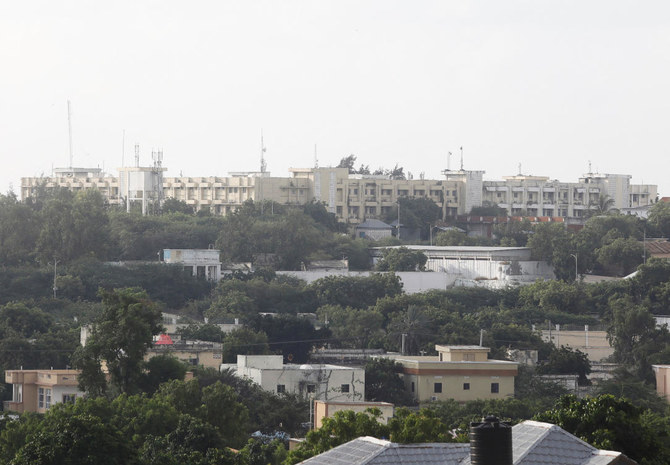
Al-Shabab Islamist militants attacked Villa Rose hotel, which is close to the Presidential Palace, above, in the Bondhere district of Mogadishu, Somalia. (Reuters)
Short Url
Updated 28 November 2022
Follow

Somali troops overpower militants to end hotel siege

  • Somalian security forces, who are trained by the US and Turkey, were under orders to “eliminate” the militants
  • Mohamed Sayid Hassan Elmi, who lives in Birmingham, was named locally as one of the victims at Villa Rose hotel

MOGADISHU: Somali security forces stormed a hotel in the capital on Monday to end a near day-long siege by Al-Shabab militants who killed nine people at the building near the president’s residence in the capital, police said.

A Briton is reported to have died in the siege, where Somalian security forces, who are trained by the US and Turkey, were under orders to “eliminate” the militants who stormed it yesterday.

Mohamed Sayid Hassan Elmi, who lives in Birmingham, was named locally as one of the victims at Villa Rose Hotel.

Gunfire crackled from inside the hotel as the special forces fought the militants more than 12 hours after the Islamist group stormed the building in the center of Mogadishu.
A police spokesperson said 60 civilians had been rescued, while a government minister said he and others had kicked down a door to escape after being caught in the hotel following evening prayers when a suicide bomber struck and the gunbattle broke out.
The assault underscores the continuing ability of the Al-Qaeda-allied militants to stage deadly attacks with sometimes high casualties inside the city even as President Hassan Sheikh Mohamud’s government presses an offensive against them.
“The operation at the hotel Rose has been concluded,” Sadik Aden Ali, the police spokesperson said, referring to the Villa Rose hotel where the siege occurred.
Ali said the militants had killed eight civilians and later added that one soldier had also died in the siege. Five soldiers were injured, he said.
Six Al-Shabab fighters had been involved in the attack, with one blowing himself up and five shot dead by the security forces, Ali said.
Al Qaeda-linked Al-Shabab, which controls swathes of the country, claimed responsibility for the attack, saying in a statement that it was targeting the nearby presidential palace.
Al Shabab, which is seeking to topple the government and establish its own rule based on an extreme interpretation of Islamic law, frequently stages attacks in Mogadishu and elsewhere.
Government officials in Mogadishu often use the Villa Rose hotel for meetings. Some officials also live there.
Somalia’s environment minister Adam Aw Hirsi said the assault on the hotel, where he lives, began with a deafening explosion by a suicide bomber who was followed by militants on foot to breach the perimeter of the heavily guarded hotel.
“I had exited the hotel mosque where we performed the evening prayer in congregation when the explosion hit. The roof of the VIP room I was in flew and glasses shattered far and wide,” Hirsi told Reuters, describing the scene of the attack.
“Then bullets rained in all directions,” he said, adding that he, a friend and another minister fled the building through a back exit. “Many people followed us to the exit, we broke the door with collective kicks and we exited to safety,” he said.
Asked what the government would do next, he said there was no turning back and the government would “not let up the fight.”
Somalia government forces, supported by clan militias and, at times, African Union troops and US air strikes, have made a number of battlefield gains in an offensive against Al-Shabab over the last three months.
The US military has conducted several air strikes against the Al-Shabab this year, but it was not clear whether it was involved in Monday’s battle.
Despite being pushed back, Al-Shabab has still been able to stage large attacks on both civilian and military targets.
In October two car bombs exploded at Somalia’s education ministry next to a busy market intersection, killing at least 120 people. It was the deadliest attack since a truck bomb exploded at the same intersection in October 2017, killing more than 500 people.
Somalia’s parliament said it had postponed a scheduled session for both of its houses on Monday as the siege unfolded.


UN’s top court opens Myanmar Rohingya genocide case

Updated 12 January 2026
Follow

UN’s top court opens Myanmar Rohingya genocide case

  • The Gambia filed a case against Myanmar at the UN’s top court in 2019
  • Verdict expected to impact Israel’s genocide case over war on Gaza

DHAKA: The International Court of Justice on Monday opened a landmark case accusing Myanmar of genocide against its mostly Muslim Rohingya minority.

The Gambia filed a case against Myanmar at the UN’s top court in 2019, two years after a military offensive forced hundreds of thousands of Rohingya from their homes into neighboring Bangladesh.

The hearings will last three weeks and conclude on Jan. 29.

“The ICJ must secure justice for the persecuted Rohingya. This process should not take much longer, as we all know that justice delayed is justice denied,” said Asma Begum, who has been living in the Kutupalong refugee camp in Bangladesh’s Cox’s Bazar district since 2017.

A mostly Muslim ethnic minority, the Rohingya have lived for centuries in Myanmar’s western Rakhine state but were stripped of their citizenship in the 1980s and have faced systemic persecution ever since.

In 2017 alone, some 750,000 of them fled military atrocities and crossed to Bangladesh, in what the UN has called a textbook case of ethnic cleansing by Myanmar.

Today, about 1.3 million Rohingya shelter in 33 camps in Cox’s Bazar, turning the coastal district into the world’s largest refugee settlement.

“We experienced horrific acts such as arson, killings and rape in 2017, and fled to Bangladesh,” Begum told Arab News.

“I believe the ICJ verdict will pave the way for our repatriation to our homeland. The world should not forget us.”

A UN fact-finding mission has concluded that the Myanmar 2017 offensive included “genocidal acts” — an accusation rejected by Myanmar, which said it was a “clearance operation” against militants.

Now, there is hope for justice and a new future for those who have been displaced for years.

“We also have the right to live with dignity. I want to return to my homeland and live the rest of my life in my ancestral land. My children will reconnect with their roots and be able to build their own future,” said Syed Ahmed, who fled Myanmar in 2017 and has since been raising his four children in the Kutupalong camp.

“Despite the delay, I am optimistic that the perpetrators will be held accountable through the ICJ verdict. It will set a strong precedent for the world.”

The Myanmar trial is the first genocide case in more than a decade to be taken up by the ICJ. The outcome will also impact the genocide case that Israel is facing over its war on Gaza.

“The momentum of this case at the ICJ will send a strong message to all those (places) around the world where crimes against humanity have been committed,” Nur Khan, a Bangladeshi lawyer and human rights activist, told Arab News.

“The ICJ will play a significant role in ensuring justice regarding accusations of genocide in other parts of the world, such as the genocide and crimes against humanity committed by Israel against the people of Gaza.”