

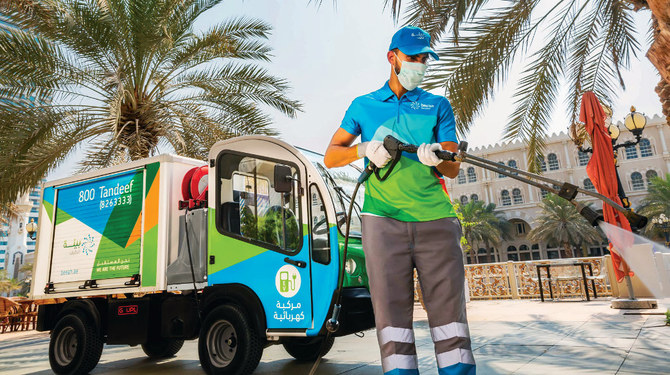

DUBAI: BEEAH Group, the UAE’s leading sustainability pioneer and digital expert, has achieved a waste diversion rate of 76 percent, the highest in the Middle East, and the remaining 24 percent was disposed of in landfills.
Speaking to Arab News, Group CEO Khaled Al-Huraimel said that BEEAH Group aims to help Sharjah achieve 100 percent landfill waste diversion in 2022, up from 76 percent currently.
BEEAH Group launched the UAE’s first waste-to-energy facility earlier in 2022 as part of its efforts to achieve zero waste, he added.
The facility, located in Sharjah, would divert over 300,000 tons of non-recyclable waste from landfills annually and generate 30 megawatts of clean energy, enough to power almost 30,000 homes.
“Once the facility reaches full operational capacity, Sharjah will become the first city in the Middle East to achieve zero waste,” Al-Huraimel said
All of this is due to BEEAH Group’s operations in Sharjah with 10 different plants.
There are 10 dedicated recycling facilities that process materials such as paper, plastic, tires, old vehicles, metals, construction and demolition waste, organic waste, industrial wastewater, maritime waste and commercial and industrial waste.
Al-Huraimel said BEEAH was established in 2007 to address the environmental challenges the region was facing, including waste. However, at the beginning of 2022, the company changed its name to BEEAH Group and adopted the structure of an investment holding company and a new visual identity. This is part of the group’s strategy to diversify its core business into new sectors.
The Gulf Cooperation Council countries have the highest waste per capita in the world. Therefore, this was the immediate challenge, he added.
“We started in waste management, and today, we’re proud to say we became the first to reach zero waste in the emirate of Sharjah, and today we are also active across the UAE,” he said. “Our new structure as an investment holding group has seen us launch several new business verticals that will capitalize on business opportunities across different industries and countries.”
BEEAH places sustainability and digitization at the heart of the business. This can be seen across several verticals, including BEEAH Tandeef for waste collection and city cleaning and BEEAH Recycling for waste processing and material recovery. There is also BEEAH Energy for clean and renewable power and BEEAH Environment Services for consulting, research and innovation.
Additionally, there is BEEAH Digital for future technologies and digital ventures, BEEAH Transport for green mobility and autonomous transportation, and BEEAH Education, an environmental education and awarding organization for businesses and individuals.
The various verticals will benefit from the collective experience of the BEEAH Group while having more room to grow within their respective industries.
BEEAH Group encourages collective responsibility for sustainability through education and awareness programs. In 2010, BEEAH Group launched the BEEAH Academy of Sustainability to promote environmental education. Today, the academy reaches a network of more than 252,000 students, 6,500 teachers, and 700 schools. Across its areas of operation, the group aims to improve quality of life through a twin-pillared approach that focuses on sustainability and digitalization.
Digitalization of BEEAH Group
During a private meeting at BEEAH Group’s recently built headquarters, designed by the late Zaha Hadid, Al-Huraimel remarked, “It was one of the last buildings she designed.”
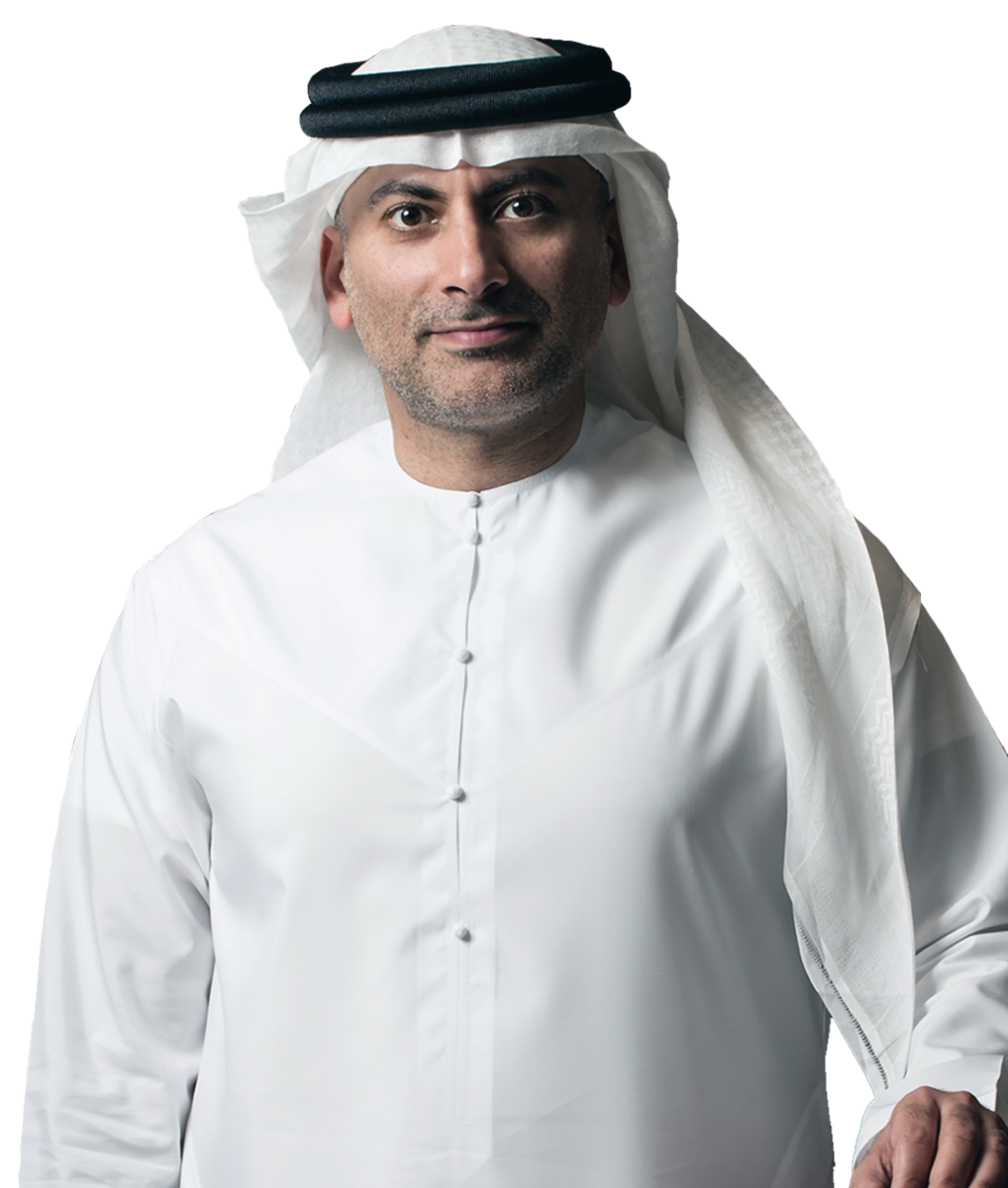
Our new structure as an investment holding group has seen us launch several new business verticals that will capitalize on business opportunities across different industries and countries.
Khaled Al-Huraimel, BEEAH Group CEO
According to him, the organization’s brand-new headquarters reflect BEEAH Group’s identity as a sustainable icon.
The BEEAH Group headquarters is a command center for all BEEAH Group operations, as it has more than 10,000 employees and is growing. “This building is one of the smartest and most sustainable buildings in the region,” he added.
A primary area of focus for BEEAH Group is technology, and the organization believes that technology has many tools to help it achieve its goals, Al-Huraimel said. In that sector, BEEAH Group has three companies: Evoteq, re.life, and One Data Center, a recent joint venture with Khazna to build Sharjah’s first data center.
He said the BEEAH Group headquarters operates using hundreds of artificial intelligence use cases.
At Tandeef, BEEAH Group’s waste collection business, the vehicles are all tracked, and the routing is also optimized by artificial intelligence.
The commercial and industrial recycling facility, a recent facility launched by BEEAH Recycling this year, has a robot with AI vision that can segregate different types of waste.
“So, we believe and embrace technology as it can help us create a better future and meet our targets,” Al-Huraimel said.
As part of its efforts in facilitating digital transformation, BEEAH Group also partnered with Khazna Data Centers recently to build Sharjah’s first Tier 3 data center.
Commenting on their JV with Khazna, the group CEO said that data centers have become necessary with the growth of cloud computing. This requires a great deal of data storage.
He added that Sharjah also needs a data center to support shortages and digitalization and become a more innovative city.
“In today’s world, it’s important to build a strong digital foundation and infrastructure,” said Al-Huraimel.
By harnessing the power of technology and innovative sustainable solutions, the BEEAH Group is paving the way for a better quality of life across the MENA region.
COP27 delegation
BEEAH Group has commenced operations in Egypt’s Sharm El-Sheikh, including sustainable waste management services during the UN Climate Change Conference, also known as COP27.
He said that the organization and Egypt’s Green Planet, an environmental solutions company, signed a contract in September to provide waste management and city cleaning services under the 10-year contract.
“We were awarded the waste management contract for Sharm El-Sheikh, and we have commenced our services before COP27,” he added.
The BEEAH Group also attended COP27 and represented the UAE as part of the UAE delegation.
Besides showcasing the organization’s groundbreaking projects, such as the UAE’s first waste-to-energy plant and the region’s first fully AI-integrated office building, BEEAH Group introduced the conference attendees to its recycling facilities and zero-waste solutions.
“We were proud to participate in COP27 as part of the UAE delegation. As a frontrunner in climate action, the UAE has made huge strides toward zero emissions; we are pleased to show how we support these targets through clean energy, sustainable infrastructure, and integrated waste management solutions,” said Al-Huraimel.
“I believe the UAE and the region have strong sustainability goals. We see that in the UAE, Saudi, Egypt, and so on,” he said, commenting on BEEAH Group’s attendance at COP27.
As the group CEO pointed out, Egypt and Saudi Arabia are two key markets for BEEAH Group, which will continue to expand over the next 18 months.
Geographic growth and diversification have been the main ways the group has grown. BEEAH has diversified into digital, energy consulting and health care.
“We targeted Saudi Arabia and Egypt for future expansion, as they are the two biggest markets for us in terms of size and recognition of the relationship between our countries,” he said.
Currently, the group focuses on growing in Saudi Arabia and Egypt by offering waste management services in both countries.
BEEAH Group also hopes to consolidate its position as a regional leader in waste management while looking at other government and private contracts.


