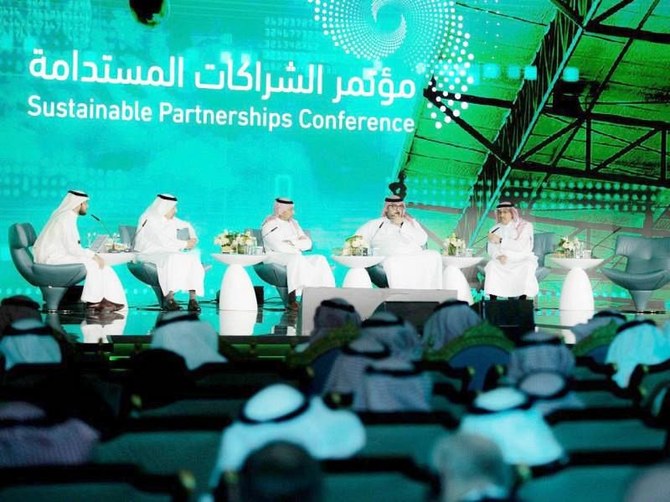
Flurry of R&D cooperation deals signed as Sustainable Partnerships Conference ends

The event hosted 150 ministers, decision-makers, local and international leaders (SPA)
Short Url
Updated 25 November 2022
Follow

Flurry of R&D cooperation deals signed as Sustainable Partnerships Conference ends

RIYADH: More than 50 cooperation and research partnership agreements were signed between universities and various sectors at the Sustainable Partnerships Conference held in Riyadh.

The two-day conference, held under the theme “Research and Innovation Towards A Prosperous Economy” was part of an initiative spearheaded by the Ministry of Education to foster ties between Saudi universities and the industrial and development sectors.

The event hosted 150 ministers, decision-makers, local and international leaders — of which 100 were from the industrial and development sector — and 40 Saudi universities and colleges.

Some 1,000 research products and industrial models for universities were presented, according to the Saudi Press Agency.

On the sidelines of the conference, 40 training workshops specialized in research and innovation were held, along with 25 dialogue sessions, in addition to a presentation of 220 scientific inventions through the “Promising Technologies and Innovations” exhibition for the country’s citizens and graduates of Saudi universities.

The conference also saw the Saudi Minister of Investment Khalid Al-Falih announce a new strategy for research and development would soon be launched in the Kingdom.

Saudi Arabia’s Minister of Industry and minimal resources Bandar Al-Khorayef also addressed the forum, revealing that a budget for research and development will be allocated soon. 

Al-Khorayef pointed out that the innovation strategy will enhance Saudi Arabia’s exports, and will contribute to national gross domestic production. 

According to SPA, the Ministry of Education sought to use the conference — the first of its kind in the Kingdom — to not only strengthen the links between the higher education sector and industry, but also to identify research and innovation needs of national priority and provide effective solutions to them.

The event was held with a growing focus on Saudi Arabia’s R&D sector, as the Kingdom seeks to diversify its economy away from oil in keeping with the Vision 2030 program.

Saudi Arabia is aiming to become one of the top 10 countries in the Global Competitive Index by the end of this decade, increasing from 24th in 2022.


Kuwait to boost Islamic finance with sukuk regulation

Updated 05 February 2026
Follow

Kuwait to boost Islamic finance with sukuk regulation

  • The move supports sustainable financing and is part of Kuwait’s efforts to diversify its oil-dependent economy

RIYADH: Kuwait is planning to introduce legislation to regulate the issuance of sukuk, or Islamic bonds, both domestically and internationally, as part of efforts to support more sustainable financing for the oil-rich Gulf nation, Prime Minister Sheikh Ahmad Abdullah Al-Ahmad Al-Sabah said on Wednesday.

Speaking at the World Governments Summit in Dubai, Al-Sabah highlighted that Kuwait is exploring a variety of debt instruments to diversify its economy. The country has been implementing fiscal reforms aimed at stimulating growth and controlling its budget deficit amid persistently low oil prices. Hydrocarbons continue to dominate Kuwait’s revenue stream, accounting for nearly 90 percent of government income in 2024.

The Gulf Cooperation Council’s debt capital market is projected to exceed $1.25 trillion by 2026, driven by project funding and government initiatives, representing a 13.6 percent expansion, according to Fitch Ratings.

The region is expected to remain one of the largest sources of US dollar-denominated debt and sukuk issuance among emerging markets. Fitch also noted that cross-sector economic diversification, refinancing needs, and deficit funding are key factors behind this growth.

“We are about to approve the first legislation regulating issuance of government sukuk locally and internationally, in accordance with Islamic laws,” Al-Sabah said.

“This enables us to deal with financial challenges flexibly and responsibly, and to plan for medium and long-term finances.”

Kuwait returned to global debt markets last year with strong results, raising $11.25 billion through a three-part bond sale — the country’s first US dollar issuance since 2017 — drawing substantial investor demand. In March, a new public debt law raised the borrowing ceiling to 30 billion dinars ($98 billion) from 10 billion dinars, enabling longer-term borrowing.

The Gulf’s debt capital markets, which totaled $1.1 trillion at the end of the third quarter of 2025, have evolved from primarily sovereign funding tools into increasingly sophisticated instruments serving governments, banks, and corporates alike. As diversification efforts accelerate and refinancing cycles intensify, regional issuers have become regular participants in global debt markets, reinforcing the GCC’s role in emerging-market capital flows.

In 2025, GCC countries accounted for 35 percent of all emerging-market US dollar debt issuance, excluding China, with growth in US dollar sukuk issuance notably outpacing conventional bonds. The region’s total outstanding debt capital markets grew more than 14 percent year on year, reaching $1.1 trillion.