


ISLAMABAD: The Economic Cooperation Organization (ECO) Trade and Development Bank on Saturday signed an agreement with Pakistan in Istanbul to provide a soft loan of €150 million for flood relief efforts and support import of fuel by the South Asian country.
Pakistan’s prime minister Shehbaz Sharif arrived in Turkey on Friday on a two-day visit that he said would unpack the “untapped potential” of bilateral ties between the two countries.
He held a bilateral meeting with Turkish President Recep Tayyip Erdogan, and also inaugurated one of the four MILGEM corvette ships for the Pakistan Navy at the Istanbul shipyard.
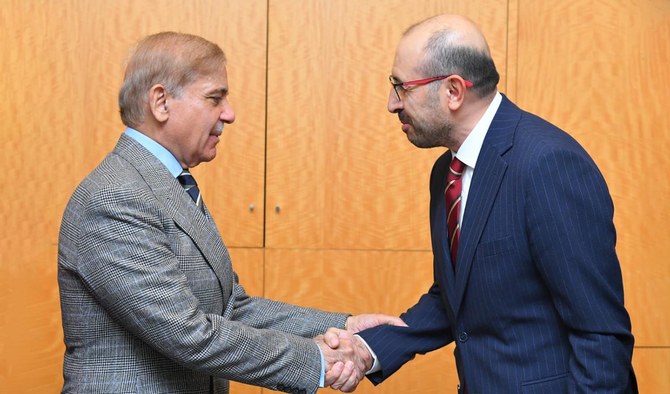
The agreement with the bank was signed during a meeting between the Pakistani delegation led by Sharif and the ECO Trade and Development Bank delegation led by its president Yalçın Yüksel.
“The ECO Trade and Development Bank will provide a soft term loan of Euro 150 million to the Government of Pakistan,” the Prime Minister’s Office announced in a statement. “The financial package will contribute to flood relief efforts as well as provide financial support for import of fuel.”
The statement added the overall financial assistance to Pakistan since the inception of the bank would reach about $1 billion after the disbursement of the committed amount.
In a separate meeting with the Pakistan-Turkey Business Council, the prime minister invited Turkish companies to invest in Pakistan as the two countries signed a memorandum of agreement to enhance bilateral trade volume to $5 billion in the next three years.
“We have signed a memorandum of agreement to enhance our trade volume from a very small amount of less than $1.5 billion to $5 billion in the next three years,” Sharif said, adding that Turkey’s international trade was somewhere around $250 billion and its bilateral trade with Pakistan was just a fraction of it.
“It’s not a big task at all and let’s resolve and commit today that we will do everything to achieve this target in three years – rather double it in three years,” he continued.
He vowed that his government would fully provide a hassle- and red tape-free environment to them: “My government would no longer tolerate any snags and impediments in the way of investment from foreign investors, including the Turkish brothers and sisters.”
To further promote bilateral trade and business ties, the prime minister said, the Turkish president had assured him that work on a “trade and goods agreement” between the two brotherly countries would be expedited.
“President Erdogan has instructed his minister to expedite its approval from the Turkish parliament,” he said.
Sharif said his government had resolved to cut down on the expensive oil and petroleum imports.
“Last year we had to spend $27 billion to finance imports of our petroleum [products] which we simply cannot afford,” he said.
“Therefore, we have rolled out our vision of 10,000 megawatts solar investment projects before local and international investors about one and a half months ago.”
He expressed his commitment to complete this scheme in letter and spirit, through investments from Saudi Arabia, Turkiye, China, Qatar and the United Arab Emirates.
“So please be ready with your coffers open and come to Pakistan as I am going to hold a special conference for Turkish investors,” he added.
The premier said the Pakistani government would also ensure payments to investors within 60 days without, in a transparent manner and without the involvement of a third party.


