ABU DHABI: The president of Turkmenistan said his country is interested in increasing bilateral trade with the UAE, given its strategic location, its outstanding relations with countries around the world, and its highly qualified workforce.
Speaking at the UAE-Turkmenistan Business Forum, President Serdar Berdimuhamedov also praised the existing economic ties between the two countries, the Emirates News Agency reported on Tuesday, and highlighted his country’s focus on exploring new opportunities for economic cooperation in various industries, including energy, trade and green energy.
The forum was organized by Abu Dhabi Chamber of Commerce and Industry in cooperation with the Ministry of Foreign Affairs and International Cooperation, Turkmenistan’s embassy, and the Abu Dhabi Department of Economic Development.
The participants discussed opportunities for new economic partnerships for the business communities in the two countries. Other key topics included ways to increase trade exchanges, attract investment, and explore new opportunities for collaboration.
“Our business communities are keen to explore promising opportunities that increase mutual trade and investment and launch joint projects and initiatives,” said the UAE’s minister of state for foreign trade, Thani Al-Zeyoudi.
“Today, we have a comprehensive cooperation plan that we are working to enhance with our partners in the Turkmen government and private sector.”
Abdullah Mohammed Al-Mazrouei, president of UAE Federation of Chambers of Commerce and Industry and chairman of Abu Dhabi Chamber of Commerce and Industry, said: “The UAE and Turkmenistan have solid and robust economic relations. The UAE is a major trading partner of Turkmenistan, with bilateral non-oil trade reaching $255.3 million in 2021.
“This figure is expected to grow, considering the keenness of both countries to explore more elements of development, expansion and promising opportunities in all sectors, especially (given) that Turkmenistan is located in a strategic geographical location in Central Asia, with promising markets that allow investors from the UAE to explore key investment opportunities.”
The UAE is a likewise a gateway to markets in its region, he added, thanks to its exceptional geographical location that links East with West, and it has a flexible and diverse economy that offers many perks and incentives for foreign investments.
“We need to have a joint road map, form joint advisory committees, activate the UAE-Turkmenistan Business Council and increase its role in promoting business opportunities, and to increase our cooperation for more growth and development,” said Al-Mazrouei.
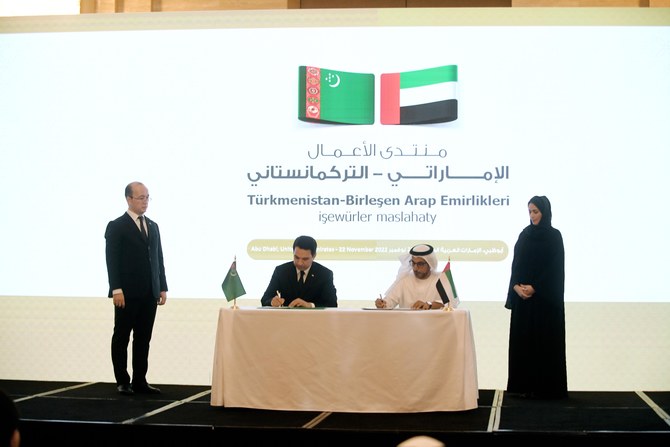
A number of agreements were signed during the forum, with the aim of enhancing cooperation between the UAE and Turkmenistan in a number of vital sectors. They included a non-disclosure agreement between the Agency for Transport and Communications, under the Cabinet of Ministers of Turkmenistan, and Abu Dhabi Ports Company; a joint-development agreement between Turkmenenergo State Power Corporation of the Ministry of Energy of Turkmenistan and renewable energy company Masdar, also known as the Abu Dhabi Future Energy Company; and a cooperation agreement between the State Bank for Foreign Economic Affairs of Turkmenistan and First Abu Dhabi Bank.


![]()

President of Turkmenistan praises economic ties with UAE and calls for trade boost
Short Url
https://arab.news/gwu7x
President of Turkmenistan praises economic ties with UAE and calls for trade boost
- Speaking during the UAE-Turkmenistan Business Forum, Serdar Berdimuhamedov highlighted his country’s focus on exploring new opportunities for economic cooperation
- Delegates at the forum also discussed opportunities for new economic partnerships between the business communities in the two countries


Latest updates





Recommended


© 2026 SAUDI RESEARCH & PUBLISHING COMPANY, All Rights Reserved And subject to Terms of Use Agreement.