In spectacular upset in World Cup history, Saudi Arabia stun Messi, Argentina to win 2-1

Saudi Arabia's Abdulelha Al-Malki celebrates at the end of the World Cup group C soccer match between Argentina and Saudi Arabia at the Lusail Stadium in Lusail, Qatar, on November 22, 2022. (AP)
Short Url
Updated 22 November 2022
Follow

In spectacular upset in World Cup history, Saudi Arabia stun Messi, Argentina to win 2-1

  • Famous Saudi win ends South American side’s 36-match unbeaten run
  • Salem Al-Dawsari hit a stunning winner to sink the red-hot favorites

DOHA: Saudi Arabia stunned Lionel Messi’s Argentina on Tuesday, beating the two-time winners 2-1 in one of the biggest upsets in World Cup history.

Salem Al-Dawsari hit a stunning winner to sink the red-hot favorites, bringing the South American side’s 36-match unbeaten run to a shuddering halt.

The win was fully deserved after Saudi Arabia came from behind after Saleh Al-Shehri canceled out an early Lionel Messi penalty.

Playing a risky high defensive line, the athletic Saudis rode their luck in the first half when three times Argentina had the ball in the net only to be denied by an offside call.

But in a chaotic start to the second half, the Saudis swarmed all over Lionel Scaloni’s team and scored twice as the Arab nation beat the South Americans for the first time in five attempts.

In a first half dominated by Argentina, it seemed only a matter of time before Saudi Arabia’s risky defensive tactics would cost them.

That condensed the game into a sliver of green turf around the halfway line as the Asian side happily allowed Argentina’s back four to pass the ball among themselves.

It seemed Saudi Arabia were facing a long afternoon after VAR intervened to award a penalty when Saud Abdulhamid wrestled Leandro Paredes to the ground in the box at a corner.

Messi waited for goalkeeper Mohammed Al-Owais to dive to his left before cooly rolling the ball into the opposite corner.

But if the Saudis felt aggrieved at the technology, it would later help keep them in the game.
Three times Argentina had the ball in the net only to be denied by razor-tight offside calls, the first given by VAR.

There was no controversy about the equalizer three minutes into the second half, though, as Al-Shehri ran onto a touch from Feras Al-Brikan, beat Cristian Romero on the outside and slotted the ball back across goalkeeper Emiliano Martinez and into the far corner.

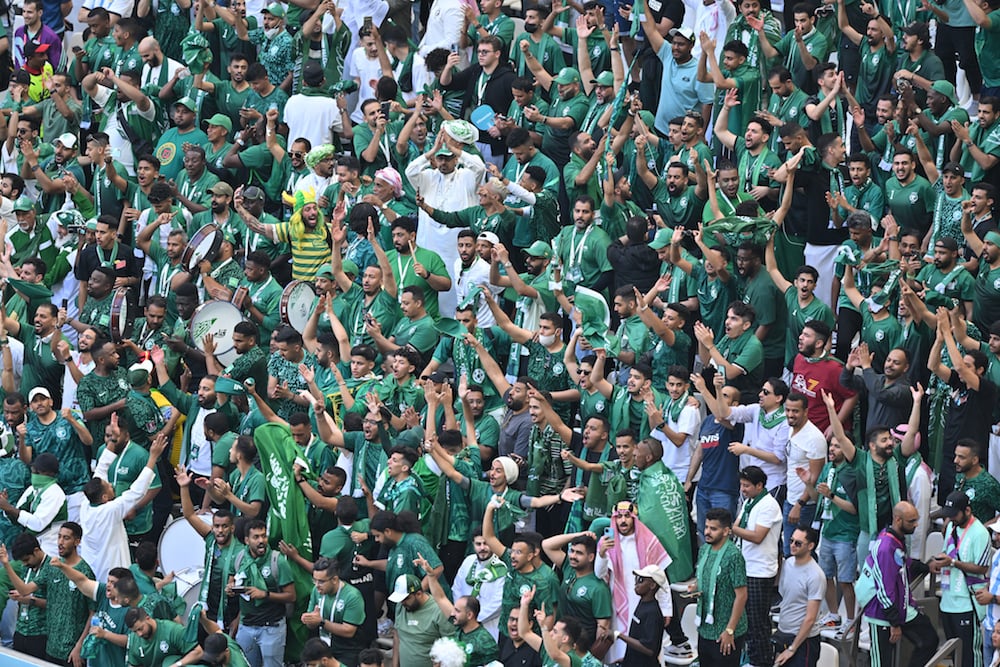
The sizeable Saudi contingent in the Lusail stadium — where the World Cup final will be held — exploded in joy.

Suddenly the Argentines were rattled and five minutes later the turnaround was complete.

Al-Dawsari’s clever turn in the box beat two defenders before he shifted the ball past a third and rifled an unstoppable shot into the top far corner.

The crowd was going wild and Hassan Al-Tambakti punched the air in delight after his desperate sliding tackle denied Messi a clear shot at goal.

Every Al-Owais save, including a point-blank block from Nicolas Tagliafico’s close-range prod, was greeted with rapturous cheers.

There was late drama after Al-Owais collided with Yasser Al-Shahrani and seemed to knock him out as his knee struck the defender’s head.


MESIF 2026 wraps up in Riyadh with spotlight on legacy, fans and sustainable sports growth

Updated 28 January 2026
Follow

MESIF 2026 wraps up in Riyadh with spotlight on legacy, fans and sustainable sports growth

  • A recurring theme in panel discussions was the importance of moving beyond siloed planning toward connected strategies
  • Abdullah Aldrees: I believe Saudi is a sleeping giant within the football ecosystem because of the high demand that exists

RIYADH: The sixth edition of the Middle East Sports Investment Forum concluded on Jan. 28 in Riyadh, reinforcing the need for long-term legacy planning, integrated infrastructure development and fan-centric strategies as the region’s sports ecosystem continues to mature.

Held over two days — Jan. 27-28 — at the ministry of investment headquarters and the Kingdom Arena, the forum brought together senior government officials, global sports executives, investors and technology leaders to assess how the Middle East — and Saudi Arabia in particular — can translate major event hosting and increased investment into sustainable impact.

A recurring theme in panel discussions was the importance of moving beyond siloed planning toward connected strategies that link infrastructure, finance, fan engagement and legacy from the earliest stages of project development.

Dr. Sakis Batsilas, deputy CEO of FIFA World Cup Qatar 2022, stressed that while international expertise has played a key role in the region’s rapid progress, long-term success depends on knowledge transfer and talent development.

“Yes, we do need experts and consultants and expatriates to help,” he said. “But the main, I would say, focus, is how we ensure that we transfer this knowledge and we build talent … to make sure we have the right talent.”

Drawing on his experience delivering major global events, Batsilas highlighted the need to embed legacy considerations during the bidding phase.

“Talking now from an operational point of view … I think everything starts with a bidding phase,” he said, adding that stronger legacy metrics would encourage greater long-term planning from host nations and rights holders alike.

Fan experience and commercialization also featured prominently, particularly as Saudi Arabia continues to expand its domestic leagues and host major international competitions. David Davies, chief experience officer of Catapult, said the Kingdom’s challenge lies in converting strong digital fandom into sustained in-stadium engagement.

“Saudi Arabia is … ranked consistently in the highest in the world” in terms of football fandom, Davies said. “However, attendance in-stadium is still developing.” He noted that younger, digitally native audiences require tailored engagement strategies. “The days of being able to ask them to come to you have gone,” he said.

From a government and delivery perspective, Abdullah Aldrees, chief of staff at the vice minister’s executive office at the ministry of sport, said MESIF highlighted the scale of opportunity ahead — and the importance of a joined-up approach.

“I believe Saudi is a sleeping giant within the football ecosystem because of the high demand that exists, the government support and the anchor IPs that we’re hosting,” Aldrees said. “So all of this can create a lot of opportunities for football to grow in Saudi.”

He said the Kingdom has entered a critical preparation phase as it gears up for a packed calendar of major events. “We are now living in the preparation phase. We’re preparing for all these IPs, we’re preparing for all these big events coming up,” Aldrees said. “So how do you make sure that you really reap the right benefit from them and have the right legacy?”

Pointing to upcoming milestones such as the AFC Asian Cup Saudi Arabia 2027 and the FIFA World Cup 2034, Aldrees emphasized the need to think beyond hosting.

“Yes, we’re hosting World Cup. We’re hosting Asia 2027, but how do you make sure that they have a long, lasting impact on the ecosystem?” he said.

Echoing a key message from the forum, Aldrees concluded: “The effective strategy is to be looking at these things together. We no longer can be looking at them as silos and test cycles.”

The transformation of Saudi football was also highlighted as a reflection of broader cultural and structural change. Juan Esteban Gomez, a football expert specializing in digitalization and artificial intelligence, said the shift has been tangible in recent years. “The people here are breathing football,” he said, describing the Saudi league as “one of the most enjoyable competitions in the world.”

As MESIF 2026 drew to a close, participants agreed that the next phase of sports investment in the Middle East will be defined by execution — ensuring that capital, policy and innovation align to deliver measurable legacy, deeper fan engagement and resilient ecosystems capable of sustaining growth well beyond headline events.