

Children returned from Syria Daesh camps ‘building new lives’: Human Rights Watch

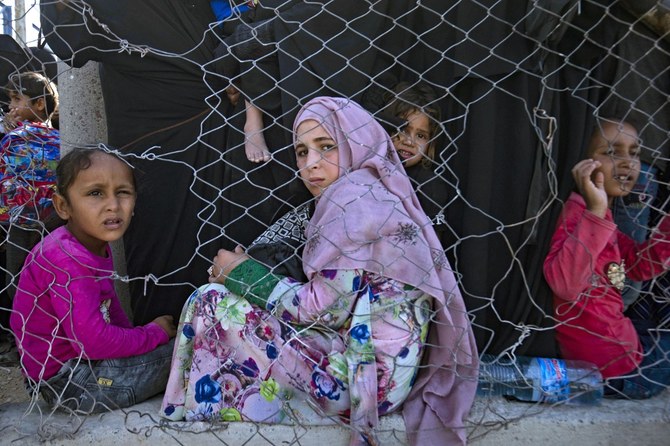
Above, the Kurdish-run Al-Hol camp, which holds relatives of suspected Daesh group fighters in the northeastern Hasakeh governorate. (AFP file photo)
Short Url
Updated 21 November 2022
Follow

Children returned from Syria Daesh camps ‘building new lives’: Human Rights Watch

  • Success of reintegration should encourage West to boost repatriation efforts, group says
  • ‘In the camps they risk death, illness, recruitment by ISIS and indefinite detention for the suspected crimes of their parents’

LONDON: Children repatriated from camps for former Daesh families in northeast Syria are “building new lives” in their home countries, Human Rights Watch said in a report published on Monday.

It added that the success of repatriation efforts to countries including France, Germany, the UK and Sweden should encourage Western governments to accept greater numbers of child nationals from former Daesh territories.

The report, titled “‘My son is just another kid’: Experiences of children repatriated from camps for Daesh suspects and their families in northeast Syria,” documents the progress of 100 children repatriated between 2019 and 2022.

The 63-page report found that the majority of the children are performing well in school, taking part in a variety of hobbies, and have been given a “new chance in life” following the “horrors of the camps.”

A survey conducted for the report found that 89 percent of respondents — family members, foster parents, social workers and teachers — reported that a repatriated child was doing “very well” or “quite well” at adjusting.

On education, 73 percent said a child under their care was performing “very well” or “quite well” in school.

The report found evidence of significant emotional and behavioral trauma among some of the repatriated children, but argued that learning assistance and psychosocial support could further encourage reintegration.

About 56,000 people, mostly women and children, remain in Syria’s Al-Hol and Roj camps. Though most detainees hail from Syria and neighboring Iraq, more than 10,000 prisoners are from countries around the world, including major Western nations. HRW said almost 80 percent of children in the camps are aged under 12.

Regional Kurdish authorities that oversee the camps have warned that they lack the required resources to maintain long-term care of the detainees.

Conditions in the camps have significantly worsened in recent years, with frequent clashes between Daesh loyalists and other prisoners.

And as a result of poor living conditions, hundreds of children have died in the camps from a range of illnesses including hypothermia, malnutrition and preventable diseases.

Jo Becker, children’s rights advocacy director at HRW, said: “Children rescued from the horrors of the camps are doing well in school, making friends and building new lives in their home countries. Despite enduring unimaginable suffering, many are reintegrating remarkably well.

“The greatest risk is not bringing the children home but leaving them in the camps where they risk death, illness, recruitment by ISIS (Daesh) and indefinite detention for the suspected crimes of their parents.

“Countries with nationals in the camps should urgently allow them to return home and do their best to keep mothers and children together.”

A grandfather in Sweden whose several grandchildren were repatriated in 2019 said: “It is possible, fully possible, for reintegration and recovery of children. My grandchildren are evidence of this.

“They have recovered in the most incredible way … All children should have the opportunity to get a new chance in life.”

Since 2019, Denmark, Finland, Germany, Kazakhstan, Kyrgyzstan, Russia, Sweden, Tajikistan, the US and Uzbekistan have successfully repatriated most of their nationals from camps in Syria. However, the UK has repatriated just 10 children and Canada only four.

In October, Australia repatriated four women and 13 children in the country’s first effort to return nationals from Syria since 2019. On Oct. 31, the Netherlands repatriated 12 women and 28 children.


Bangladesh’s Yunus announces resignation, end of interim govt

Bangladesh’s interim leader Muhammad Yunus stepped down on February 16, 2026 in a farewell broadcast to the nation.
Updated 7 sec ago
Follow

Bangladesh’s Yunus announces resignation, end of interim govt

  • Yunus handed over power after congratulating the Bangladesh Nationalist Party and its leader Tarique Rahman

DHAKA: Bangladesh’s interim leader Muhammad Yunus stepped down on Monday in a farewell broadcast to the nation before handing over to an elected government.
“Today, the interim government is stepping down,” the 85-year-old Nobel Peace Prize winner said.
“But let the practice of democracy, freedom of speech, and fundamental rights that has begun not be halted.”
Yunus returned from self-imposed exile in August 2024, days after the iron-fisted government of Sheikh Hasina was overthrown by a student-led uprising and she fled by helicopter to India.
“That was the day of great liberation,” he said. “What a day of joy it was! Bangladeshis across the world shed tears of happiness. The youth of our country freed it from the grip of a demon.”
He has led Bangladesh as its “chief adviser” since, and now hands over power after congratulating the Bangladesh Nationalist Party (BNP) and its leader Tarique Rahman on a “landslide victory” in elections last week.
“The people, voters, political parties, and stakeholder institutions linked to the election have set a commendable example,” Yunus said.
“This election has set a benchmark for future elections.”
Rahman, 60, chief of the BNP and scion of one of the country’s most powerful political dynasties, will lead the South Asian nation of 170 million.
Rebuilt institutions’
Bangladeshi voters endorsed sweeping democratic reforms in a national referendum, a key pillar of Yunus’s post-uprising transition agenda, on the same day as the elections.
The lengthy document, known as the “July Charter” after the month when the uprising that toppled Hasina began, proposes term limits for prime ministers, the creation of an upper house of parliament, stronger presidential powers and greater judicial independence.
“We did not start from zero — we started from a deficit,” he said.
“Sweeping away the ruins, we rebuilt institutions and set the course for reforms.”
The referendum noted that approval would make the charter “binding on the parties that win” the election, obliging them to endorse it.
However, several parties raised questions before the vote, and the reforms will still require ratification by the new parliament.
The BNP alliance won 212 seats, compared with 77 for the Jamaat-e-Islami-led alliance, according to the Election Commission.
Jamaat chief Shafiqur Rahman conceded on Saturday, saying his Islamist party would “serve as a vigilant, principled, and peaceful opposition.”
Newly elected lawmakers are expected to be sworn in on Tuesday, after which Tarique Rahman is set to become Bangladesh’s next prime minister.
Police records show that political clashes during the campaign period killed five people and injured more than 600.
However, despite weeks of turbulence ahead of the polls, voting day passed without major unrest and the country has responded to the results with relative calm.