

Pakistan reopens border with Afghanistan more than a week after soldier’s killing

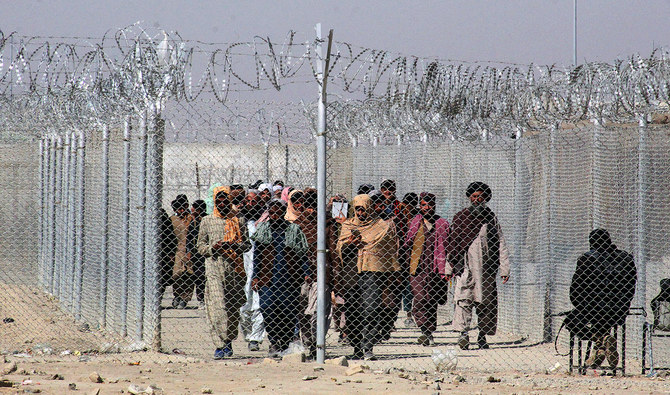
Pakistan's and Afghan's nationals walk along a fenced corridor as they enter Pakistan through the Pakistan-Afghanistan border crossing point in Chaman on February 27, 2022. (Photo courtesy: AFP)
Short Url
Updated 21 November 2022
Follow

Pakistan reopens border with Afghanistan more than a week after soldier’s killing

  • The Chaman border crossing was closed after a Pakistani border guard was killed in a shooting on Nov 13
  • The decision to reopen the border comes after Taliban officials assured Pakistan of arresting the suspects

QUETTA: Pakistan has reopened its border with Afghanistan in the southwestern Balochistan province, officials said on Monday, more than a week after it was closed because of the killing of a Pakistani soldier.

The soldier of Pakistan’s Frontier Corps paramilitary force died in a shooting from the Afghan side on November 13, leading Pakistani authorities to indefinitely close the Chaman border crossing, the most important border point for trade between the two countries after Torkham in Pakistans’ mountainous northwest.

The decision to reopen the border crossing, which connects with Spin Boldak district in Afghanistan’s Kandahar province, was made after multiple meetings of Pakistan’s border liaison committee, comprising officials of Pakistan Army and district administration as well as tribal elders, with Taliban border officials.

“During various rounds of talks, the Afghan government expressed grief over the killing of Pakistani border guard and assured of averting these attacks in future,” Chaman Deputy Commissioner Abdul Hameed Zehri said at a press conference.

“After this, Pakistan’s border liaison committee has decided to reopen the border for all trade and pedestrian movement through Pak-Afghan Friendship Gate.”

Zehri said no one would be allowed to disturb friendly relations between Pakistan and Afghanistan.

Hundreds of Afghans cross into Pakistan every day for trade, medical treatment, work or to meet relatives, who have taken refuge in various Pakistani cities. Most Pakistanis go to the other side of the border for business transactions.

The unruly frontier between Pakistan and Afghanistan has seen similar shooting incidents in the past at Chaman, Torkham and other border crossings.

The Afghan government said the attack was an attempt by a “third party” to disturb peaceful relations between the two countries.

“The Taliban government has a clear policy toward all neighboring countries and has been working with all neighbors in a very conducive manner,” Hajji Zaid, a spokesman for the Kandahar governor, told Arab News.

“We will not allow any third party within or outside Afghanistan to disturb our relations with any neighboring country, particularly Pakistan.”

He said Taliban officials had assured the Pakistani government that all efforts were being made to arrest the suspect, who had killed the Pakistani border guard.

The Chaman border crossing remained close for eight consecutive days, causing heavy losses to traders and stranding thousands of people on both sides.

Traders and business community on Monday welcomed Pakistan’s decision to reopen the border crossing.


UNGA adopts Pakistan-sponsored resolution focusing world attention on Palestine, Kashmir

Updated 9 sec ago
Follow

UNGA adopts Pakistan-sponsored resolution focusing world attention on Palestine, Kashmir

  • The resolution calls on countries to immediately cease foreign military intervention in and occupation of foreign countries and territories
  • Islamabad says the resolution reinforces international attention to the legitimate causes and aspirations of Palestinian, Kashmiri peoples

ISLAMABAD: The United Nations General Assembly (UNGA) has adopted a Pakistan-sponsored resolution on the peoples’ right to self-determination, Pakistan’s UN mission said on Friday, saying it reinforces the world attention to the Palestine and Kashmir issues.

The text, which was adopted by consensus, was recommended last month by the 193-member General Assembly’s Third Committee, which deals with social, humanitarian and cultural issues, according to Pakistani state media.

Co-sponsored by 65 countries, it called on countries to immediately cease foreign military intervention in and occupation of foreign countries and territories as well as acts of “repression, discrimination, and maltreatment.”

The resolution also declared the General Assembly’s firm opposition to acts of foreign military intervention, aggression and occupation, which have resulted in suppression of peoples’ right to self-determination in parts of the world.

“The consensual adoption of the resolution manifests broad international support for the inalienable right of the peoples facing colonialism, alien domination and foreign occupation,” Pakistan’s UN mission said on X. 

“For the people of Indian Illegally Occupied Jammu and Kashmir (IIOJK) and Palestine, the resolution reinforces international attention to their just and legitimate cause and their aspirations for freedom and dignity in accordance with UN Security Council resolutions.”

Pakistan, which does not recognize Israel, supports an independent Palestinian state based on “internationally agreed parameters” and pre-1967 borders, calling for an end to Israeli occupation of the Gaza Strip and the West Bank, including East Jerusalem.

Kashmir, on the other hand, has been divided between Pakistan and India since their independence from British rule in 1947. Both countries claim the Himalayan territory in its entirety but rule it in part and have fought multiple wars over it.

Islamabad has repeatedly urged New Delhi to hold a plebiscite in the disputed territory in line with the United Nations Security Council resolutions.

Ambassador Usman Jadoon, Pakistan’s deputy permanent representative to the UN, this week said the realization of self-determination is not merely a historical aspiration, but an enduring obligation.

“Recent developments in the Middle East demonstrate that lasting peace cannot be achieved through the continued denial and suppression of the legitimate right to self-determination of the Palestinian people,” he said on Thursday.

“Similarly, the UN Security Council has, through several resolutions, recognized the legitimate right of self-determination of the people of Jammu and Kashmir. A just resolution of the Jammu and Kashmir dispute remains central to the establishment of durable peace in South Asia.”