

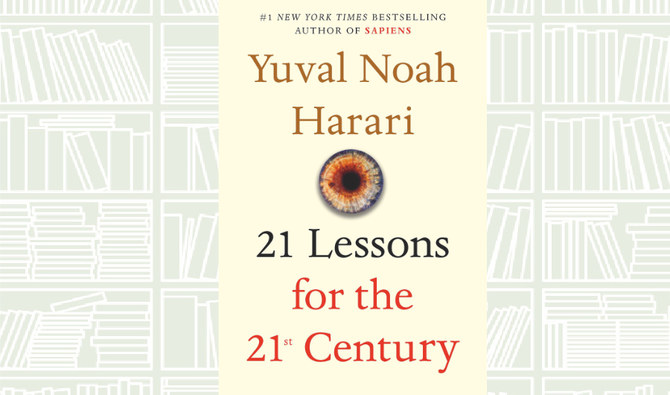

“21 Lessons for the 21st Century” is a nonfiction social philosophy book written by Yuval Noah Harari and published in 2018.
Harari seeks to spark debate about the future of humanity and raises questions about how our daily habits can distract us from pressing global issues.
His previous works “Sapiens” and “Homo Deus” are somewhat of a precursor to this book, as he expands on his views of technology, politics and economics, and how humans draw meaning from their existence.
Harari argues that “clarity is power,” and that by offering insights to readers about contemporary society, he can help “level the global playing field.”
The author touches on topics including despair, hope, truth and resilience.
In part one, Harari makes the argument that human beings do not often memorize facts or statistics, but can latch more effectively onto ideas through storytelling modes.
He contends that in the 20th century, global elites explained the world through three stories — of the communists, liberals and fascists.
The rhetoric after the Second World War, following the fall of fascist regimes, left behind a bipolar world of the communists and liberals, up until 1980, he asserts.
The book is certainly a dense read, but is provocatively questioning the systems that govern us.
He appears to conclude that people cannot kill an idea.
Harari is a philosopher and professor at the Hebrew University of Jerusalem’s history department.
His books have been translated into 65 languages, with 40 million copies sold worldwide.
Harari received his doctorate from the University of Oxford and was awarded the Polonsky Prize for Creativity and Originality twice, in 2009 and 2012.


