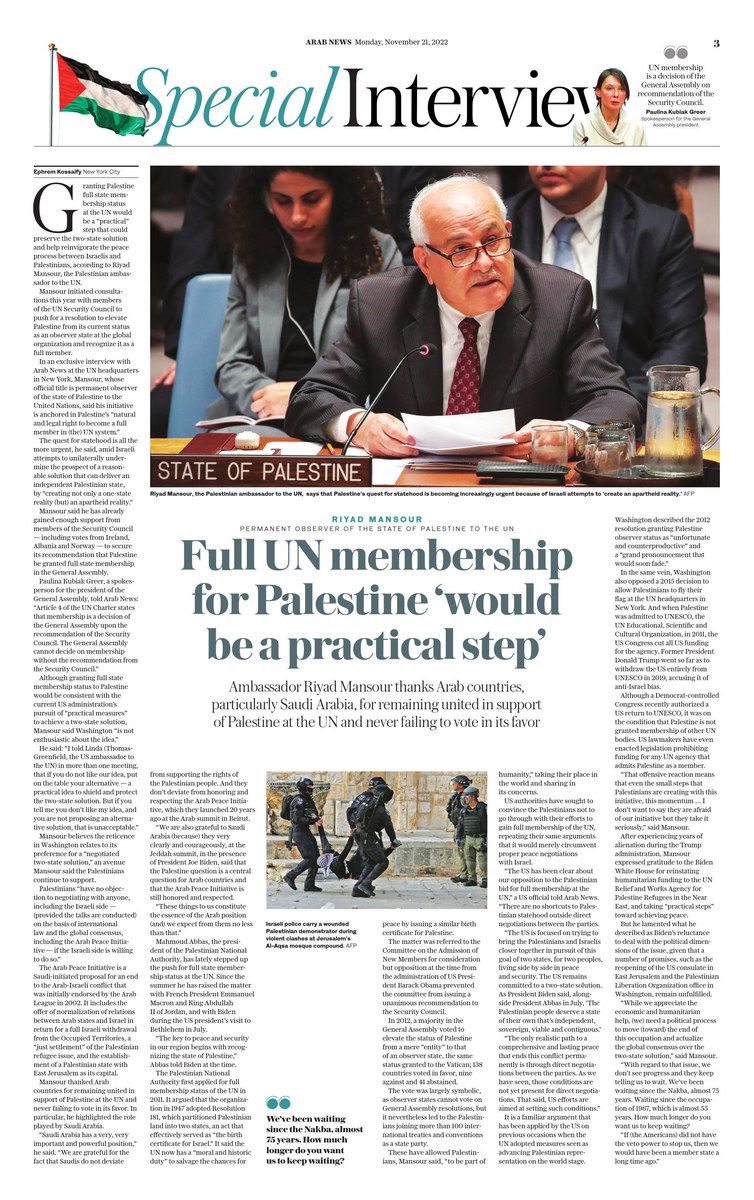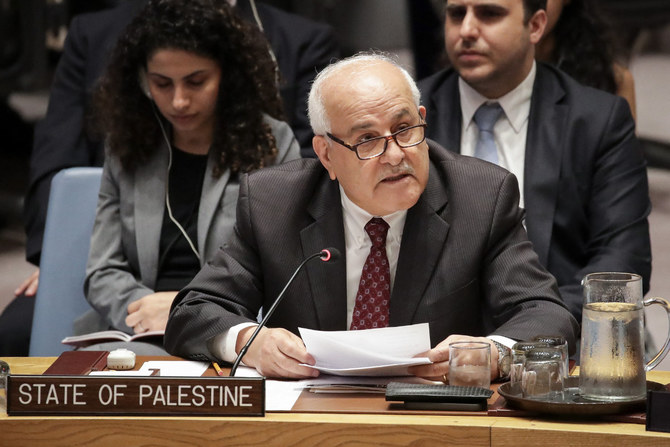


NEW YORK CITY: Granting Palestine full state membership status at the UN would be a “practical” step that could preserve the two-state solution and help reinvigorate the peace process between Israelis and Palestinians, according to Riyad Mansour, the Palestinian ambassador to the UN.
Mansour initiated consultations this year with members of the UN Security Council to push for a resolution to elevate Palestine from its current status as an observer state at the global organization and recognize it as a full member.
In an exclusive interview with Arab News at the UN headquarters in New York, Mansour, whose official title is Permanent Observer of the State of Palestine to the United Nations, said his initiative is anchored in Palestine’s “natural and legal right to become a full member in (the) UN system.”

The quest for statehood is all the more urgent, he said, amid Israeli attempts to unilaterally undermine the prospect of a reasonable solution that can deliver an independent Palestinian state, by “creating not only a one-state reality (but) an apartheid reality.”
Mansour said he has already gained enough support from members of the Security Council — including votes from Ireland, Albania and Norway — to secure its recommendation that Palestine be granted full state membership in the General Assembly.
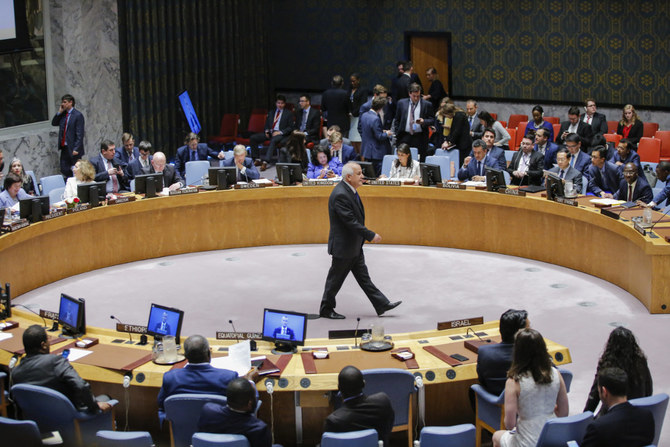
Paulina Kubiak Greer, a spokesperson for the president of the General Assembly, told Arab News: “Article 4 of the UN Charter states that membership is a decision of the General Assembly upon the recommendation of the Security Council. The General Assembly cannot decide on membership without the recommendation from the Security Council.”

Paulina Kubiak Greer, spokesperson for the president of the UN General Assembly. (UN photo)
Although granting full state membership status to Palestine would be consistent with the current US administration’s pursuit of “practical measures” to achieve a two-state solution, Mansour said Washington “is not enthusiastic about the idea.”
He said: “I told Linda (Thomas-Greenfield, the US ambassador to the UN), in more than one meeting, that if you do not like our idea, put on the table your alternative — a practical idea to shield and protect the two-state solution. But if you tell me you don’t like my idea, and you are not proposing an alternative solution, that is unacceptable.”
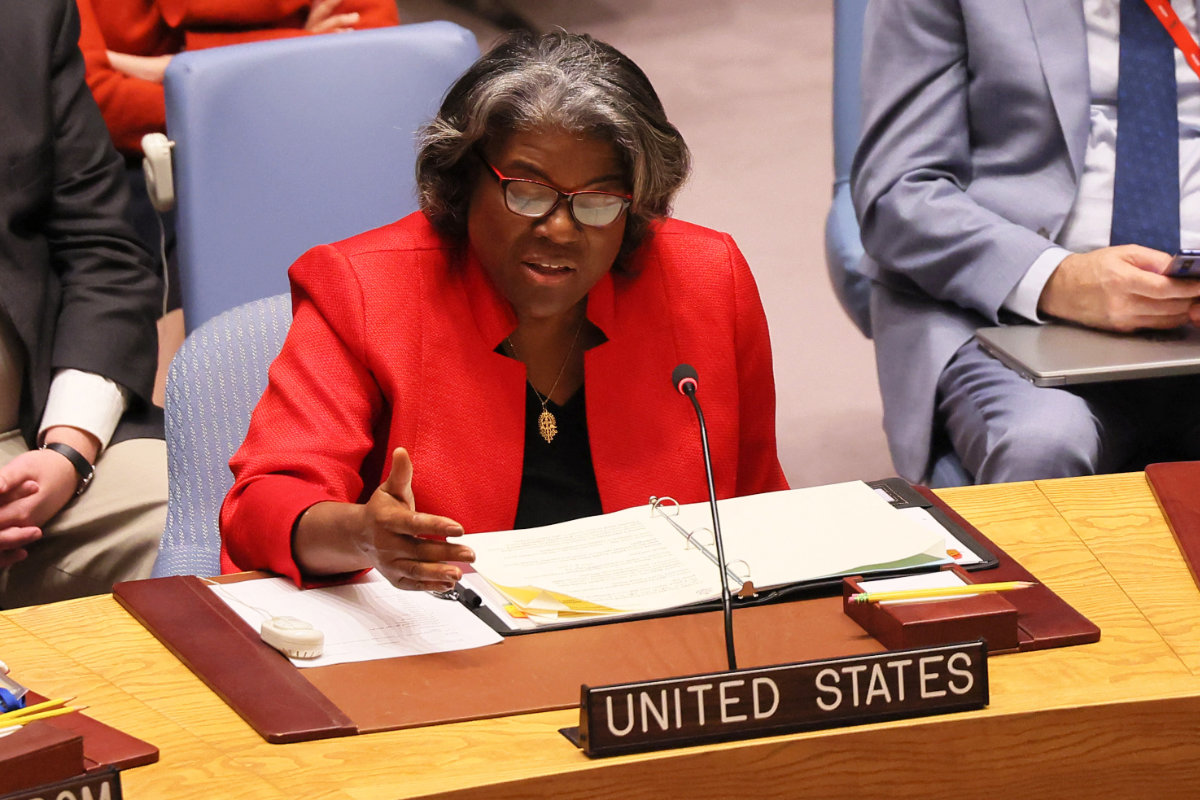
US Ambassador to the UN Linda Thomas-Greenfield speaking at a meeting of the UN Security Council. (AFP file)
Mansour believes the reticence in Washington relates to its preference for a “negotiated two-state solution,” an avenue Mansour said the Palestinians continue to support.
Palestinians “have no objection to negotiating with anyone, including the Israeli side — (provided the talks are conducted) on the basis of international law and the global consensus, including the Arab Peace Initiative — if the Israeli side is willing to do so.”
The Arab Peace Initiative is a Saudi-initiated proposal for an end to the Arab-Israeli conflict that was initially endorsed by the Arab League in 2002. It includes the offer of normalization of relations between Arab states and Israel in return for a full Israeli withdrawal from the Occupied Territories, a “just settlement” of the Palestinian refugee issue, and the establishment of a Palestinian state with East Jerusalem as its capital.
Mansour thanked Arab countries for remaining united in support of Palestine at the UN and never failing to vote in its favor. In particular, he highlighted the role played by Saudi Arabia.
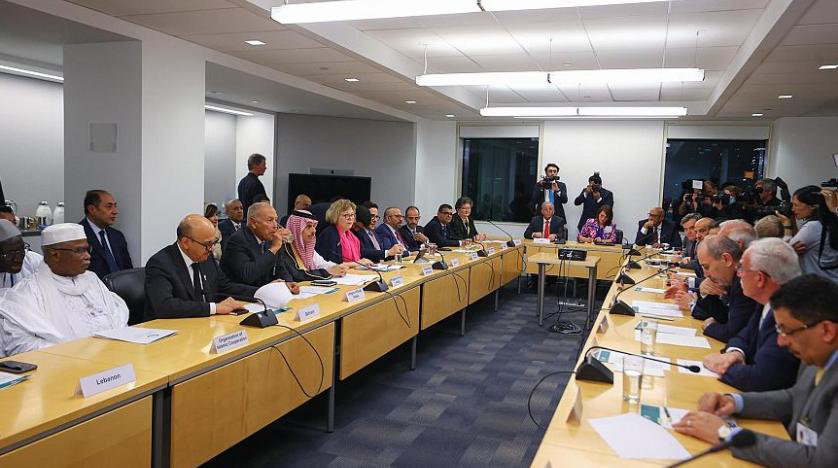
Members of the Arab Peace Initiative Committee meeting in New York on Sept. 21, 2022, on the sidelines of the 77th United Nations General Assembly. (SPA file photo)
“Saudi Arabia has a very, very important and powerful position,” he said. “We are grateful for the fact that Saudis do not deviate from supporting the rights of the Palestinian people. And they don’t deviate from honoring and respecting the Arab Peace Initiative, which they launched 20 years ago at the Arab summit in Beirut.
“We are also grateful for Saudi when they very clearly and courageously, at the Jeddah summit, in the presence of President Joe Biden, said that the Palestine question is a central question for Arab countries and that the Arab Peace Initiative is still honored and respected.
“These things to us constitute the essence of the Arab position (and) we expect from them no less than that.”
Mahmoud Abbas, the president of the Palestinian National Authority, has lately stepped up the push for full state membership status at the UN. Since the summer he has raised the matter with French President Emmanuel Macron and King Abdullah II of Jordan, and with Biden during the US president’s visit to Bethlehem in July.
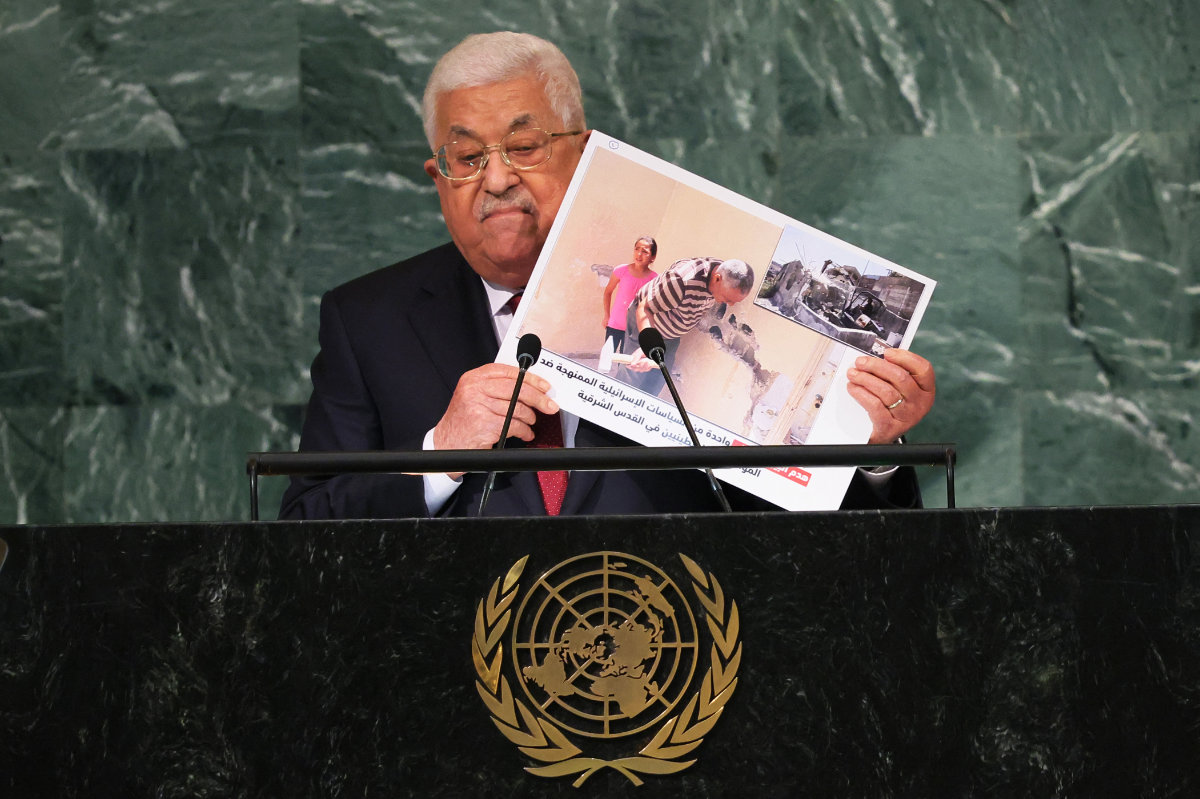
Palestine President Mahmoud Abbas shows a photo as he speaks at the 77th session of the United Nations General Assembly on September 23, 2022 in New York. (Getty Images via AFP/file)
“The key to peace and security in our region begins with recognizing the state of Palestine,” Abbas told Biden at the time.
The Palestinian National Authority first applied for full membership status of the UN in 2011. It argued that the organization in 1947 adopted Resolution 181, which partitioned Palestinian land into two states, an act that effectively served as “the birth certificate for Israel.” It said the UN now has a “moral and historic duty” to salvage the chances for peace by issuing a similar birth certificate for Palestine.
The matter was referred to the Committee on the Admission of New Members for consideration but opposition at the time from the administration of US President Barack Obama prevented the committee from issuing a unanimous recommendation to the Security Council.
In 2012, a majority in the General Assembly voted to elevate the status of Palestine from a mere “entity” to that of an observer state, the same status granted to the Vatican; 138 countries voted in favor, nine against and 41 abstained.

Delegates cheer as PA President Mahmoud Abbas (upper photo) addresses the UN General Assembly before voting to upgrade Palestine to non-member observer state on Nov. 29, 2012 in New York. (Getty Images/AFP)
The vote was largely symbolic, as observer states cannot vote on General Assembly resolutions, but it nevertheless led to the Palestinians joining more than 100 international treaties and conventions as a state party.
These have allowed Palestinians, Mansour said, “to be part of humanity,” taking their place in the world and sharing in its concerns.
US authorities have sought to convince the Palestinians not to go through with their efforts to gain full membership of the UN, repeating their same arguments that it would merely circumvent proper peace negotiations with Israel.
“The US has been clear about our opposition to the Palestinian bid for full membership at the UN,” a US official told Arab News. “There are no shortcuts to Palestinian statehood outside direct negotiations between the parties.
“The US is focused on trying to bring the Palestinians and Israelis closer together in pursuit of this goal of two states, for two peoples, living side by side in peace and security. The US remains committed to a two-state solution. As President Biden said, alongside President Abbas in July, ‘The Palestinian people deserve a state of their own that’s independent, sovereign, viable and contiguous.’

US President Joe Biden (L) is received by Palestinian President Mahmud Abbas (R) during a welcome ceremony in Bethlehem in the occupied West Bank on July 15, 2022. (AFP file)
“The only realistic path to a comprehensive and lasting peace that ends this conflict permanently is through direct negotiations between the parties. As we have seen, those conditions are not yet present for direct negotiations. That said, US efforts are aimed at setting such conditions.”
It is a familiar argument that has been applied by the US on previous occasions when the UN adopted measures seen as advancing Palestinian representation on the world stage. Washington described the 2012 resolution granting Palestine observer status as “unfortunate and counterproductive” and a “grand pronouncement that would soon fade.”
In the same vein, Washington also opposed a 2015 decision to allow Palestinians to fly their flag at the UN headquarters in New York. And when Palestine was admitted to UNESCO, the UN Educational, Scientific and Cultural Organization, in 2011, the US Congress cut all US funding for the agency. Former President Donald Trump went so far as to withdraw the US entirely from UNESCO in 2019, accusing it of anti-Israel bias.
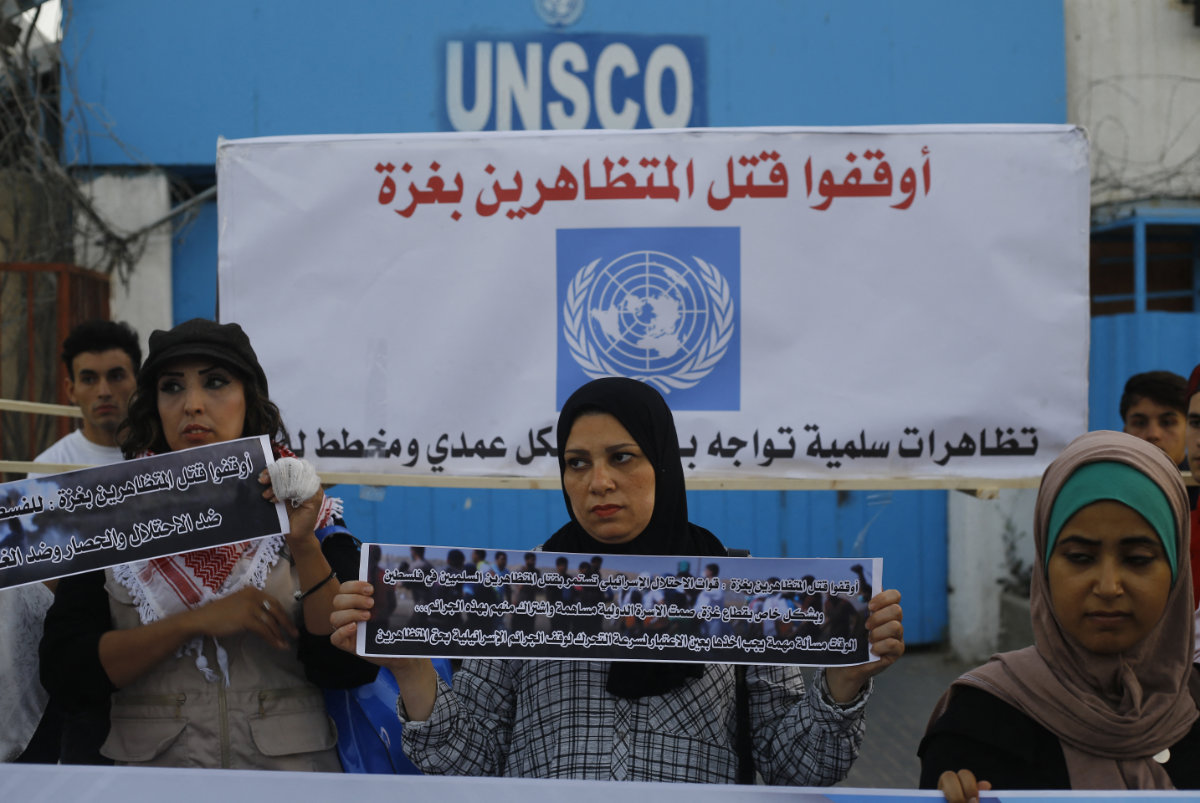
Palestinians call for an end to Israeli atrocities during a demonstration next to the UNESCO headquarters in Gaza City on May 16, 2018. (AFP file)
Although a Democrat-controlled Congress recently authorized a US return to UNESCO, it was on the condition that Palestine is not granted membership of other UN bodies. US lawmakers have even enacted legislation prohibiting funding for any UN agency that admits Palestine as a member.
“That offensive reaction means that even the small steps that Palestinians are creating with this initiative, this momentum … I don’t want to say they are afraid of our initiative but they take it seriously,” said Mansour.
After experiencing years of alienation during the Trump administration, Mansour expressed gratitude to the Biden White House for reinstating humanitarian funding to the UN Relief and Works Agency for Palestine Refugees in the Near East, and taking “practical steps” toward achieving peace.

Palestinians receive their monthly food rations from the United Nations Relief and Works Agency (UNRWA) in Khan Younis, Gaza Strip, on June 14, 2022. It was defunded during the term of US President Donald Trump but Joe Biden restored support when he became president. (AFP)
But he lamented what he described as Biden’s reluctance to deal with the political dimensions of the issue, given that a number of promises, such as the reopening of the US consulate in East Jerusalem and the Palestinian Liberation Organization office in Washington, remain unfulfilled.
“While we appreciate the economic and humanitarian help, (we) need a political process to move (toward) the end of this occupation and actualize the global consensus over the two-state solution,” said Mansour.
“With regard to that issue, we don’t see progress and they keep telling us to wait. We’ve been waiting since the Nakba, almost 75 years. Waiting since the occupation of 1967, which is almost 55 years. How much longer do you want us to keep waiting?
“If (the Americans) did not have the veto power to stop us, then we would have been a member state a long time ago.”