

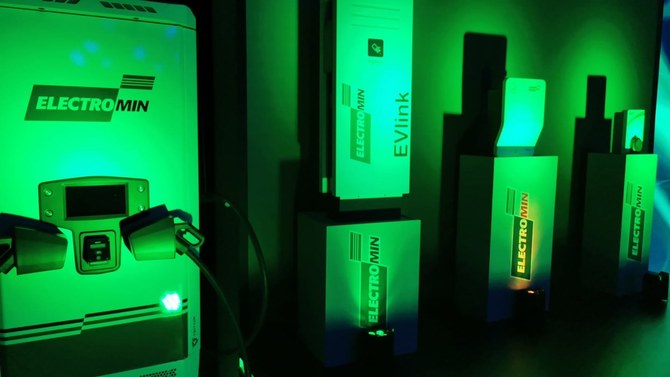

RIYADH: In a bid to accelerate the growth of electric vehicles in Saudi Arabia, Siemens agreed to supply EV chargers to Electromin for its planned development of a Kingdom- and region-wide charging network.
The move will address one of the most critical concerns of people who wish to buy EVs, which is charging their vehicles if they run out of storage and get stuck on the road.
The agreement will ensure supplies of Siemens’ advanced EV infrastructure technology for Electromin’s network, including the ultra-fast Sicharge D chargers that use direct current and the smart Versicharge AC wall or pole mounted units that run on alternating current.
Electromin, the e-mobility unit of the Kingdom’s lubricants and automotive services company Petromin, is also developing a consumer app that will allow users to locate public chargers, plan their route and book and pay for sessions.
“Electromin’s Electric Mobility as a Service solutions are contributing to the development of the Saudi EV ecosystem, and this partnership with Siemens will allow us to provide the charging infrastructure and technology necessary to boost adoption of EVs in the Kingdom,” said Kalyana Sivagnanam, group CEO of Petromin and CEO of Electromin.
He added: “The rollout of EV charging points across Saudi Arabia is our first phase of a significant national strategy that extends to 2030 and beyond.”
In an earlier interview to Arab News, Sivagnanam had noted that the company considers Electromin charging stations a long-term investment in Saudi Arabia, as he strongly believes in the future of EVs. He had also stated that the adoption of EVs in the Kingdom would be much higher than in other countries in the coming years.
“We look forward to working with Electromin on this important project that demonstrates our commitment to supporting sustainability programs in Saudi Arabia,” said Karim Mousa, senior vice president of e-mobility for Siemens in the Middle East.
“EVs are the key technology to decarbonize road transport, and Siemens is proud to provide the infrastructure that accelerates the growth of EVs and contributes to the Saudi Green Initiative.”
Saudi Arabia has committed to achieving net-zero carbon emissions by 2060. The government wants three of every 10 vehicles in Riyadh to be EVs by 2030. Globally, passenger electric cars are surging in popularity, and the Paris-based International Energy Agency estimates that 13 percent of new cars sold in 2022 will be electric.
The Kingdom is also leading the EV wave by encouraging the US-based Lucid Motors to establish its first EV factory in the region with an annual capacity of 150,000 zero-emission units.
The deal is estimated to provide Lucid Motors financing and incentives of up to $3.4 billion over the next 15 years to build and operate the manufacturing facility in the Kingdom.
The production will start next year, and a complete assembly will be ready by 2025. To be located in King Abdullah Economic City, the factory is the EV manufacturer’s first production facility outside the US.


