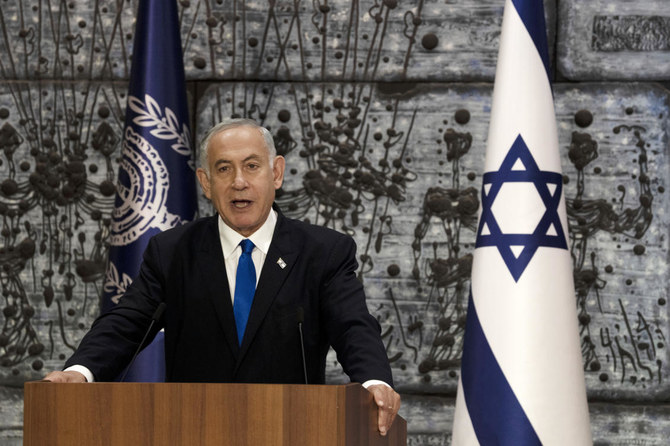
JERUSALEM: Israeli Prime Minister-designate Benjamin Netanyahu’s efforts to swiftly form a government faltered on Sunday as a prospective far-right coalition partner demanded the cabinet role of defense minister.
A clear right-wing victory in the Nov. 1 ballot — ending nearly four years of political deadlock — raised expectations within Netanyahu’s conservative Likud of speedy alliances with like-minded religious-nationalist parties.
But fissures have emerged between Likud and the powerful Religious Zionism party whose hard-line settler leaders oppose Palestinian statehood and want the occupied West Bank annexed — views in direct opposition to successive US administrations.
Religious Zionism lawmakers are demanding party leader Betzalel Smotrich become defense minister in order to impact policy in the West Bank, more than half of which is under full Israeli military control and which the Palestinians want for a future state. Likud wants to keep the key post.
“There was still misunderstandings and disagreements on the matter of Smotrich. I hope this will be worked out soon,” Likud lawmaker Miki Zohar told Kan radio, adding that defense was “the most important portfolio” for Likud.
One Religious Zionism lawmaker, Orit Strock, said her party would also accept the finance portfolio but was unwilling to accept anything that would not allow it to wield “true influence” on settlement development in the West Bank.
“He (Netanyahu) is not treating us as partners, but as excess baggage,” Strock told Kansas
Even the finance role would present problems for Netanyahu, who had said before the election that Likud would keep the big three portfolios: defense, finance and foreign affairs.
Most countries view the settlements as illegal, a view Israel disputes, and the Palestinians say their expansion denies them a viable state.
Whichever portfolio Religious Zionism lands, the incoming government looks to be the most right-wing in Israel’s history, forcing Netanyahu into a diplomatic balancing act between his coalition and Western allies.

Israeli far-right’s demand for defense post hinders Netanyahu’s coalition bid
Short Url
https://arab.news/magga
Israeli far-right’s demand for defense post hinders Netanyahu’s coalition bid
- Religious Zionism lawmakers are demanding party leader Betzalel Smotrich become defense minister in order to impact policy in the West Bank
Erdogan condemns Israel’s Somaliland recognition as thousands protest
- Somalia’s President Hassan Sheikh Mohamud holds talks with Turkish counterpart
- Demonstrations take place across the country against Israel’s recognition of breakaway region
MOGADISHU: Tens of thousands of Somalis gathered across the country Tuesday to protest Israel’s recognition of the breakaway region of Somaliland, a move condemned by more than 20 countries as an attack on the East African nation’s sovereignty.
Meanwhile, Somalia’s President Hassan Sheikh Mohamud arrived in Turkiye on Tuesday for talks with President Recep Tayyip Erdogan, following Israel’s announcement.
At a UN Security Council emergency meeting Monday, Somalia protested the recognition saying it poses regional security issues. The Israeli representative decried those comments as a double standard because other nations have recognized Palestine as a state. The US special representative said the country’s position on Somalia remains unchanged.
Last week, Israel became the first country to recognize Somaliland, drawing strong condemnation from Turkiye — already at odds with Israel over the war in Gaza — as well as from Somalia and other nations.
Somaliland, a territory of more than 3 million people in the Horn of Africa, declared independence from Somalia in 1991 during a period of conflict that left the country fragile. Despite having its own government and currency, Somaliland had never been recognized by any nation until Friday.
In the Somali capital, Mogadishu, crowds gathered at the main stadium for a rally led by prominent religious figures who condemned Israel’s recognition and called for unity in defense of Somalia’s territorial integrity.
Similar protests were reported in Baidoa in the southwest, Guriel and Dhusamareeb in central Somalia, and Lasanod and Buhoodle in the northeast. Protesters in those towns chanted slogans rejecting the recognition and waved Somali flags, according to residents and video footage shared online.
The combined protests marked the largest turnout of protesters since Israel’s declaration.
At the Mogadishu rally, traditional leader Mohamed Hassan Haad called on Somalis to oppose the recognition and warned against any attempts to claim Somali territory, urging people in Somaliland to reject the move.
Religious scholar Sheikh Mohamud Sheikh Abulbari also condemned Israel’s decision, describing it as unacceptable and saying it was wrong to welcome Israel into any part of Somalia, citing Israel’s actions toward Palestinians and Muslims at Jerusalem’s Al-Aqsa Mosque.
Somalia’s permanent representative to the United Nations, Abukar Dahir Osman protested the recognition at the Security Council meeting Monday. “Israel’s action not only sets a dangerous precedent but also poses a serious threat to regional and international peace and security,” he told the council.
In Istanbul on Tuesday, Mohamud expressed gratitude to regional and international institutions that opposed Israel’s recognition of Somaliland, describing it as a violation of international law, the United Nations Charter, the African Union’s principles, and established diplomatic norms.
“This sets a dangerous precedent that is contrary to the principle of sovereignty and territorial integrity, and non-interference that underpins in all international systems,” Mohamud said, standing alongside Erdogan.
“Such actions are creating conditions that embolden violent extremist groups who thrive on narratives of external interference,” Mohamud said. “The result is cascading insecurity for Somalia and the wider region of the Horn of Africa already strained by armed violent, humanitarian pressures and political fragility”
Erdogan expressed strong support for Somalia’s unity and integrity and condemned Israel’s decision to recognize Somaliland as “illegitimate and unacceptable.”
“The preservation of Somalia’s unity and integrity under all circumstances is a priority for us,” Erdogan said, accusing Israel of attempting to drag the Horn of Africa into instability.
Turkiye has become one of Somalia’s closest allies over the past decade, providing military training and supporting infrastructure projects. It operates a military base in Mogadishu, where Somali forces are trained, and has dispatched a seismic research vessel — escorted by naval ships — to survey Somalia’s coast for potential oil and gas reserves. Erdogan said Turkiye plans to begin drilling operations in Somalia in 2026.
Ankara has called Israel’s move unlawful and warned it could destabilize the fragile balance in the Horn of Africa. The reasons behind Israel’s declaration remain unclear.
Earlier in 2025, Turkiye hosted talks between Ethiopia and Somalia to address tensions sparked by a deal between Ethiopia and Somaliland.
In January 2024, Ethiopia signed a memorandum of understanding with Somaliland to lease land along its coastline for a naval base. In return, Ethiopia pledged to recognize Somaliland’s independence — a step Somalia says violates its sovereignty and territorial integrity.
Meanwhile, Somalia’s President Hassan Sheikh Mohamud arrived in Turkiye on Tuesday for talks with President Recep Tayyip Erdogan, following Israel’s announcement.
At a UN Security Council emergency meeting Monday, Somalia protested the recognition saying it poses regional security issues. The Israeli representative decried those comments as a double standard because other nations have recognized Palestine as a state. The US special representative said the country’s position on Somalia remains unchanged.
Last week, Israel became the first country to recognize Somaliland, drawing strong condemnation from Turkiye — already at odds with Israel over the war in Gaza — as well as from Somalia and other nations.
Somaliland, a territory of more than 3 million people in the Horn of Africa, declared independence from Somalia in 1991 during a period of conflict that left the country fragile. Despite having its own government and currency, Somaliland had never been recognized by any nation until Friday.
In the Somali capital, Mogadishu, crowds gathered at the main stadium for a rally led by prominent religious figures who condemned Israel’s recognition and called for unity in defense of Somalia’s territorial integrity.
Similar protests were reported in Baidoa in the southwest, Guriel and Dhusamareeb in central Somalia, and Lasanod and Buhoodle in the northeast. Protesters in those towns chanted slogans rejecting the recognition and waved Somali flags, according to residents and video footage shared online.
The combined protests marked the largest turnout of protesters since Israel’s declaration.
At the Mogadishu rally, traditional leader Mohamed Hassan Haad called on Somalis to oppose the recognition and warned against any attempts to claim Somali territory, urging people in Somaliland to reject the move.
Religious scholar Sheikh Mohamud Sheikh Abulbari also condemned Israel’s decision, describing it as unacceptable and saying it was wrong to welcome Israel into any part of Somalia, citing Israel’s actions toward Palestinians and Muslims at Jerusalem’s Al-Aqsa Mosque.
Somalia’s permanent representative to the United Nations, Abukar Dahir Osman protested the recognition at the Security Council meeting Monday. “Israel’s action not only sets a dangerous precedent but also poses a serious threat to regional and international peace and security,” he told the council.
In Istanbul on Tuesday, Mohamud expressed gratitude to regional and international institutions that opposed Israel’s recognition of Somaliland, describing it as a violation of international law, the United Nations Charter, the African Union’s principles, and established diplomatic norms.
“This sets a dangerous precedent that is contrary to the principle of sovereignty and territorial integrity, and non-interference that underpins in all international systems,” Mohamud said, standing alongside Erdogan.
“Such actions are creating conditions that embolden violent extremist groups who thrive on narratives of external interference,” Mohamud said. “The result is cascading insecurity for Somalia and the wider region of the Horn of Africa already strained by armed violent, humanitarian pressures and political fragility”
Erdogan expressed strong support for Somalia’s unity and integrity and condemned Israel’s decision to recognize Somaliland as “illegitimate and unacceptable.”
“The preservation of Somalia’s unity and integrity under all circumstances is a priority for us,” Erdogan said, accusing Israel of attempting to drag the Horn of Africa into instability.
Turkiye has become one of Somalia’s closest allies over the past decade, providing military training and supporting infrastructure projects. It operates a military base in Mogadishu, where Somali forces are trained, and has dispatched a seismic research vessel — escorted by naval ships — to survey Somalia’s coast for potential oil and gas reserves. Erdogan said Turkiye plans to begin drilling operations in Somalia in 2026.
Ankara has called Israel’s move unlawful and warned it could destabilize the fragile balance in the Horn of Africa. The reasons behind Israel’s declaration remain unclear.
Earlier in 2025, Turkiye hosted talks between Ethiopia and Somalia to address tensions sparked by a deal between Ethiopia and Somaliland.
In January 2024, Ethiopia signed a memorandum of understanding with Somaliland to lease land along its coastline for a naval base. In return, Ethiopia pledged to recognize Somaliland’s independence — a step Somalia says violates its sovereignty and territorial integrity.
© 2025 SAUDI RESEARCH & PUBLISHING COMPANY, All Rights Reserved And subject to Terms of Use Agreement.


