Saudi Green Initiative agriculture projects ‘to start in 3 years,’ says state properties authority

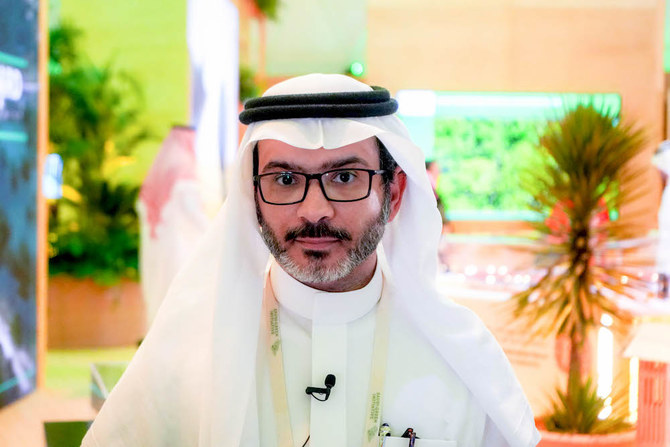
Nabeel Al-Hakbani, the State Properties General Authority’s chief strategy officer. (AN Photo)
Short Url
Updated 20 November 2022
Follow

Saudi Green Initiative agriculture projects ‘to start in 3 years,’ says state properties authority

  • State land body to implement sustainability plan
  • ‘Critical to reduce CO2 emissions, plant trees’

SHARM EL-SHEIKH, Egypt: The Kingdom’s State Properties General Authority has announced that it would start implementing the Saudi Green Initiative’s agricultural and environmental schemes within the next four years.

The SPGA, which is responsible for all public real estate in the Kingdom, has a strategic plan aimed at the sustainable use of all state land.

Nabeel Al-Hakbani, the authority’s chief strategy officer, told Arab News that he was “very, very optimistic” that all the projects would be fully operational “within just a few years.”


The SPGA took part in the second Saudi Green Initiative Forum that was held on the sidelines of the UN Climate Change Conference (COP27) in the Red Res resort town of Sharm El-Sheikh in Egypt. (Twitter/@SpgaKsa)

“We strongly believe that you will see tangible outputs, at least for the first milestone, which is to establish the legal framework for our initiatives,” he said.

“So a year from now, we think that we will finish 25 percent of our workload, we will launch the legal and legislative umbrella of our initiatives (and) within three to four years we will go with the full-scale implementation of our initiative, along with our strategic partner the Ministry of Environment, Water and Agriculture and its subsidiaries.”

The SPGA, an independent body that is linked to the prime minister, Crown Prince Mohammed bin Salman, is financed by a government fund under the Ministry of Finance and partners with the Public Investment Fund on several environmental and agricultural initiatives.


The SPGA has launched a sustainable strategic initiative to exploit and utilize the country’s agricultural real estate and land, as a contributor to achieving the SGI’s goals.(Twitter/@SpgaKsa)

Al-Hakbani said the SPGA also works with the National Center for Vegetation Cover Development and Combating Desertification and the private sector to reduce CO2 emissions, increase the number of trees planted by 2030, and cultivate land.

As part of the Saudi Green Initiative’s goals, announced by the crown prince last year, the Kingdom aims to plant 10 billion trees by 2030, while also reducing emissions by 278 million tons per annum and protecting over 30 percent of its terrestrial and marine areas.

The authority took part in the second SGI Forum that was held on the sidelines of the UN Climate Change Conference, or COP27, in the Red Sea resort town of Sharm El-Sheikh in Egypt this past week.

“We believe our initiative is a game changer, (especially) once you see the government itself incorporate it and enhance it, and also encourage individuals and the private sector to work hand in hand with us,” Al-Hakbani said.


Education spending surges 251% as students return from autumn break: SAMA

Updated 12 December 2025
Follow

Education spending surges 251% as students return from autumn break: SAMA

RIYADH: Education spending in Saudi Arabia surged 251.3 percent in the week ending Dec. 6, reflecting the sharp uptick in purchases as students returned from the autumn break.

According to the latest data from the Saudi Central Bank, expenditure in the sector reached SR218.73 million ($58.2 million), with the number of transactions increasing by 61 percent to 233,000.

Despite this surge, overall point-of-sale spending fell 4.3 percent to SR14.45 billion, while the number of transactions dipped 1.7 percent to 236.18 million week on week.

The week saw mixed changes between the sectors. Spending on freight transport, postal and courier services saw the second-biggest uptick at 33.3 percent to SR60.93 million, followed by medical services, which saw an 8.1 percent increase to SR505.35 million.

Expenditure on apparel and clothing saw a decrease of 16.3 percent, followed by a 2 percent reduction in spending on telecommunication.

Jewelry outlays witnessed an 8.1 percent decline to reach SR325.90 million. Data revealed decreases across many other sectors, led by hotels, which saw the largest dip at 24.5 percent to reach SR335.98 million. 

Spending on car rentals in the Kingdom fell by 12.6 percent, while airlines saw a 3.7 percent increase to SR46.28 million.

Expenditure on food and beverages saw a 1.7 percent increase to SR2.35 billion, claiming the largest share of the POS. Restaurants and cafes retained the second position despite a 12.6 percent dip to SR1.66 billion.

Saudi Arabia’s key urban centers mirrored the national decline. Riyadh, which accounted for the largest share of total POS spending, saw a 3.9 percent dip to SR4.89 billion, down from SR5.08 billion the previous week.

The number of transactions in the capital settled at 74.16 million, down 1.4 percent week on week.

In Jeddah, transaction values decreased by 5.9 percent to SR1.91 billion, while Dammam reported a 0.8 percent surge to SR713.71 million.

POS data, tracked weekly by SAMA, provides an indicator of consumer spending trends and the ongoing growth of digital payments in Saudi Arabia. 

The data also highlights the expanding reach of POS infrastructure, extending beyond major retail hubs to smaller cities and service sectors, supporting broader digital inclusion initiatives. 

The growth of digital payment technologies aligns with the Kingdom’s Vision 2030 objectives, promoting electronic transactions and contributing to the nation’s broader digital economy.