Climate change ‘main threat’ for World Heritage sites

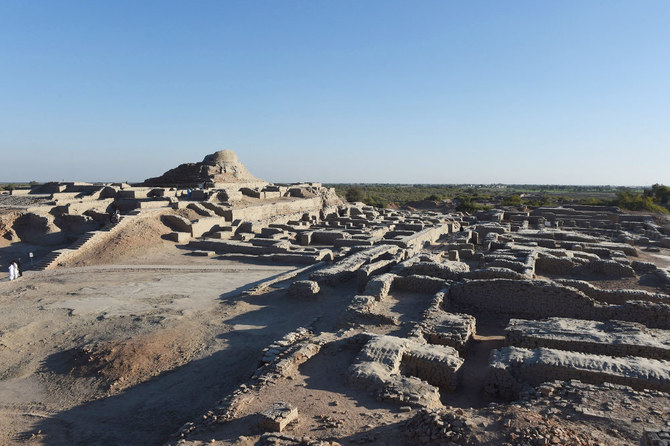
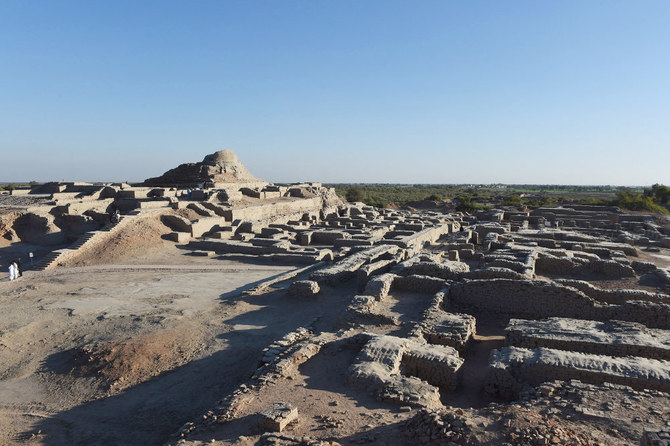
In this file photo taken on February 9, 2017 visitors walk through the UNESCO World Heritage archeological site of Mohenjo Daro some 425 kms north of the Pakistani city of Karachi. (AFP)
Short Url
Updated 20 November 2022
Follow

Climate change ‘main threat’ for World Heritage sites

  • For 50 years, Paris-based UNESCO has compiled a list of World Heritage sites, significant places that are deemed worthy of protection, and is marking the milestone this week in Greece

PARIS: One of the world’s first cities came close to being wiped off the map during tragic floods this summer in Pakistan. Though Mohenjo Daro survived, it has become a symbol of the threat global warming poses to humanity’s cultural heritage.
Built in around 3,000 B.C. by the Indus civilization in modern-day South Asia, Mohenjo Daro was not swept away by the floods, most likely thanks to the genius of its designers.
Perched high above the Indus River, the city was equipped with a primitive drainage system and sewers, meaning much of the floodwaters could be evacuated.
Nearly 1,600 Pakistanis died in the floods and 33 million others were affected in a disaster “probably” made worse by global warming, according to World Weather Attribution, a network of researchers.

HIGHLIGHTS

• In Peru, landslides occurred this year at the foot of Machu Picchu in the Andes mountains.

• In Australia, the protected Great Barrier Reef is experiencing bleaching episodes due to rising water temperatures.

The ancient metropolis “could have disappeared with all the archaeological traces” it contains, said Lazare Eloundou Assamo, the director of the World Heritage program at UN agency UNESCO.
The Pakistani site was “a victim” of climate change and was “very lucky” to still be around, exactly 100 years since it was first discovered in 1922, Assamo said.
Fortunately, “the situation is not catastrophic” in Mohenjo Daro, said Thierry Joffroy, a specialist in brick architecture who visited the site on behalf of UNESCO.
Despite ground sinking in some areas and water damage to some structures, the site “can be repaired,” Joffroy said.
For 50 years, Paris-based UNESCO has compiled a list of World Heritage sites, significant places that are deemed worthy of protection, and is marking the milestone this week in Greece.
“To protect this heritage ourselves ... is to confront the consequences of climate disruption and the loss of biodiversity. It’s the main threat ... that we assess in a tangible way,” UNESCO director Audrey Azoulay told the conference in Delphi on Thursday.
Of its 1,154 World Heritage sites, “one site in five, and more than a third of natural sites, already see this threat as a reality,” she said.
“We are experiencing many more incidents of floods, hurricanes, cyclones, typhoons,” said Rohit Jigyasu of the International Center for the Study of the Conservation and Restoration of Cultural Property (ICCROM).
“We have these climate-related disasters, which are having a huge impact on sites, for example Mohenjo Daro,” he said.
Huge forest fires have scorched the Rocky Mountains in Canada, which are a world heritage site, and this year flames came within 15 kilometers of Delphi as heatwave intensify the severity of wildfires across the Mediterranean basin.
In Peru, meanwhile, landslides occurred this year at the foot of Machu Picchu in the Andes mountains.
Other less noticeable changes can also have serious consequences.
In Australia, the protected Great Barrier Reef is experiencing bleaching episodes due to rising water temperatures.
In Ghana, erosion has washed away part of Fort Prinzenstein, which is conserved as a notable slave trading post.


94 million need cataract surgery, but access lacking: WHO

A Somali patient undergoes free cataract surgery at Al Nuur eye Hospital in Mogadishu, on February 16, 2015. (AFP)
Updated 6 sec ago
Follow

94 million need cataract surgery, but access lacking: WHO

  • Of the 94 million affected, fewer than 20 percent are blind, while the rest suffer from impaired vision

GENEVA: More than 94 million people suffer from cataracts, but half of them do not have access to the surgery needed to fix it, the World Health Organization said Wednesday.
Cataracts — the clouding of the eye’s lens that causes blurred vision and can lead to blindness — are on the rise as populations get older, with age being the main risk factor.
“Cataract surgery — a simple, 15-minute procedure — is one of the most cost-effective medical procedures, providing immediate and lasting restoration of sight,” the WHO said.
It is one of the most frequently performed surgeries undertaken in high-income countries.
However, “half of the world’s population in need of cataract surgery don’t have access to it,” said Stuart Keel, the UN health agency’s technical lead for eye care.
The situation is worst in the WHO’s Africa region, where three in four people needing cataract surgery remain untreated.
In Kenya, at the current rate, 77 percent of people needing cataract surgery are likely to die with their cataract blindness or vision impairment, said Keel.
Across all regions, women consistently experience lower access to care than men.
Of the 94 million affected, fewer than 20 percent are blind, while the rest suffer from impaired vision.

- 2030 vision -

The WHO said that over the past two decades, global cataract surgery coverage had increased by 15 percent.

In 2021, WHO member states set a target of a 30-percent increase by 2030.
However, current modelling predicts that cataract surgery coverage will rise by only about 8.4 percent this decade.
To close the gap, the WHO urged countries to integrate eye examinations into primary health care and invest in the required surgical equipment.
States should also expand the eye-care workforce, training surgeons in a standardised manner and then distributing them throughout the country, notably outside major cities.
The WHO was on Wednesday launching new guidance for countries on how to provide quality cataract surgery services.
It will also issue guidance to help support workforce development.
Keel said the main issue was capacity and financing.
“We do need money invested to get rid of this backlog, which is nearly 100 million people,” he told a press conference.
While age is the primary risk factor for cataracts, others include prolonged UV-B light exposure, tobacco use, prolonged corticosteroid use and diabetes.
Keel urged people to keep up regular eye checks as they get older, with most problems able to be either prevented or diagnosed and treated.
The cost of the new lens that goes inside the eye can be under $100.
However, out-of-pocket costs can be higher when not covered by health insurance.
“Cataract surgery is one of the most powerful tools we have to restore vision and transform lives,” said Devora Kestel, head of the WHO’s noncommunicable diseases and mental health department.
“When people regain their sight, they regain independence, dignity, and opportunity.”