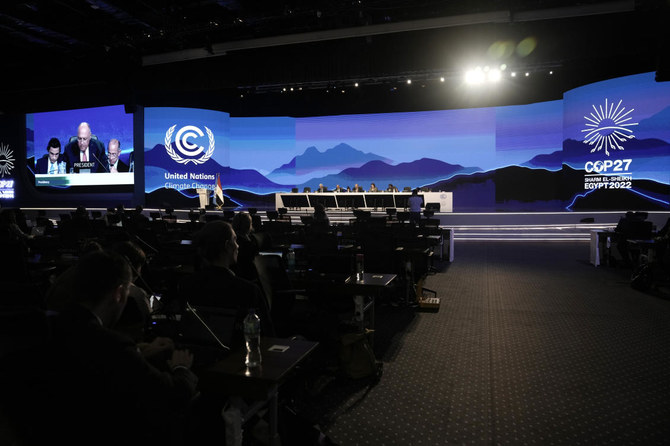
SHARM EL-SHEIKH, Egypt: UN climate talks were extended by a day Friday in an effort to break the deadlock as nations tussle over funding for developing countries battered by weather disasters and ambition on curbing global warming.
Representatives from nearly 200 countries have gathered at the COP27 in Egypt for two weeks with the aim of driving forward action on climate change as the world faces a worsening onslaught of weather extremes.
But wealthy and developing nations were struggling to find common ground on creating the fund, and on a host of other crucial issues, with only hours before the summit was scheduled to end in the Red Sea resort of Sharm el-Sheikh.
Egyptian Foreign Minister Sameh Shoukry, who chairs the COP27 talks, told delegates that the negotiations would spill into Saturday, a delay not unusual in such sprawling UN climate talks.
“I remain concerned at the number of outstanding issues,” he said.
The daunting list of tasks includes finding agreement on reaffirming a goal to limit average warming to 1.5 degrees Celsius from pre-industrial levels, which scientists say is a safer guardrail to avoid the most dangerous impacts.
Rich countries are also under pressure to finally fulfil promises to provide $100 billion a year to help developing countries green their economies and adapt to future impacts, and to hammer out future finance plans.
But for many vulnerable countries, the defining issue at the conference is money for the “loss and damage” caused by climate change — a controversial issue previously blocked by wealthy countries fearful of open-ended liability.
Dr. Mohamed Sabry El-Tawabty, a member of the UN Youth 2030, extended his thanks to all the global attendees that took part in the two-week summit, particularly the youth.
“We also extend our thanks to everyone who contributed to the success of this forum and to all the youth of the world who work diligently and effortlessly to preserve the climate by all means and methods,” he said.
“We look forward, after the end of this forum, to start working effectively and achieve what (we) ...have agreed upon over the past weeks,” El-Tawabty also said, adding: “The time for talking has ended immediately after the conclusion of this forum.”
(With AFP)


UN climate talks in Egypt head into overtime
https://arab.news/69du7
UN climate talks in Egypt head into overtime

- Egyptian Foreign Minister Sameh Shoukry told delegates that the negotiations would spill into Saturday


Saudi minister at Davos urges collaboration on minerals
- The reason of the tension of geopolitics is actually the criticality of the minerals
LONDON: Countries need to collaborate on mining and resources to help avoid geopolitical tensions, Saudi Arabia’s minister of industry and mineral resources told the World Economic Forum on Tuesday.
“The reason of the tension of geopolitics is actually the criticality of the minerals, the concentration in different areas of the world,” Bandar Alkhorayef told a panel discussion on the geopolitics of materials.
“The rational thing to do is to collaborate, and that’s what we are doing,” he added. “We are creating a platform of collaboration in Saudi Arabia.”

The Kingdom last week hosted the Future Minerals Forum in Riyadh. Alkhorayef said the platform was launched by the government in 2022 as a contribution to the global community. “It’s very important to have a global movement, and that’s why we launched the Future Minerals Forum,” he said. “It is the most important platform of global mining leaders.”
The Kingdom has made mining one of the key pillars of its economy, rapidly expanding the sector under the Vision 2030 reform program with an eye on diversification. Saudi Arabia has an estimated $2.5 trillion in mineral wealth and the ramping up of extraction comes at a time of intense global competition for resources to drive technological development in areas like AI and renewables.
“We realized that unlocking the value that we have in our natural resources, of the different minerals that we have, will definitely help our economy to grow to diversify,” Alkhorayef said. The Kingdom has worked to reduce the timelines required to set up mines while also protecting local communities, he added. Obtaining mining permits in Saudi Arabia has been reduced to just 30 to 90 days compared to the many years required in other countries, Alkhorayef said.
“We learned very, very early that permitting is a bottleneck in the system,” he added. “We all know, and we have to be very, very frank about this, that mining doesn’t have a good reputation globally.
“We are trying to change this and cutting down the licensing process doesn’t only solve it. You need also to show the communities the impact of the mining on their lives.”
Saudi Arabia’s new mining investment laws have placed great emphasis on the development of society and local communities, along with protecting the environment and incorporating new technologies, Alkhorayef said. “We want to build the future mines; we don’t want to build old mines.”


