COP27: Counting rising cost of climate disasters for developing countries like Pakistan

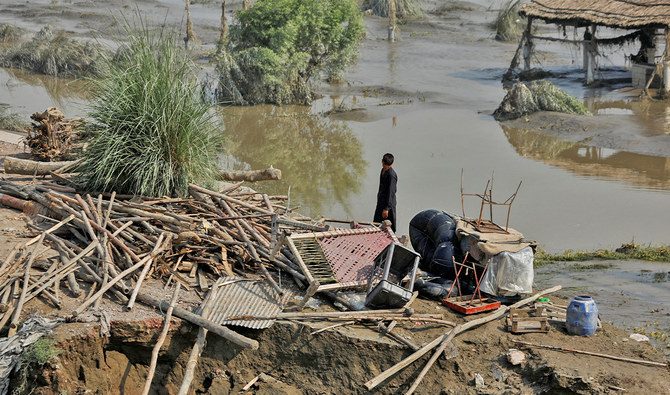
A flood victim stands in his damaged house, following rains and floods during the monsoon season, in Nowshera, Pakistan on August 31, 2022. (REUTERS)
Short Url
Updated 16 November 2022
Follow

COP27: Counting rising cost of climate disasters for developing countries like Pakistan

  • Intense monsoon rains, unusual heat led to unprecedented glacial melt, starting floods on June 14
  • Floodwaters in flat-lying Indus floodplains took months to recede, displaced eight million people

Climate change has raised the cost of natural disasters, as rising sea levels and drought increase the frequency and severity of flooding and wildfires, insurers and risk modelling experts say.

The list of the 10 most expensive events of the last decade provided to Reuters by risk modelling firm RMS all took place over the past five years.

While the biggest losses are in richer countries with more expensive assets, developing countries such as Pakistan, which suffered flooding this year that cost an estimated $3 billion, often bear the brunt of damaging weather events.

How to get money to poorer countries after climate disasters has been a dominant theme at the COP27 climate talks in Egypt, and insurance is seen as one way to do that.

On Monday, a G7-led plan dubbed “Global Shield” to provide pre-arranged insurance and disaster protection funding to countries suffering climate disasters was launched at the climate conference.

The disasters are ranked by economic losses, both insured and uninsured, with the costliest first.

1. California wildfires 2017-2018

After a multi-year drought in California, numerous fires destroyed more than 100 million trees.

Worst fires: Tubbs Fire Oct 2017, Camp Fire Nov 2018

2017 loss: $180 billion

2017 deaths: 40

2018 loss: $148.5 billion

2018 deaths: 103

Total loss: $328.5 billion

2. Atlantic hurricanes Harvey, Irma, Maria Aug-Sept 2017

The three hurricanes devastated parts of Florida, Texas, Puerto Rico and the Caribbean.

Harvey loss: $125 billion

Harvey deaths: 88

Irma loss: $65 billion

Irma deaths: 134

Maria loss: $107 billion

Maria deaths: 4,600

Total loss: $297 billion

3. Australian bushfires 2019-2020

Nearly 11 months of fires affected 80 percent of Australians and killed or displaced at least three billion animals.

Total loss: $110 billion

Deaths: 34

4. Hurricane Ian, Florida, Sept 2022

The hurricane hit southwestern Florida and South Carolina, with a 4-meter high storm surge on the west coast of Florida.

Total loss: more than $100 billion

Deaths: 101

5. Hurricane Ida Aug 2021

The hurricane hit Louisiana and also brought heavy rain and flooding to New Jersey and New York.

Total loss: $75 billion

Deaths: 107

6. Floods in Germany and Belgium July 2021

Between July 12-15 2021, intense rainfall caused record river levels and left a trail of destruction, mainly in Belgium and Germany but also in Austria, Switzerland and the Netherlands.

Total loss: 40 billion euros

Deaths: 230

7. Typhoons Faxai and Hagibis in Japan Aug-Oct 2019

The two typhoons hit central and eastern Japan, with Faxai causing 900,000 homes to lose power, while more than seven million people were told to evacuate due to Hagibis.

Faxai loss: $9.1 billion

Hagibis loss: $17 billion

Hagibis deaths: 85

Total loss: $26.1 billion

8. European heatwave summer 2022

Central Europe suffered three heatwaves over the course of the summer, including the hottest temperature so far measured in Britain at 40.3 degrees Celsius (104.54°F).

Total loss: more than 10 billion euros ($10.43 billion)

Deaths: 1,500 as a result of excess heat

9. Northwestern US and British Columbia Canada heatwave June-July 2021

An extreme heatwave from June 25 to July 1 across western Canada and the US Pacific Northwest, caused many wildfires.

Total loss: $8.9 billion

Fatalities: 1,400 as a result of excess heat

10. Pakistan floods June-Aug 2022

Intense monsoon rains and unusual heat in the Karakoram Mountains led to unprecedented glacial melt, starting floods on June 14. Floodwaters in flat-lying Indus floodplains took months to recede. The floods displaced eight million people.

Total loss: $3 billion

Deaths: 1,717

($1 = 0.9588 euros)


Pakistan, other Muslim states raise alarm over Gaza situation after heavy flooding

Updated 02 January 2026
Follow

Pakistan, other Muslim states raise alarm over Gaza situation after heavy flooding

  • Cold winter rains have repeatedly lashed the sprawling tent cities, turning Gaza’s dirt roads into mud and causing damaged buildings to collapse
  • The situation has been compounded by lack of sufficient humanitarian access, acute shortages of essential life-saving supplies and materials

ISLAMABAD: Foreign ministers of Pakistan, Saudi Arabia and other Muslim nations on Friday voiced concern over the situation in Gaza, following severe flooding triggered by heavy rains in the territory.

As 2026 begins, the shaky 12-week-old ceasefire between Israel and Hamas has largely ended large-scale Israeli bombardment of Gaza. But Palestinians are still being killed almost daily by Israeli fire, and the humanitarian crisis shows no signs of abating.

Cold winter rains have repeatedly lashed the sprawling tent cities over past weeks, turning Gaza’s dirt roads into mud and causing buildings damaged in Israeli bombardment to collapse. UNICEF says at least six children have now died of weather-related causes.

In a joint message, foreign ministers of Pakistan, Saudi Arabia, Egypt, Indonesia, Jordan, Qatar, Türkiye, the United Arab Emirates, expressed their “deepest concern” over the situation, compounded by lack of sufficient humanitarian access, acute shortages of essential life-saving supplies, and the slow pace of the entry of essential materials required for the rehabilitation of basic services.

“The ministers highlighted that the severe weather has laid bare the fragility of existing humanitarian conditions, particularly for almost 1.9 million people and displaced families living in inadequate shelters,” the Pakistani foreign ministry said in a joint statement.

“Flooded camps, damaged tents, the collapse of damaged buildings, and exposure to cold temperatures coupled with malnutrition, have significantly heightened risks to civilian lives, including due to disease outbreaks, especially among children, women, the elderly, and individuals with medical vulnerabilities.”

The statement came a day after UNICEF said a 7-year-old, Ata Mai, had drowned Saturday in severe flooding that engulfed his tent camp in Gaza City. Mai had been living with his younger siblings and family in a camp of around 40 tents.

They lost their mother earlier in the war, according to the UN agency.

Video from Civil Defense teams, shown on Al Jazeera, showed rescue workers trying to get Mai’s body out of what appeared to be a pit filled with muddy water surrounded by wreckage of bombed buildings. The men waded into the water, pulling at the boy’s ankle, the only part of his body visible. Later, the body is shown wrapped in a muddy cloth being loaded into an ambulance.

Foreign minister of Pakistan, Saudi Arabia and other states appreciated the efforts of all United Nations (UN) organizations and agencies as well as non-government organizations (NGOs) in continuing to assist Palestinian civilians and deliver humanitarian assistance under extremely difficult and complex circumstances.

“They demanded that Israel ensure the UN and international NGOs are able to operate in Gaza and the West Bank in a sustained, predictable, and unrestricted manner, given their integral role in the humanitarian response in the Strip. Any attempt to impede their ability to operate is unacceptable,” the statement read.

The foreign ministers reaffirmed support to President Donald Trump’s plan for Gaza, with a view to ensuring the sustainability of the ceasefire, bringing an end to the war in Gaza, to secure a dignified life for the Palestinian people who have endured prolonged humanitarian suffering, and leading to a credible pathway to Palestinian self-determination and statehood.

“In this context, they stressed the urgent need to immediately initiate and scale up early recovery efforts, including the provision of durable and dignified shelter to protect the population from the severe winter conditions,” the statement read further.

“The ministers called on the international community to uphold its legal and moral responsibilities and to pressure Israel, as the occupying power, to immediately lift constraints on the entry and distribution of essential supplies including tents, shelter materials, medical assistance, clean water, fuel, and sanitation support.”