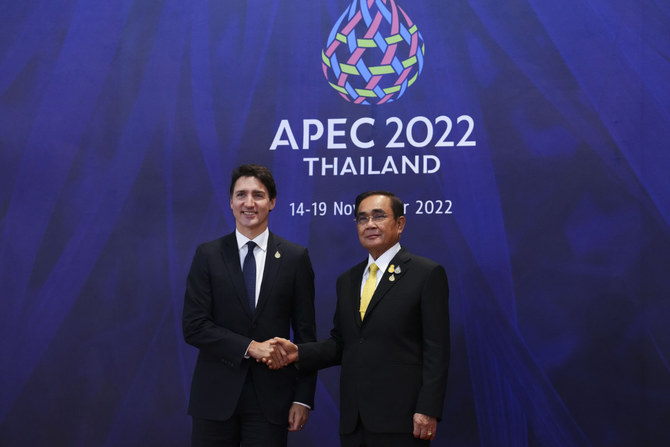

BANGKOK: Thailand, the host of the APEC summit, urged leaders of the group meeting in Bangkok on Friday and Saturday to “rise above differences” and focus on resolving pressing global economic issues in areas such as trade and inflation.
Established to promote economic integration, the Asia-Pacific Economic Cooperation (APEC) forum consists of 38 percent of the global population and 62 percent of gross domestic product and 48 percent of trade.
China’s President Xi Jinping is attending the summit, while the United States is being represented by US Vice President Kamala Harris.
While Thailand hopes to make progress on forming a Free Trade Area of the Asia Pacific (FTAAP), the talks come amid geopolitical tensions over the war in Ukraine and other flashpoints such as Taiwan and the Korean peninsula.
Thailand’s Foreign Minister Don Pramudwinai said on Thursday the meeting of the 21-member bloc was taking place at a “pivotal juncture” with the world facing multiple risks.
“That’s why APEC this year must rise above these challenges and deliver hope to the world at large,” he said in a statement.
Security was tight at the APEC summit with around 100 anti-government protesters gathered and planning to march on the meeting venue on Friday morning.

Protesters push anti-riot police during a demonstration near the APEC forum venue on Nov. 17, 2022, in Bangkok, Thailand. (AP)
Xi, warning against Cold War tensions in a region that is a focus for competition between Beijing and Washington, said on Thursday the Asia-Pacific is no one’s backyard and should not become an arena of big power rivalry,
“No attempt to wage a new cold war will ever be allowed by the people or by our times,” Xi said in written remarks prepared for a business event linked to the summit.
Relations between the world’s two largest economies have been strained in recent years over issues like tariffs, Taiwan, intellectual property, the removal of Hong Kong’s autonomy and disputes over the South China Sea, among others.
In a move that may be seen by Beijing as a provocation, a senior US official said Vice President Harris will on visit the Philippine islands of Palawan on the edge of the disputed South China Sea Tuesday.
The trip will make Harris the highest-ranking US official to visit the island chain adjacent to the Spratly Islands. China has dredged the sea floor to build harbors and airstrips on the Spratlys, parts of which are also claimed by Brunei, Malaysia, the Philippines, Taiwan and Vietnam.

US Vice President Kamala Harris (C) and husband Doug Emhoff are welcomed by Thai officials upon arrival at Don Mueang International Airport in Bangkok on Nov. 17, 2022. (AFP)
Harris will visit Palawan after attending the APEC meeting, which follows a series of regional summits so far dominated by geopolitical tension over the war in Ukraine.
At a G20 meeting in Bali earlier this week, countries unanimously adopted a declaration saying most members condemned the Ukraine war, but that also acknowledged some countries saw the conflict differently.
Russia is a member of both G20 and APEC but President Vladimir Putin has stayed away from the summits. First Deputy Prime Minister Andrei Belousov will represent him at APEC.
Australian Prime Minister Anthony Albanese is among those also attending the main meeting, while French President Emmanuel Macron is a special guest.
Xi held a rare summit with Japanese Prime Minister Fumio Kishida while in Bangkok, the first leadership-level meeting between the countries in nearly three years, after which Kishida said he conveyed concerns about peace in the Taiwan Strait.

Japanese PM Fumio Kishida, left, and Chinese President Xi Jinping shake hands as they meet on the sidelines for the APEC forum on Nov. 17, 2022, in Bangkok, Thailand. (Kyodo News via AP)
China’s CCTV reported that Xi told Kishida the Taiwan issue involved the political foundation of ties between their two countries, and territorial disputes should be properly managed.
The meeting came a day after tensions simmered in Bali, where Xi criticized Canadian Prime Minister Justin Trudeau in person over alleged leaks of their closed-door meeting, a rare public display of annoyance by Xi. Trudeau is also in Bangkok.