

Kuwait executes seven, including Pakistani, convicted of murder

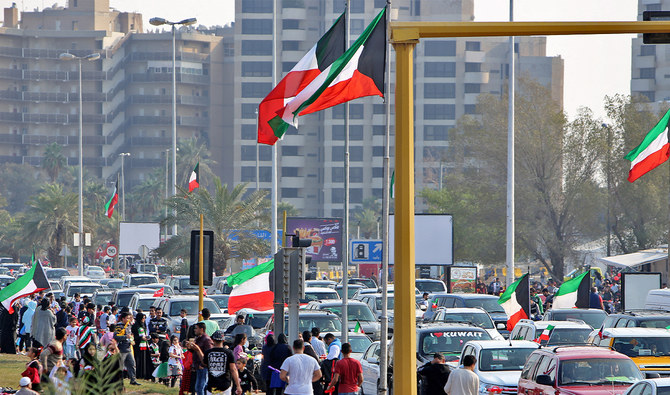
Kuwaiti flag flutters on a street in Kuwait City on February 25, 2018. (AFP/File)
Short Url
Updated 17 November 2022
Follow

Kuwait executes seven, including Pakistani, convicted of murder

  • Three Kuwaiti men and one woman, a Syrian man, a Pakistani man and an Ethiopian woman executed
  • First set of executions in Kuwait since 2017, drawing criticism from the European Commission

KUWAIT: Kuwait executed seven people convicted of murder and other crimes on Wednesday for the first time since 2017, drawing criticism from the European Commission which said that Kuwait's envoy to the EU in Brussels had been summoned.

Three Kuwaiti men and one woman, a Syrian man, a Pakistani man and an Ethiopian woman were executed at the Gulf Arab state's Central Prison, the Public Prosecution said in a statement posted on Twitter.

It said that murder warranted the "strongest punishment of execution" which also acts as a "deterrent" to others.

"It is regrettable that despite raising this yesterday and having received assurances to the contrary, Kuwait went ahead with 7 executions today," Margaritis Schinas, European Commission vice president for promoting the European way of life, said in statement on Twitter.

Schinas said the European Union strongly opposes the death penalty and that the EU's diplomatic service has summoned Kuwait's ambassador to the EU in Brussels. The executions would be raised in discussions on the Commission's proposal to put Kuwait on the visa free list, Schinas added.

In January 2017, Kuwait hanged a prince in the ruling Al-Sabah family for premeditated murder alongside six other prisoners, in what appeared to be the first execution of a member of the royal family in the Gulf Arab state.

Those executions had been the first in Kuwait since 2013.


Captain Agha reiterates Pakistan’s refusal to play India at the T20 World Cup

Updated 7 sec ago
Follow

Captain Agha reiterates Pakistan’s refusal to play India at the T20 World Cup

  • India vs. Pakistan is usually the showpiece match in world tournaments, with the eyeballs on it rising into the hundreds of millions
  • The boycott has caused an uproar and the International Cricket Council is trying to resolve the issue with the Pakistan Cricket Board

COLOMBO: Pakistan captain Salman Ali Agha has reiterated that his team will abide by his government’s ruling not to play India in the much-anticipated Twenty20 World Cup fixture next week.

India vs. Pakistan is usually the showpiece match in world tournaments — the eyeballs on it rise into the hundreds of millions. The boycott has caused an uproar and the International Cricket Council is trying to resolve the problem with the Pakistan Cricket Board.

At a captains’ media conference on Thursday, Agha repeated the team will follow its government’s advice.

“The India game is not in our control,” Agha said. “The government has decided and we respect that. Whatever they are saying we’ll do.

“We are playing three other (group) games and we are excited about that.”

Pakistan’s World Cup opener is against the Netherlands on Saturday in Colombo. It will play all of its games in co-host Sri Lanka. Namibia and the United States are also in the group. The India game is scheduled for Feb. 15 in Colombo.

In Mumbai, India captain Suryakumar Yadav said they were going to Colombo whether the match was on or not.

“(Our) mindset is pretty clear,” Yadav said. “We did not refuse to play them. The refusal came from them. ICC organized the fixture. BCCI and (Indian) government decided to play in neutral venue in coordination with ICC. Our flight to Colombo is booked. So we are going. We’ll see what happens later.”

The Pakistan government decision came after Bangladesh was kicked out of the World Cup by the ICC. Bangladesh refused to play in India for security reasons and wanted its games moved to Sri Lanka but the ICC dismissed those concerns.

Agha said he was saddened that Bangladesh wasn’t playing in the World Cup for the first time and asked Bangladeshi fans to back his team.

Pakistan has accused the ICC of double standards and not accommodating security concerns. India and Pakistan do not play in each other’s territory and meet in ICC tournaments only at neutral venues.

Their countries are embroiled in military and diplomatic tensions which have spilled into sports for more than a decade. Last year at the men’s Asian Cup and Women’s World Cup, the teams did not shake hands when they met.