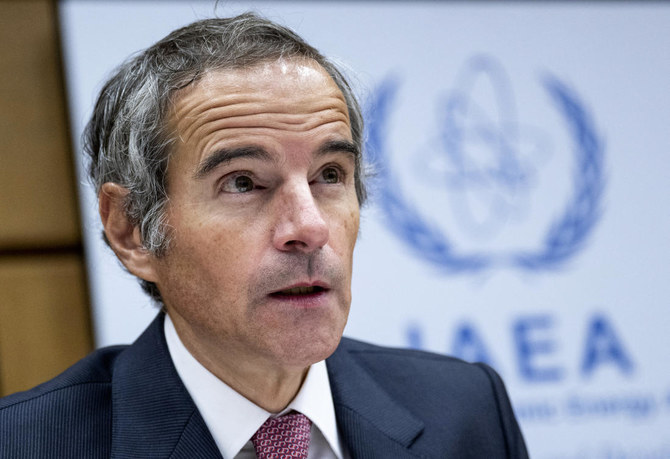
VIENNA/DUBAI: UN nuclear watchdog chief Rafael Grossi said on Wednesday he hoped a meeting with Iran later this month to end an impasse over traces of uranium found at undeclared sites would proceed after Iran’s nuclear chief reportedly said it was not “on the agenda.”
“I hope our planned technical meeting with Iran takes place,” Grossi said on Twitter.
He said at a news briefing moments later that he was responding to a comment by Iran’s nuclear chief Mohammad Eslami, reported by state media. Iran has not made such remarks directly to the IAEA, he added.
The International Atomic Energy Agency’s years-long investigation into the particles is now stalled, and both sides have agreed to meet in Tehran, with the IAEA saying it “expects to start receiving from Iran technically credible explanations” on how the particles got there.
The issue has been an obstacle to progress in wider talks to revive the 2015 Iran nuclear deal, and has prompted Western powers to push for a fresh resolution targeting Iran at the IAEA’s 35-nation Board of Governors meeting this week, this time ordering Iran to quickly answer the IAEA’s questions.
Eslami’s comments appeared to be in response to the draft resolution prepared by the United States and the so-called E3 — Britain, France and Germany — that the board will vote on this week. A similar resolution was passed by a large margin in June.
“For now, there is no trip of the IAEA to Iran on the agenda. Considering Iran’s goodwill and its logical answers, we can hope for good results if the agency follows a professional and non-political path,” Iranian state media quoted Eslami as saying on Wednesday, the opening day of the IAEA board meeting.
Eslami added that Iran rejects the draft resolution, which says the board “decides it is essential and urgent” for Iran to give the IAEA the answers and cooperation it seeks.
Asked what it would mean if the meeting did not happen, Grossi said: “Well, it would make things even worse than they already are. We are not making progress.”


![]()


IAEA chief hopes for crunch meeting in Iran after Tehran says it’s off
Short Url
https://arab.news/ygx9e
IAEA chief hopes for crunch meeting in Iran after Tehran says it’s off
- “I hope our planned technical meeting with Iran takes place,” Grossi said on Twitter
- The issue has been an obstacle to progress in wider talks to revive the 2015 Iran nuclear deal


Israel PM holds coalition meeting after objecting to Gaza panel
- Israeli Prime Minister Benjamin Netanyahu convened a meeting of his ruling coalition partners on Sunday after objecting to the composition of a Gaza advisory panel
JERUSALEM: Israeli Prime Minister Benjamin Netanyahu convened a meeting of his ruling coalition partners on Sunday after objecting to the composition of a Gaza advisory panel formed by the White House, according to an official and media reports.
The White House announced this week the setting up of a “Gaza Executive Board,” which would operate under a broader “Board of Peace” to be chaired by US President Donald Trump as part of his 20-point plan to end the war in Gaza.
The executive board, described as having an advisory role, includes Turkish Foreign Minister Hakan Fidan and Qatari diplomat Ali Al-Thawadi, alongside other regional and international officials.
Late on Saturday, Netanyahu’s office objected to the composition of the executive board.
“The announcement regarding the composition of the Gaza Executive Board, which is subordinate to the Board of Peace, was not coordinated with Israel and runs contrary to its policy,” the office of Netanyahu said.
“The Prime Minister has instructed the Foreign Affairs Minister to contact the US Secretary of State on this matter.”
It did not explain the reason for its objection, but Israel has previously objected strongly to any Turkish role in post-war Gaza, with relations between the two countries deteriorating sharply since the war began in October 2023.
In addition to naming Turkiye’s foreign minister to the executive board, Trump has also invited Turkish President Recep Tayyip Erdogan to join the overarching Board of Peace.
Media reports said that leaders of the country’s ruling coalition were scheduled to meet on Sunday to examine the composition of the executive board.
“There is a meeting scheduled of the coalition at 10:00 am (0800 GMT),” the spokesman of Netanyahu’s Likud Party told AFP, declining to provide further details.
Alongside Likud, the coalition includes the Religious Zionist Party led by far-right Finance Minister Bezalel Smotrich and Otzma Yehudit (Jewish Power) led by far-right National Security Minister Itamar Ben Gvir.
The White House said Trump’s plan would include three bodies: the Board of Peace, chaired by Trump; a Palestinian committee of technocrats tasked with governing Gaza; and the Gaza Executive Board, which would play an advisory role.
The Palestinian technocratic committee held its first meeting in Cairo on Saturday.
The diplomatic developments came as the United States said this week that the Gaza truce plan had entered a second phase, shifting from implementing a ceasefire to the disarmament of Hamas, whose October 7, 2023 attack on Israel triggered the Israeli offensive in Gaza.
The White House announced this week the setting up of a “Gaza Executive Board,” which would operate under a broader “Board of Peace” to be chaired by US President Donald Trump as part of his 20-point plan to end the war in Gaza.
The executive board, described as having an advisory role, includes Turkish Foreign Minister Hakan Fidan and Qatari diplomat Ali Al-Thawadi, alongside other regional and international officials.
Late on Saturday, Netanyahu’s office objected to the composition of the executive board.
“The announcement regarding the composition of the Gaza Executive Board, which is subordinate to the Board of Peace, was not coordinated with Israel and runs contrary to its policy,” the office of Netanyahu said.
“The Prime Minister has instructed the Foreign Affairs Minister to contact the US Secretary of State on this matter.”
It did not explain the reason for its objection, but Israel has previously objected strongly to any Turkish role in post-war Gaza, with relations between the two countries deteriorating sharply since the war began in October 2023.
In addition to naming Turkiye’s foreign minister to the executive board, Trump has also invited Turkish President Recep Tayyip Erdogan to join the overarching Board of Peace.
Media reports said that leaders of the country’s ruling coalition were scheduled to meet on Sunday to examine the composition of the executive board.
“There is a meeting scheduled of the coalition at 10:00 am (0800 GMT),” the spokesman of Netanyahu’s Likud Party told AFP, declining to provide further details.
Alongside Likud, the coalition includes the Religious Zionist Party led by far-right Finance Minister Bezalel Smotrich and Otzma Yehudit (Jewish Power) led by far-right National Security Minister Itamar Ben Gvir.
The White House said Trump’s plan would include three bodies: the Board of Peace, chaired by Trump; a Palestinian committee of technocrats tasked with governing Gaza; and the Gaza Executive Board, which would play an advisory role.
The Palestinian technocratic committee held its first meeting in Cairo on Saturday.
The diplomatic developments came as the United States said this week that the Gaza truce plan had entered a second phase, shifting from implementing a ceasefire to the disarmament of Hamas, whose October 7, 2023 attack on Israel triggered the Israeli offensive in Gaza.
Latest updates



© 2026 SAUDI RESEARCH & PUBLISHING COMPANY, All Rights Reserved And subject to Terms of Use Agreement.