

Pakistan’s Sindh province establishes commission for protection of journalists

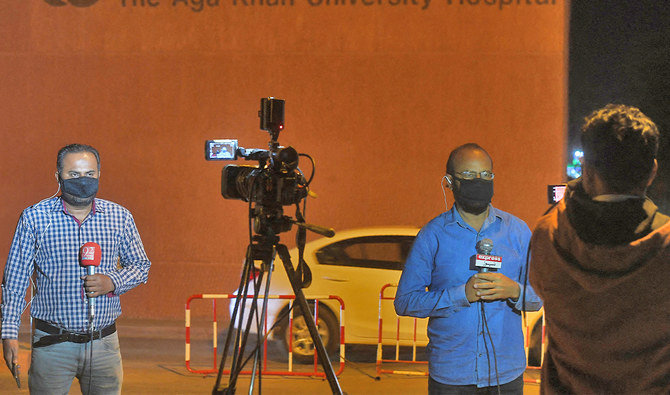
Pakistani journalists report from outside the hospital in Karachi, Pakistan, on February 26, 2020. (AFP/File)
Short Url
Updated 16 November 2022
Follow

Pakistan’s Sindh province establishes commission for protection of journalists

  • Sindh Protection of Journalists and Other Media Practitioners Bill 2021 became law in July 31, 2021
  • Journalists’ bodies welcome commission which is to be headed by a former judge as its chairman

KARACHI: Over 15 months after Pakistan’s Sindh province passed a landmark law for the protection of journalists, the provincial government on Wednesday approved setting up a high-powered commission that will serve as a court to receive complaints and also proactively pursue cases of attacks on media workers.

The Sindh Protection of Journalists and Other Media Practitioners Bill 2021 became law in July 31, 2021. Among its provisions, the bill calls for the establishment of a “Commission for Protection of Journalists and Other Media Workers.’

The commission is to be headed by a former judge as its chairman and will comprise officials from the provincial information, home, law and human rights departments as well as representative of journalists, editors and employers’ unions, lawyers and the Human Rights Commission of Pakistan. Two members of the provincial assembly will also be part of the body.

Pakistan, where journalists face frequent attacks, acts of intimidation and harassment from both state and non-state actors and political groups, registered a steep decline of 12 points in the World Press Freedom Index 2022, dropping to 157 from 145 out of 180 nations in 2021. According to a report by the Freedom Network of Pakistan, 86 attacks were carried out against journalists across the country in the last one year.

“Sindh Cabinet has approved the establishment of the Commission for the Protection of Journalists & Other Media Practitioners. Justice Rasheed Rizvi will serve as its 1st Chairperson,” Sindh government spokesperson Murtaza Wahab said on Twitter.

According to the law, the commission will look into complaints filed “in respect of acts of harassment, sexual harassment, violence, and threats of violence is committed against a journalist or media practitioner”, whether perpetrated by “any person or groups of persons or public or private institution or authority.”

The commission, which will exercise the powers of a civil court, will also be able to take suo moto notice of attacks on journalists and media practitioners, recommend appropriate action to the government, direct an immediate and expeditious investigation and ensure speedy trials.

“The establishment of journalist protection commission and making Justice (R) Rasheed Rizvi as chairman is a welcome decision,” Fazil Jamili, present of the Karachi Press Club, said.

Aamir Latif, assistant secretary general of the Pakistan Federal Union of Journalists (PFUJ), said journalists in Pakistan faced threats both to their lives and their jobs. 

“In Sindh also, dozens of journalists have been booked in fake cases just for performing their duties. We hope the commission will change the course of life for journalists currently working under many threats,” Latif told Arab News, saying owners of media houses needed to comply with the provisions of the new law, which calls for training and job security for journalists.


No casualties as blast derails Jaffar Express train in Pakistan’s south

Updated 47 min 50 sec ago
Follow

No casualties as blast derails Jaffar Express train in Pakistan’s south

  • Passengers were stranded and railway staffers were clearing the track after blast, official says
  • In March 2025, separatist militants hijacked the same train with hundreds of passengers aboard

QUETTA: A blast hit Jaffar Express and derailed four carriages of the passenger train in Pakistan’s southern Sindh province on Monday, officials said, with no casualties reported.

The blast occurred at the Abad railway station when the Peshawar-bound train was on its way to Sindh’s Sukkur city from Quetta, according to Pakistan Railways’ Quetta Division controller Muhammad Kashif.

No group immediately claimed responsibility for the bomb attack, but passenger trains have often been targeted by Baloch separatist outfits in the restive Balochistan province that borders Sindh.

“Four bogies of the train were derailed due to the intensity of the explosion,” Kashif told Arab News. “No casualty was reported in the latest attack on passenger train.”

The Jaffar Express stands derailed near Abad Railway Station in Jacobabad following a blast on January 26, 2026. (AN Photo/Saadullah Akhtar)

Another railway employee, who was aboard the train and requested anonymity, said the train was heading toward Sukkur from Jacobabad when they heard the powerful explosion, which derailed power van among four bogies.

“A small piece of the railway track has been destroyed,” he said, adding that passengers were now standing outside the train and railway staffers were busy clearing the track.

In March last year, fighters belonging to the Balochistan Liberation Army (BLA) separatist group had stormed Jaffar Express with hundreds of passengers on board and took them hostage. The military had rescued them after an hours-long operation that left 33 militants, 23 soldiers, three railway staff and five passengers dead.

The passenger train, which runs between Balochistan’s provincial capital of Quetta and Peshawar in the country’s northwest, had been targeted in at least four bomb attacks last year since the March hijacking, according to an Arab News tally.

The Jaffar Express stands derailed near Abad Railway Station in Jacobabad following a blast on January 26, 2026. (AN Photo/Saadullah Akhtar)

Pakistan Railways says it has beefed up security arrangements for passenger trains in the province and increased the number of paramilitary troops on Jaffar Express since the hijacking in March, but militants have continued to target them in the restive region.

Balochistan, Pakistan’s southwestern province that borders Iran and Afghanistan, is the site of a decades-long insurgency waged by Baloch separatist groups who often attack security forces and foreigners, and kidnap government officials.

The separatists accuse the central government of stealing the region’s resources to fund development elsewhere in the country. The Pakistani government denies the allegations and says it is working for the uplift of local communities in Balochistan.